The $276 Kit Is Gone Overnight as 32GB Returns to $479.99: November 5 Buying Receipt
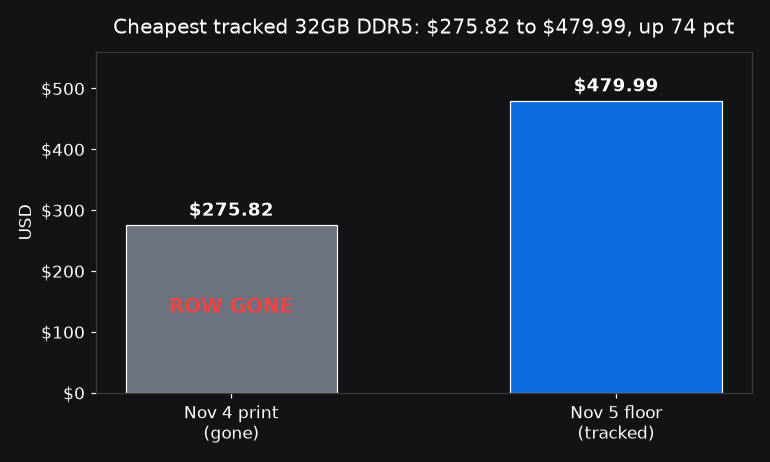
A single tracker row can bend a whole market conversation, and this week one did in both directions. Two days ago a $275.82 32GB DDR5 listing looked like a possible pricing break; a day later a second tracker echoed it; this morning the row is simply absent. Savy's November 5 video receipt captured the aftermath across memory, graphics, used cards, and storage for the US buyer paying dollars before tax. This page is the written companion to that capture, with every figure dated. Last checked November 5, 2026 — all prices in US dollars before tax and shipping. Shelf rows turn over intraday, so confirm each figure on a live page before paying. The companion video link lands here at upload; nothing below needs it.
Seven snapshots that set the day
| Shelf item | November 5 read with check date | Which way it points |
|---|---|---|
| Cheapest tracked 32GB DDR5 | $479.99, V-Color and Lexar rows (Nov 5) | Up: the $275.82 print is gone, +74% overnight |
| Amazon-lane 32GB DDR5 | $479.99 cheapest, $549.49 middle of 23 kits (Nov 5) | Sideways: street band sits near $460–480 |
| RX 9070 XT cheapest new | $949.99 at Newegg (Nov 5) | Up $30 in three days; wait |
| RTX 5060 Ti 16GB floor | $799.99, seventh straight day (Nov 5) | Flat; cheapest Nvidia path to CUDA |
| RX 9060 XT 16GB floor | About $650–660, fifth straight day (Nov 5) | Flat; cheapest new 16GB card sold anywhere |
| Used RTX 3090 completed sales | $1,503 median over 90 days; $1,584 over 7 days (Nov 5) | Creeping up; asks run far hotter |
| Cheapest new 2TB SSD | $239.97 Gen-3 drive (Nov 5) | Flat for weeks |
Memory: treat lone rows as leads, not prices
The index tracker opened the day with a hole in it. The Lexar ARES 32GB DDR5 kit at $275.82 no longer appears anywhere in its table, and the only ARES 32GB entry left is a different CL28 variant at $699.99. The bottom of that same table now reads $479.99 twice: the V-Color Manta XSky, flagged at or near its low, beside Lexar's Thor kit at the identical figure. Measured against the departed print, the cheapest tracked price climbed 74 percent before most builders finished coffee.
The Amazon-focused tracker tells the same story from a second angle: $479.99 cheapest, a Lexar Thor kit, with the center of its 23 tracked kits at $549.49. A hardware-press index from November 3 had DDR5-6000 32GB kits opening at $459, which puts the genuine street band near $460–480 for anyone catching the right listing at the right hour.
Two live offers duck just under or over the edges without changing the picture. Corsair's Vengeance RGB 32GB 6000 kit reads $489.99 at Newegg with code BNWF89, roughly $148 below its list price, while a G.Skill Trident Z5 Neo RGB 32GB kit falls to $539 after a $110 limited-time reduction. Both sit above street level, so the premium buys tighter timings and lighting rather than savings. Practical rule: if the machine must run now, plan on $480 for 32GB from a seller with a real return desk, and stop budgeting around a number that never cleared checkout.
Why wholesale offers no rescue
TrendForce's November 4 bulletin keeps the pressure upstream. Server memory contracts continue rising, with the size of the gain varying by module, while consumer memory stays tight and year-end caution compresses consumer contract gains toward flat or slight increases. The spot desk agrees: mainstream DDR4 chips eased a tenth of a percent on thinning volume, DDR5 buyers lifted target prices under delivery pressure without being able to chase higher, and NAND flash wafers slid more than 4 percent with no retail effect yet. In plain terms, contracted supply feeds servers first and desktop builders divide what remains.
Builder forums read like the comments section on that bulletin. November threads describe 32GB DDR5 pricing in exasperated terms, Threadripper builders cite quotes above $2,400 per 64GB RDIMM, and the recurring counsel is familiar: buy used where safe, stay on a DDR4 board if one still serves, or simply wait if the current machine boots. Chatter is mood lighting, not evidence — but here the mood matches the meter.
Graphics: one climber, two anchors
The 9070 XT moved the wrong way. The cheapest new card is $949.99, an ASRock Challenger at Newegg checked November 5, against $919.99 for a PowerColor Reaper three days earlier — $30 upward and nearly 59 percent above the $599 launch price. Amazon prints drift between $917 and $945 by the hour, and the used lane opens at $900 on eBay. That $900 used figure beside $950 new repeats a familiar snare: a thin discount in exchange for another owner's card, a shorter warranty, and weaker return leverage. The posture stays unchanged and gets firmer — wait for $800 or less, new, from a seller worth an RMA, with the 90-day median parked at $850.
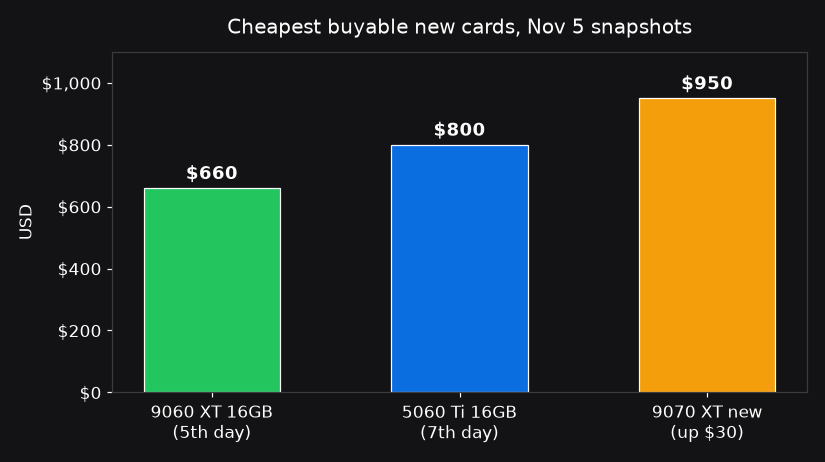
Below that climber, both sensible floors refused to move. The RTX 5060 Ti 16GB holds $799.99 for a seventh consecutive day, with 33 tracked offers starting at $800 on the November 5 capture. Against a typical street near $880, the floor sits about 9 percent under typical, and it remains the least expensive Nvidia doorway into CUDA and local-AI software support. Exact board and retailer rows were read from live listings at capture time and rotate intraday — the tracker evidence substantiates the $800 floor itself, so verify the live row before paying.
AMD's counterweight still undercuts it by $140. The RX 9060 XT 16GB sits near $650–660 for a fifth straight day, the lowest verified print $660 inside a $660–1,100 spread. That is the cheapest new 16GB card actually purchasable with a warranty. The arithmetic is unchanged: $660 versus $800 for the same 16GB of frame buffer. Straight raster gaming value favors the AMD row; anything touching CUDA makes the $800 card the cheapest way in, and it keeps waiting in that doorway.
Set apart: 24GB of used VRAM is capacity planning, not gaming advice
Gamers can stop here — what follows sizes memory for hosted models, not frames per dollar.
The used RTX 3090 market tilted upward. A tracker refreshed November 5 places the median completed sale at $1,503 across 370 eBay sales over 90 days, with the typical transaction landing between $1,375 and $1,607. The 7-day sold median reads $1,584, roughly 7 percent above a month ago. The direction is unmistakable even if the slope is gentle: drifting up, not washing out.
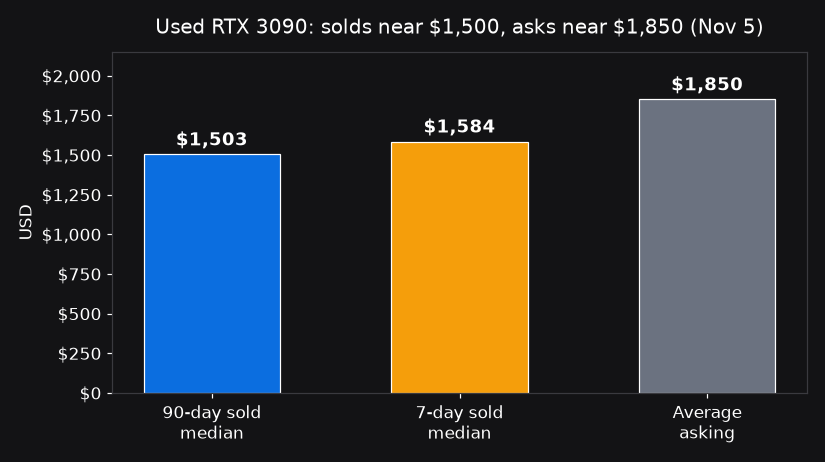
Asking prices float well above that waterline. Sellers seek around $1,850 on average, with live asking prints stretching from $1,599 past $2,000. Completed sales record what buyers actually paid; listings record what sellers hope to get — keep the two in separate columns. Standing guidance holds: carry a $1,400-plus budget or sit out, demand testing proof and return terms in writing, and never let one stray listing reset expectations. An $870 parts-only card with missing screws is a repair bench with a price tag, not a bargain. These are 350W cards, so confirm power supply, case clearance, and buyer-protected payment on the exact photographed unit.
Storage: the flat line
Retail storage ignored the entire drama. The cheapest new 2TB SSD on Amazon reads $239.97, a Gen-3 drive, flat for weeks, with the middle of tracked drives at $297. The tracker's own good-price line of $216 or less remains untouched. Buy storage when the build needs it rather than timing a dip the wholesale signal has not yet delivered to shelves.
Spend-or-wait checklist
- Re-price memory on a live page — the cheapest tracked row moved 74 percent in a single refresh
- Never anchor a build budget to $275.82 — one tracker plus one echo, zero checkout proof
- Match DDR5 kits to board generation, form factor, and
EXPO/XMPsupport before sorting by price — desktopUDIMMfits neither DDR4 boards nor laptopSO-DIMMslots - Give raster gaming the $660 AMD row, feature and compute work the $800 Nvidia band, and nothing near $917–950 any urgency
- Read the condition column before celebrating a low 9070 XT print — $900 used against $950 new is a warranty trade, not a sale
- Keep sold medians and asking prices apart — closings pay for cards, listings open negotiations
- Confirm used-3090 testing and returns per listing — exact-card photos, seller history, protected payment
- Buy the capacity the machine needs — 32GB finishes a gaming build while hosted models and virtual machines justify more, and spare gigabytes at record prices help nobody
- Verify codes and bundle terms at checkout — the $489.99 code price and limited-time cuts lapse without warning
Sources
Research basis: project folder 2026-11-05_276-kit-gone (Savy's November 5 video package: narration in video/narr_parta.txt, video/narr_partb.txt, video/narr_partc.txt, video/narr_partd.txt and video/script.md, brief.md, verification.md with the beat-5 floor-only QC closeout, evidence captures; research/ empty at publish, figures and cross-checks documented in verification.md).
Public sources reused, with the dates behind each claim:
- datacenterdisk RAM index — ARES $275.82 row gone, cheapest 32GB $479.99 V-Color and Thor rows, CL28 ARES $699.99 (Nov 5 capture)
- basketprice RAM tracker — $479.99 Amazon-lane cheapest, $549.49 middle of 23 kits (Nov 5 capture)
- TrendForce memory and storage research — Nov 4 bulletin on server-contract strength plus spot DDR5 16Gb $60.667 down 1.09 percent and NAND wafers down 4 percent-plus
- componentprices 9070 XT lane — $949.99 cheapest new, Amazon $917–945 prints, $900 used lane (Nov 5)
- thecomparator RTX 5060 Ti 16GB tracker — $800 floor across 33 offers, seventh day (Nov 5)
- thecomparator RX 9060 XT 16GB tracker — lowest verified $660, $660–1,100 spread, fifth day (Nov 5)
- thecomparator RX 9070 XT tracker — 90-day median context near $850 (Nov 5)
- pcprice.watch RTX 3090 solds — $1,503 median across 370 sales over 90 days, 7-day $1,584, typical $1,375–1,607 (Nov 5 refresh)
- basketprice SSD page — cheapest new 2TB $239.97, tracked middle $297 (Nov 5)
- Newegg — Corsair Vengeance RGB 32GB $489.99 with code BNWF89, G.Skill $539 limited-time rows as read on live listings (Nov 5, verify live)
- Builder-forum November threads — discussion signal only, single-poster anecdotes, no price evidence drawn
Fine print
Every row here is tracker, aggregator, press, or listing level — no checkout was completed and no unit was purchased. Snapshots refresh intraday and drift from capture time; each figure above carries its check date. Retailer and board-variant rows for the two holding GPU floors were read from live listings at capture and rotate by the hour — the tracker evidence substantiates the $800 and $660 floors, not any single seller row. Used-market prints differ by sample and window and are reported, not reconciled. Community quotes are sentiment. No benchmarks, defect rates, or brand-reliability claims sit behind this snapshot, and no forecast is offered. Stale-price warning: the cheapest tracked RAM row moved 74 percent in one refresh — recheck every figure at checkout before spending.
Post-freeze note (Nov 6): after the video locked, trackers showed a $440–445 Newegg-universe print against this receipt's $480 floor, with no checkout proof on either side and a methodology split between trackers. The November 5 snapshots above remain accurate to their captures; if the lower print firms up with checkout evidence, the next receipt leads with it.
This video cut carries no paid sponsor segment, and this page carries no affiliate links.
Findings in this guide follow Savy's video research; the prose, tables, and charts on this page are original to s-scottek.com.