Memory Prints a Record High While $660 and $800 GPUs Hold the Line: November 3 Receipt
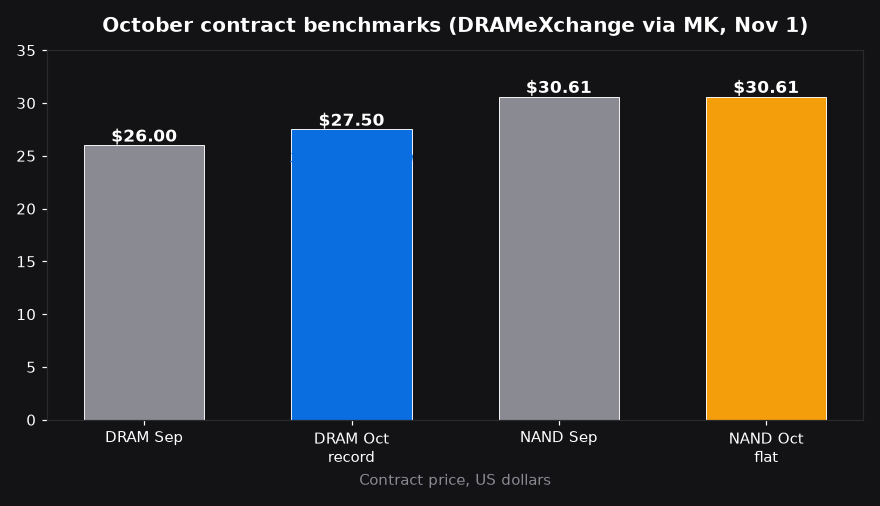
Wholesale memory just did something it has never done, and the receipt from the shelves shows it. October contract pricing for mainstream PC memory closed at an all-time high, the nineteenth straight monthly climb in a row, and the cheapest 32GB desktop kit on Amazon refused to budge off $479.99 for another day. Graphics cards told a steadier story with an uneven edge: the cheapest new 16GB gaming card stayed at $660, its Nvidia rival at $800, and the one 9070 XT flashing under $920 deserves a closer look at its condition column before anyone gets excited.
Savy's November 3 video receipt gathered the day's snapshots from retail trackers, index tables, completed-sale histories, and builder forums for the US buyer spending dollars before tax. This page is the written companion to that research, every figure dated. Last checked November 4, 2026 — all prices in US dollars before tax and shipping. Shelf prices move intraday, so recheck each one on a live page before spending. The companion video link lands here at upload; nothing below depends on watching it.
The day in one table
| What sets the tone | November 3 read with check date | What it tells a buyer |
|---|---|---|
| October PC memory contract | $27.50, up 5.77 percent on the month (Nov 1 report) | All-time high; no relief coded into wholesale |
| Cheapest 32GB DDR5 on Amazon | $479.99 Lexar Thor Z RGB 6000 CL38 (Nov 3) | Floor holds; yesterday's upward break sticks |
| Odd low print on one index | $275.82 Lexar ARES 6000 CL30 (Nov 3, hedged) | One tracker, no checkout proof — not the floor |
| RX 9060 XT 16GB street level | About $660 at Central Computer (Nov 3) | Third straight day; cheapest new 16GB anywhere |
| RTX 5060 Ti 16GB street level | $800 at B&H and Newegg (Nov 3) | Fifth straight day; the CUDA door costs $140 more |
| RX 9070 XT street level | $920 new; $900 refurb to skip (Nov 3) | First sub-$920 print in days is somebody else's returns |
| Used RTX 3090 completed sales | $1,550 median over 30 days (Nov 3) | Sales cluster while listings ask far more |
| Cheapest new 2TB SSD on Amazon | $239.97 Gen-3 drive (Nov 3, held Nov 4) | Flat retail against a grim wholesale backdrop |
Why memory costs what it costs
The wholesale desk published first and the shelves obeyed. Market data carried by MK Business News on November 1 put October mainstream PC memory at $27.50, up 5.77 percent in a single month from $26.00 — the record print and the nineteenth consecutive monthly gain. The same report has mainstream NAND flash motionless at $30.61, which snaps a 21-month climb and opens the door to a slight fourth-quarter dip.
Forward guidance gives builders no reason to hover over the buy button waiting for a sale. TrendForce holds that PC memory contracts climb another 13 to 18 percent this quarter, a gentler slope than last quarter's 18 to 23 but still uphill, with suppliers thinning PC output to feed server demand and analysts penciling in negative PC supply growth next year. A November 4 TrendForce bulletin adds texture: server memory still rising, consumer gains narrowing toward flat, and NAND wafer prices already softening — 512Gb TLC down 4.33 percent on November 2 — with zero effect at retail yet. Company filings sharpen the picture without naming a sale: one large memory maker saw DRAM up high-teens percent and NAND near 30 percent in a single quarter and expects tighter conditions through 2027 and 2028, while another booked nearly four times the revenue on barely more bits shipped.
The RAM shelf: $479.99 sticks, one print you should not trust
Amazon's cheapest 32GB DDR5 desktop kit is still Lexar's Thor Z RGB 2x16GB 6000 CL38 at $479.99, checked November 3, with the middle of 23 tracked kits at $549.99. The index tracker broadly agrees on the band: outside a single wild row, its cheapest lines sit at $479.99 with a $18.72 median per gigabyte across roughly a hundred in-stock kits. Yesterday's story was the band breaking upward past $475; today's is the new level holding.
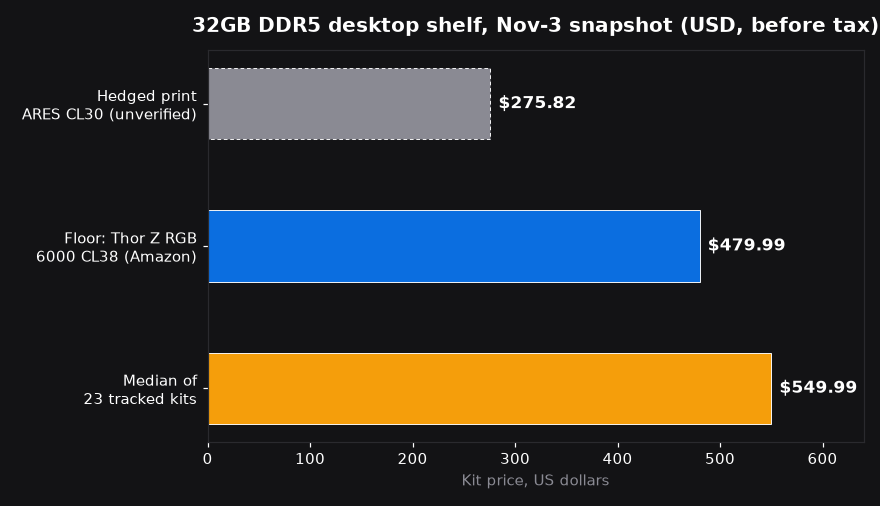
Then the strange row. The same index tracker refreshed to show a Lexar ARES 6000 CL30 kit at $275.82 on Amazon — some $200 under the next kit on its own table. Against it stands the Amazon-focused tracker at $479.99 cheapest the same day, plus a blocked direct verification pull. One kit, one tracker, no checkout proof: the video refused to call $276 the floor until a second source confirmed it. A November 4 cross-check partly answers the call — a second tracker now shows the same $275.82 print labeled typical — but with still no Amazon-checkout evidence, the verdict stays hedged. Treat it as a curiosity to watch, not a price to plan around, and match any kit to board generation, form factor, and QVL before ordering — desktop UDIMM kits fit neither DDR4 boards nor laptop SO-DIMM slots.
Graphics for gamers: $660 AMD, $800 Nvidia, and a refurb to walk past
The RX 9060 XT 16GB sits at $660 for the third running day — the ASRock Challenger OC at Central Computer checked November 3, with the ASUS Dual at $700 beside it and Newegg rows at $790 for that same Dual. Seventeen offers across four shops span $660 to $1,100, which makes the Central Computer lane the one to watch. It remains the cheapest new 16GB card actually purchasable with a warranty, while the 8GB version opens near $460 for esports titles where 8GB still suffices. The old $409 line stays buried: that was the 8GB card all along, never the 16GB.
Nvidia's answer still costs $140 more and has not moved in five days. The 5060 Ti 16GB floor is $800 — PNY's OC at B&H plus ASUS Dual and MSI Ventus rows at $799.99 at Newegg with free shipping, the latter confirmed holding into November 4 for a sixth day. Thirty-four tracked offers center near $880, so $800 lands about 9 percent under typical yet still nearly double the $429 launch price; Amazon's cheapest in class is $829.99, roughly 93 percent over sticker. The arithmetic is blunt: $660 against $800 for the same 16GB. Pure raster frames per dollar go to the AMD card; anything touching CUDA, DLSS, or local-AI software support makes the $800 card the cheapest door in, and it has been standing in that doorway all week.
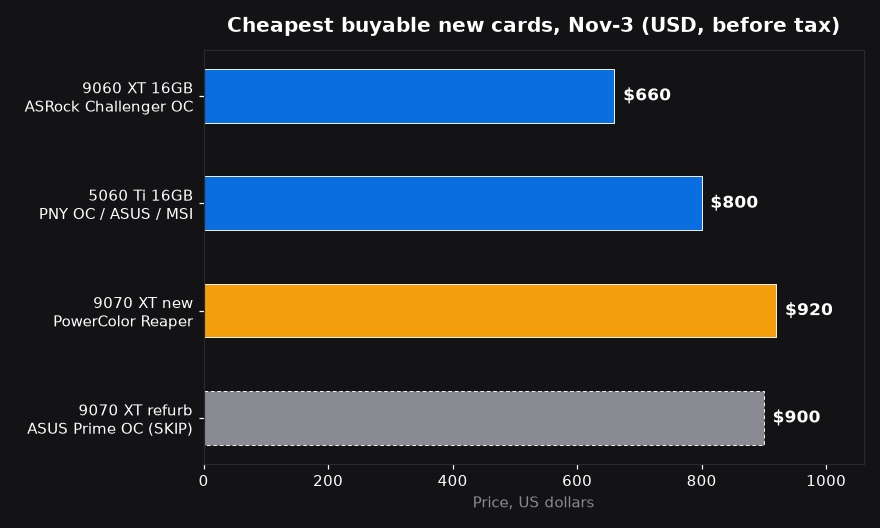
One rung up sits a trap with a price tag. Trackers show a $900 9070 XT at Newegg, the first sub-$920 print in days — with the condition column reading refurbished. The cheapest genuinely new card is still $920 for a PowerColor Reaper, with $950 at Central Computer, inside a $900 to $1,527 spread across 34 offers and a $1,049.99 weekly median. November 4 rechecks at $919.99 and $914.99 keep the new-card line essentially parked. A $20 discount in exchange for somebody else's problem, a shorter warranty, and a restocking-fee lottery is not a deal. Wait for $800 or less, new, from a seller worth an RMA — and note the trend is climbing, with buyer threads already mourning $800 to $900 as normal. Normal is not good.
Set apart: 24GB of used VRAM for local-AI builders
Gaming math ends here. Below is capacity planning for hosted models, not frames per dollar, and gamers should not read it as buying advice.
The used RTX 3090 market looks calm only when sold prices are kept far away from asking prices. A tracker refreshed this week medians completed sales at $1,550 across the last 30 days, the typical sale landing between $1,418 and $1,606. Asking prices run much hotter: three live-listing trackers average $1,573 to $1,798, eBay asks stretch from $1,599 past $2,000, and the cheapest live delivered listing on one tracker sits at $1,470 against a live-asking median above $2,150. Listings are wishes; solds are the market.
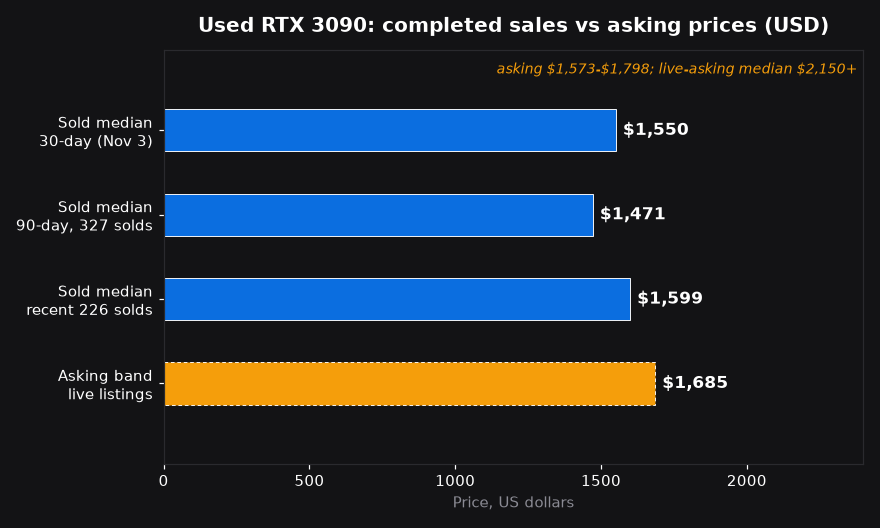
November 3 to 4 cross-checks add two more sold prints with different windows, both reported because the samples refuse to agree: pcprice.watch medians $1,471 across 327 sales over 90 days, CompSniper medians $1,599 across 226 recent completed sales, while the video's $1,550 30-day figure stands as the November 3 snapshot. Guidance does not move: budget $1,400-plus or wait, confirm testing and return terms in writing, and never let a single cheap listing set expectations — a $870 Zotac sold print on November 3 was parts-only, which is a project, not a GPU. These are 350W cards, so verify a strong power supply, case clearance, and buyer-protected payment on the exact photographed card.
Storage sits still while the backdrop burns
Retail storage ignored the whole drama. The cheapest new 2TB SSD on Amazon reads $239.97 — a Gen-3 KingSpec drive, confirmed flat on the November 4 refresh — with the middle of tracked drives at $295. The tracker's own good-price line of $216 or less goes untouched; the cheapest new quality NVMe options sit between $246 and $286, and everything under $220 anywhere is used or renewed. Buy storage because the build needs it, and never pay new-drive money for a renewed label without reading the warranty first.
What builders are saying
Forum chatter from r/buildapc through early November sketches mood, not data, and it matches the numbers above. Threads on 32GB DDR5 cost call current pricing extreme, with the top aggregated offer near $485 and warnings that marketplace DDR5 listings either sell out or come from unreliable third-party vendors. Workstation builders report 64GB DDR5 RDIMM above $2,400 per stick — a separate, worse market. And 9070 XT buyers increasingly treat $800 to $900 as simply the remembered normal US price. Single posters, no sales volumes — sentiment to season the snapshot, never to set it.
Before money changes hands
- Re-price memory against a live page — both big retailers stepped up within days and October moved weekly
- Never cite $275.82 as the RAM floor — one tracker plus a corroborating print, still zero checkout proof
- Match the card to the workload — raster gaming favors the $660 AMD row, feature and compute work justifies the $800 Nvidia band, nothing near $920 to $1,050 earns urgency
- Read the condition column before celebrating — the $900 9070 XT is refurbished against $920 new with full returns
- Keep sold history and asking prices in separate columns — medians close deals, listings open negotiations
- Confirm used-3090 testing and returns per listing — exact-card photos, seller history, buyer-protected payment only
- Buy capacity the machine needs — 32GB finishes a gaming build while hosted models and virtual machines justify more, and spare gigabytes at record prices help nobody
- Verify bundle and combo terms at checkout — discounts and codes lapse without warning
Sources
Research basis: project folder 2026-11-03_dram-record-receipt (Savy's November 3 video package: narration in video/narr_parta.txt, video/narr_partb.txt, video/narr_partc.txt, video/narr_partd.txt and video/script.md, brief.md, verification.md, evidence captures; research/ and meta/ empty at publish, cross-checks documented in verification.md and the article update box).
Public sources reused, with the dates behind each claim:
- MK Business News DRAM report — October PC DRAM up 5.77 percent to $27.50, NAND flat $30.61 ending a 21-month rally (Nov 1; page re-verified Nov 4)
- TrendForce memory and storage research — Q4 PC DRAM contracts guided up 13 to 18 percent; Nov 4 bulletin on server strength and NAND wafer softness
- basketprice RAM tracker — $479.99 Amazon floor, $549.99 tracked median, kit-level rows (Nov 3; live page re-verified Nov 4)
- datacenterdisk DDR5 tables — index band at $479.99, $18.72 median per gigabyte, $275.82 print corroborated typical (Nov 3 to 4)
- basketprice SSD page — cheapest new 2TB $239.97, tracked middle $295 (Nov 3, held Nov 4)
- thecomparator RX 9060 XT 16GB tracker — $660 ASRock Challenger OC cheapest of 17 offers (Nov 3)
- thecomparator RTX 5060 Ti 16GB tracker — $800 floor across 34 offers, $880 typical (Nov 3, held Nov 4)
- thecomparator RX 9070 XT tracker — $920 cheapest new, $900 refurb flag, $1,049.99 weekly median (Nov 3 to 4)
- pcprice.watch RTX 3090 solds — $1,471 median across 327 sales over 90 days (Nov 3 to 4 refresh)
- CompSniper RTX 3090 worth page — $1,599 median across 226 recent completed sales (Nov 3 to 4)
- TechRadar deal coverage — Corsair $489.99 with code (Nov 3), above the $479.99 floor, not a deal
- r/buildapc threads (Nov 1 to 3) — discussion signal only, single-poster anecdotes, no price evidence drawn
Fine print
Every row here is tracker, aggregator, press, or listing level — no checkout was completed and no unit was purchased. Comparator rows are dated snapshots, not live quotes. Amazon direct pages resisted verification pulls. Used-market figures are asking-versus-sold splits across different trackers and windows; treat them as bands, never exact prices. No new benchmarks, defect rates, or brand-reliability claims sit behind this snapshot, and no forecast is offered. Stale-price warning: October moved weekly and November has already stepped twice — recheck every figure at checkout before spending.
The companion video carries a short paid sponsor segment for the narration tool used in production, under an owner-approved brief; it does not touch the rankings, and this page carries no affiliate links.
Findings in this guide follow Savy's video research; the prose, tables, and charts on this page are original to s-scottek.com.