GPU Prices Are Broken (Oct 2026): What Gamers Should Actually Buy
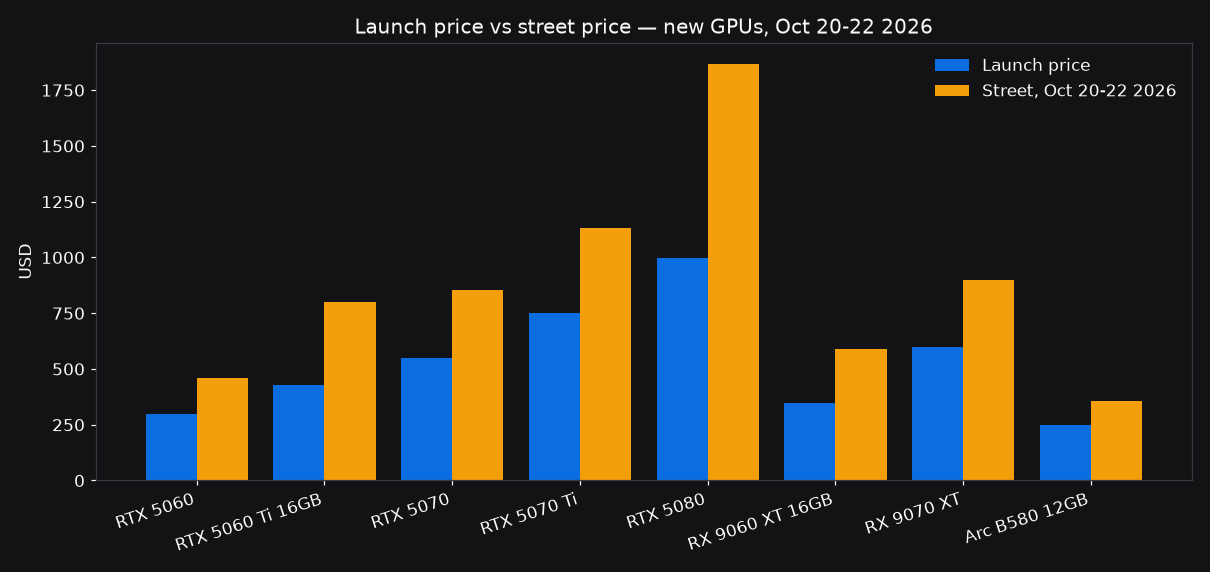
Somebody should say it plainly: the graphics card market has lost the plot. A card with a $299 sticker changes hands at $460. A 16GB card meant to cost $429 lists near $800. And the RTX 5080 — a $999 product on paper — starts at $1,869 if you want to actually take one home. That is not a sale rack. That is the shelf price.
Savy spent October 20 pulling real listings, completed-sale trackers, benchmark suites, and owner reviews to answer one question for the $300–600 buyer who plays at 1080p or 1440p: what can you buy without feeling robbed? This companion piece turns her video's findings into a written guide with every figure on the record. All prices in US dollars before tax — first checked October 20, refreshed against her October 21–22 trends research — and all perishable, so treat this as a dated survey, not a menu.
Market update — October 22
Two days moved the shelves. The $519.99 Sapphire Pulse low that anchored this guide is no longer confirmed live — street on the 9060 XT 16GB has drifted to roughly $590–650, with one aggregator claiming $450 that nobody has verified at checkout. Treat $450–650 as the band and confirm before paying. The B580's $329.99 price is now $355 at the low end with the free-cooler bundle unconfirmed and current stock unknown. The new name on the board is the RX 9070 XT at about $900 — up from ~$780 — still the only 16GB card under $1,000 with 5070-Ti-class raster, and the sensible step-up while everything with an Nvidia sticker sits 50-plus percent over launch. Used 3080s keep ticking up. Nothing below changes the verdicts, but every number below now carries its check date.
The short version
Three options survive scrutiny, and everything else is a waiting game. The Radeon RX 9060 XT 16GB at roughly $520–650 new (band, confirm live) is the only sane 16GB purchase with a warranty attached. The Intel Arc B580 12GB at about $330–355 plus shipping is the cheapest acceptable way in, provided you do the setup homework and confirm stock. A used RTX 3080 near $400 delivered is the fastest raster per dollar if you accept a 10GB ceiling and zero manufacturer warranty — and it is drifting upward, so dawdling costs money. The RX 9070 XT near $900 is the step-up for 1440p-Ultra-plus budgets. Every new RTX 50-series card sits 50% or more above its launch price, and none of them earns a buy at those numbers.
The market in one glance
| Card | Buyable floor (checked Oct 20) | Over launch price | Verdict | |
|---|---|---|---|---|
| RTX 5060 | $459.99, Newegg | +54% over $299 | Wait | |
| RTX 5060 Ti 8GB | $500–530, various | +32–40% over $379 | Wait | |
| RTX 5060 Ti 16GB | $799.99 | +86% over $429 | Wait | |
| RTX 5070 | $856.49, Best Buy | +56% over $549 | Wait | |
| RTX 5070 Ti | $1,129.99, Micro Center | +51% over $749 | Wait | |
| RTX 5080 | $1,869, B&H (was $1,599.99 on Oct 7) | +87% over $999 | Wait | |
| RX 9060 XT 16GB | $590 street, $450 low unconfirmed (Oct 21–22) | New | +49–69% over $349 | Buyable, verify live |
| RX 9070 XT | ~$900 floor (Oct 21–22) | New | +50% over $599 | Step-up pick |
| Arc B580 12GB | $355 low, stock unknown (Oct 20–22) | New | +32–43% over $249 | Buyable with homework, confirm stock |
| Used RTX 3080 | ~$426 sold median, eBay | n/a (used) | Buyable near $400 |
Why 16GB is the line that matters
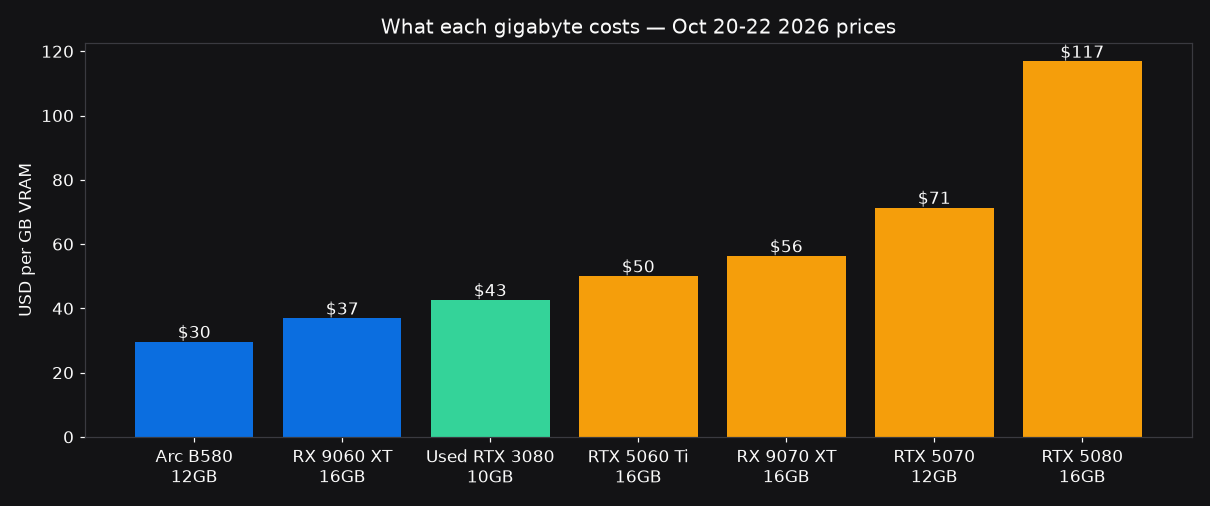
The 9060 XT recommendation starts with an unglamorous technical fact: 8GB cards stumble in long 1440p sessions, forcing players to quit and restart games to clear the stutter. That finding, from Tom's Hardware testing, turns VRAM from a spec-sheet number into the difference between playing and troubleshooting. The Sapphire Pulse 16GB at $519.99 — sold and shipped by Newegg itself, in stock, five-per-customer limit, free 30-day returns — is the cheapest 16GB card available new in the US right now, verified by pulling the product page directly. Yes, it is 49% over AMD's sticker. That says the market is sick; the card is merely the healthiest patient.
The $330 door with strings attached
Intel's Arc B580 is the budget door, and the ASRock Challenger at $329.99 plus $11.22 shipping is its cheapest working key. But count the strings before walking through. The headline free 360mm liquid cooler is a conditional gift, not a discount: you must click the free-gift offer into the cart, it runs for a limited time on selected purchases, and if it lapses your real price is $341 shipped with no cooler. Only value it if a 360mm cooler is already on your shopping list. Then the technical toll: Resizable BAR must be on or you surrender 30–40% of the performance, switching from Nvidia demands a full driver wipe, and owner reports still mention software quirks from Fortnite hiccups to sample-dependent coil whine. This is a gaming-only card — creators needing Blender, AI coursework, or streaming features should walk past it. As of October 22 the $329.99 price reads $355 at the low end, the cooler bundle is unconfirmed, and current stock is unknown — confirm both before counting this as the budget door.
The used 3080: fastest silicon, most homework
Nothing new under $600 touches a used RTX 3080 for raw rasterization — but buy the market, not the listing. Completed-sale trackers put the 90-day sold median at $426 across 107 sales, typically $385–499, with the 30-day median at $449 and climbing about 26% week over week. That trend is the whole ballgame: set alerts near $385–400 delivered and refuse to chase $500 premiums. The trade is stark — 10GB of VRAM, no factory warranty beyond eBay's buyer guarantee, higher power bills, and GDDR6X cards that may want fresh thermal paste. Buy like an inspector: demand temperature readings and repaste history, confirm the exact SKU in photos since 10GB, 12GB, and Ti variants share names, stress-test on arrival with a VRAM-heavy game, and stick to domestic sellers with free returns.
The backdoor nobody advertises
Here is the market's strangest tell: bare graphics cards are marked up while complete systems containing those same GPUs are discounted. A Gigabyte A16 Pro laptop with a 5070 Ti, 32GB of memory, and a terabyte drive goes for $1,449 at Walmart — $700 off, reported across four outlets. An MSI Crosshair 16 with a 5070 is $1,399. An Acer Predator Orion desktop with a real desktop 5080 is $2,699.99 at Best Buy. If you must have Nvidia silicon today, buying it wrapped in a computer is the only rational route found. Two cautions: Walmart's pages blocked direct re-verification, so treat system prices as deal-reported until you confirm them yourself — and ignore the $899 ABS Cyclone headline, which is a refurbished unit that is out of stock, not a buyable machine. The cheapest new ABS 5060 system on the same page is $1,149.99.
What the benchmarks actually say
TechSpot ran a 9060 XT 16GB across 18 games at 1440p without upscaling: roughly 70 frames per second on average, about one percent behind the 5060 Ti 16GB — AMD's parity claim holds. Tom's Hardware's hierarchy puts the Ti about 9% ahead at 1440p Ultra, with the B580 and 5060 trailing well behind. GamersNexus lands in the same neighborhood: the 9060 XT roughly 10% past the 5060 at 1080p and up to 22% better at 1440p. On ray tracing the outlets split — TechSpot measures the AMD card about 20% slower in its suite, worse under heavy path tracing, while TechPowerUp's mix shows near parity. Both results are reported here because the honest answer genuinely depends on which games are in the mix. The used 3080 gets no precise frame-rate claim: one aggregate index credits it with a 10–20% raster lead, but nobody has re-benched a used card in the same suite, and a number without a shared test is marketing, not data.
Owners weigh in
Best Buy buyers rate the XFX Swift 9060 XT 16GB 4.8 out of 5 across 175 mostly verified reviews, citing quiet coolers, Cyberpunk at 80 fps on Ultra, and comfortable 1440p after upgrading from far weaker cards. A useful trap to avoid: Newegg's XFX product pages show no product reviews at all — the 4.7 badge on display is the marketplace seller rating, not a card score. Intel's own B580 Limited Edition holds 4.6 from 96 Amazon ratings on value and much-improved older-DirectX support, with software maturity and Fortnite as the recurring complaints. Across Reddit, one chorus repeats for Arc owners: enable ReBAR, wipe old Nvidia drivers, and expect some tinkering.
Who should buy what
Take the 9060 XT 16GB if you want 16GB, a warranty, and near-Ti raster without a science project — unless your life is heavy ray tracing or Nvidia-specific software. Take the B580 if $341 landed is your ceiling, you can flip ReBAR on, and you game exclusively. Take a used 3080 near $400 if maximum raster matters more than warranty or VRAM headroom — and walk away past $450. Everyone else has one rational move: wait, because a market charging 50-plus percent over launch on every current Nvidia card is a market asking to be sat out.
Fine print
Some rows rest on retailer and tracker data rather than hands-on pulls. Walmart's system deals could not be directly re-verified. Used medians are completed-sale aggregates from early-to-mid October, not a first-party eBay pull, in a market ticking upward. No sales-volume data exists anywhere in this survey; interest, discussion, price, and stock were kept deliberately separate. Last checked October 20, 2026 — recheck before spending a dollar.
Sources
- Newegg: Sapphire Pulse RX 9060 XT 16GB $519.99
- Newegg: ASRock Challenger B580 $329.99
- WCCFTech: B580 bundle terms
- ComputingForgeeks GPU price table
- pcprice.watch RTX 3080 tracker
- GetPCParts RTX 3080 used value
- PC Tech Vault RTX 5070 tracker
- PC Tech Vault RTX 5080 tracker
- Tom's: 50-series price spike
- Tom's GPU hierarchy
- TechSpot 9060 XT review
- 9to5Toys: MSI Crosshair $1,399
- 9to5Toys: Acer Predator Orion $2,699.99
- IGN: Gigabyte A16 Pro $1,449
Findings follow Savy's video research plus her October 20–22 trends tracking (narration, verified listings, trackers, and benchmarks); the prose, tables, and charts here are original to this page. Figures are research-level — re-verify every price at checkout. Last refreshed October 23, 2026.