The $409 Price Tag Was Real, the Card Was Not: November 2 Hardware Receipt
Yesterday's open question has an answer, and it changes how the whole shelf reads. The stray $409 Newegg figure hanging over the RX 9060 XT turned out to be attached to the wrong card entirely — the 8GB version, not the 16GB one builders are actually shopping. Strip that line out and the market looks harsher than it did a day ago: memory floors rising on both big retailers, every new 16GB GPU stuck hundreds over launch price, and the only cheap graphics play still sitting on the used shelf.
Savy's November 2 video receipt pulled fresh snapshots from retail trackers, weekly index tables, completed-sale histories, and builder forums for the US buyer paying dollars before tax. What follows is a written companion to that research with every number dated. Last checked November 2, 2026 — all prices in US dollars before tax and shipping. Figures move intraday, so confirm each one on a live page before spending.
Five numbers that set the day
| What to watch | November 2 read with check date | Why it matters |
|---|---|---|
| Cheapest 32GB DDR5 kit on Amazon | $479.99 Lexar Thor Z RGB 6000 CL38 (Nov 2) | Three-week band at $469.99 to $474.99 broke upward |
| RTX 5060 Ti 16GB street level | $800 at B&H and Newegg (Nov 1 to 2) | Fourth straight day; still near double the $429 launch tag |
| RX 9060 XT 16GB street level | About $660 at Central Computer (Nov 2) | Yesterday's $409 line was the 8GB card, now resolved |
| RX 9070 XT street level | $920 cheapest, $1,049.99 weekly median (Nov 1 to 2) | One SKU jumped $300 in eighteen days |
| Used RTX 3090 24GB sold history | $1,061 against $1,462 against $1,599 (Oct 31 to Nov 1) | Three trackers, three samples; local-AI sidebar only |
| Cheapest new 2TB SSD on Amazon | $239.97 (Nov 2) | Flat on the day against a brutal quarterly backdrop |
Memory climbs on both storefronts
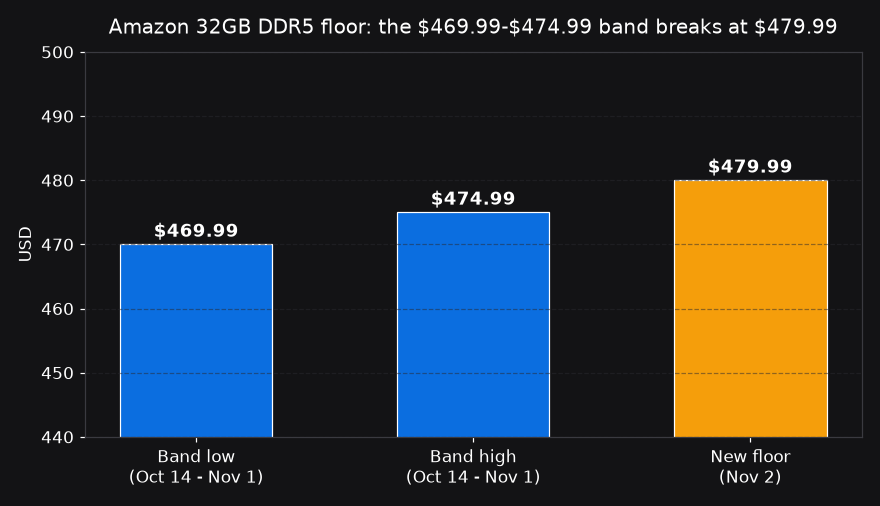
Newegg moved first and Amazon just followed. BasketPrice's November 2 Amazon snapshot puts the cheapest 32GB desktop DDR5 kit at $479.99 — a Lexar Thor Z RGB 2x16GB 6000MT/s CL38 kit that itself fell 4 percent from $499.99. The kit got cheaper while the floor got dearer, which tells you how thin the bottom of this market has become. Runner-up is Corsair's Vengeance RS 6000 at $484.99, up 3 percent from $469.99, and the middle of the 22 tracked kits sits at $554.99. The $469.99 to $479.99 corridor that held every day since October 14 is broken. Of 39 kits tracked for two weeks or more, 25 cost more today than when tracking started and only 4 cost less.
The wholesale desks explain why no dip is coming. TrendForce's October 30 update has fourth-quarter PC memory contracts still rising, with the gains narrowing as buyers resist, suppliers trimming PC output to feed servers, and negative PC supply growth penciled in for next year. The matched-model index at datacenterdisk — same kits repriced daily, immune to catalogue churn — reads 106.2, up 6.2 percent since September 22, with a $19.45 median per gigabyte across 170 in-stock kits. A second index at rampricesusa lands within a dollar at $18.75, up 19 percent in 90 days. If you need RAM, the workable rule is the cheapest kit from a brand you would trust with a return — bargain hunting against this tape is a hobby, not a plan.
New GPUs: a correction, a flatline, and a climb
Start with the correction, because yesterday's column carried the error. The vga.live weekly tracker report dated November 2 covers new, in-stock US listings sold by retailers themselves from October 26 to November 1, and it splits the two cards cleanly: the 9060 XT 16GB shows a $799.99 median with a $499.99 low, while the 8GB model's low is $409.00. Same store, different silicon — the mystery line is resolved, so strike $409 from every 16GB conversation.
The genuine 16GB floor is roughly $660: an ASRock Challenger OC at Central Computer checked November 2, then an ASUS Dual at $700, with Newegg rows at $790 for the Dual and $800 for the Nitro Plus. The $520 Sapphire Pulse that anchored October was last in stock October 27 and has shown out of stock at every checked shop for four days. At $660 it remains the cheapest new 16GB card with a warranty — but only about $140 separates it from the RTX 5060 Ti, and that gap buys CUDA plus DLSS for anyone whose machine does more than game.
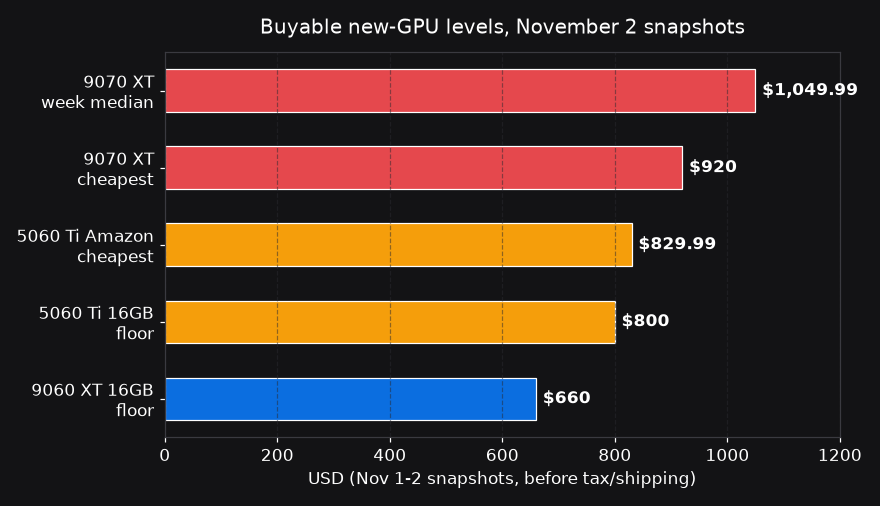
The 5060 Ti itself has not moved in four days. $800 holds: PNY's OC card at B&H checked November 2, plus the ASUS Dual OC and MSI Ventus 3X OC at Newegg checked November 1 and 2, across 34 offers from 4 retailers against a site-typical $875. That is 9 percent under typical and still nearly twice the $429 launch price. Amazon's cheapest card in the class is $829.99, about 93 percent over sticker, and an October 30 full-Amazon pull found the month low at $799.99 for a PNY card sold by Amazon itself. Nothing under $700 exists. If a new 16GB card must be bought today, this is the least-bad register to pay it at — otherwise the only sub-$500 graphics play remains a used 3080, carried over from yesterday's verified band at $380 to $440 all-in and not re-pulled today.
The 9070 XT keeps walking uphill. Cheapest verified is $920 for a PowerColor Reaper at Newegg checked November 1, with a Steel Legend at $950 at Central Computer on November 2, inside a $900 to $1,527 spread across 35 offers. The weekly median prints $1,049.99, BasketPrice shows its cheapest card at $919.99 — up 16 percent since October 2 — and one Micro Center Red Devil row tells the story in miniature: $849.99 on October 14 to $1,149.99 now, $300 in eighteen days on a single SKU. Builder forums have started treating $800 to $900 as simply the normal US price for this card. Normal is not good. The standing guidance holds with more conviction: wait unless $800 or less appears at a seller you trust.
Kept apart: the 24GB question for local-AI builders
Gaming logic stops at this line. What follows is capacity math for hosted models, not frames-per-dollar, and it should not set gamer expectations.
The used RTX 3090 now has a third sold-data print, and all three stay on the table because their samples refuse to agree. GetPCParts through October 31 averages $1,061 across 39 weekly observations, down 2.9 percent on the week, with a 30-day average of $1,122 and a 90-day of $1,047 — and its own buying advice calls around $942 a good buy and up to about $1,099 normal for a tested card with returns. Pcprice.watch refreshed November 1 medians $1,462 across 300 sales in 90 days, middle half $1,339 to $1,549. CompSniper's live page medians $1,599 across the 188 most recent completed sales, typically $1,494 to $1,699, latest sale November 1.
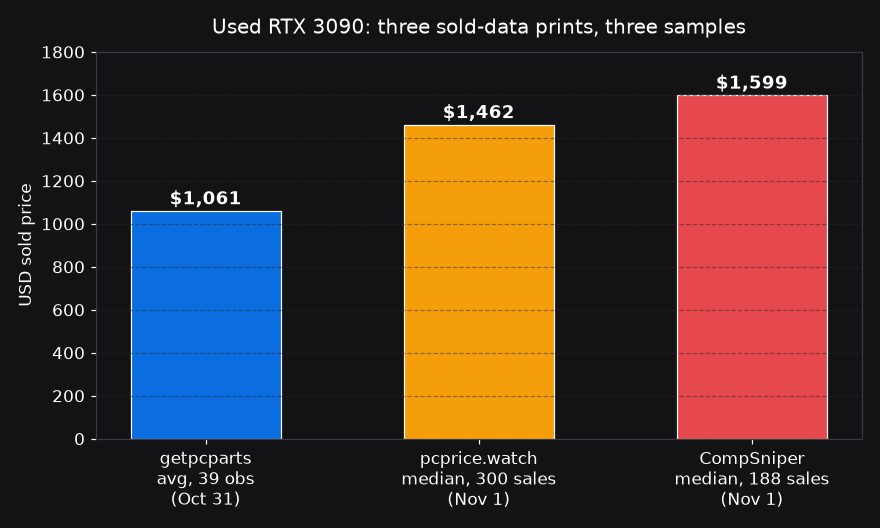
Three methods, three windows, three answers — the market did not swing $500 overnight, the samples differ. Live buy-it-now rows near $850 to $1,000 are listings, not sales, and the auction-format rows near $850 to $1,000 flagged in research are called out as curiosities rather than comps. Guidance is unchanged: budget $1,400-plus or wait, confirm the seller's testing and return terms in writing, and never treat one cheap listing as the market. These are 350W, triple-slot-plus cards — verify a 750W-plus power supply, case clearance, and that the listing is the tested complete card rather than parts-only.
Storage flat, backdrop grim, forums grimly consistent
The cheapest new 2TB SSD on Amazon reads $239.97 — a Gen-3 KingSpec drive at about $120 per terabyte — with the middle of the tracked drives at $294.99 and the tracker's own good-price line of $215.97 or less untouched. But the context darkens every week: average tracked 2TB NVMe pricing ran from about $169 last November to $358 in March, up 114 percent, SATA trailing at plus 76 percent exactly the way parts furthest from AI servers should. NAND flash contracts are forecast up another 15 to 20 percent this quarter as AI datacenters absorb 48 percent of shipped flash bits against 26 percent a year earlier, some contract SSD prices run 303 percent higher year over year, bank analysts see no real relief until 2028, and one NAND maker's chief executive warns the squeeze locks elevated SSD pricing in through 2030. Buy storage because the build needs it.
Builder chatter on r/buildapc from November 1 and 2 sketches the coping playbook, and it is sentiment rather than data: buy-now-before-worse dominates, one active thread calls the 5080 effectively out of production and counsels buying now while holding the box sealed through the Black Friday return window, the 5070 Ti gets named the leading new option, $500 is treated as used 3080 or 3080 Ti money, 8GB cards split the room between fine-for-esports and risky-for-AAA, and the most repeated advice is to keep the current configuration. Single posters, no sales volumes — but the direction matches every hard number above it.
Before money changes hands
- Re-price memory against a live page — October moved weekly and both retailers stepped up within days
- Never cite the $409 line for a 16GB card — it is the 8GB model, resolved on the weekly tracker
- Match the card to the workload — raster gaming favors the $660 AMD row, feature and compute work justifies the $800 Nvidia band, and nothing near $920 to $1,050 earns urgency
- Keep sold history and asking prices in separate columns — medians close deals, listings open negotiations
- Confirm used-3090 testing and returns per listing — photos of the exact card, seller history, and buyer-protected payment only
- Fit memory to the job — 32GB finishes a gaming build while larger capacities serve hosted models and virtual machines, and spare gigabytes at record prices help nobody
- Verify bundle and combo terms at checkout — discounts and codes lapse without warning
Sources
Research basis: project folder 2026-11-02_mirage-409-receipt (Savy's November 2 video package: narration in video/narr_parta.txt, video/narr_partb.txt, video/narr_partc.txt, video/narr_partd.txt and video/script.md, research/offers.csv, research/sources.md, research/benchmarks-feedback.md, research/methodology.md, verification.md, evidence captures).
Public sources reused, with the dates behind each claim:
- basketprice RAM tracker — $479.99 Amazon floor, broken band, kit-level moves (Nov 2)
- basketprice SSD page — cheapest 2TB $239.97, $120 per terabyte (Nov 2)
- basketprice GPU trackers — 8 of 8 above MSRP, 9070 XT $919.99 up 16 percent since October 2 (Nov 2)
- thecomparator RTX 5060 Ti 16GB tracker — $800 floor across 34 offers and 4 retailers (Nov 2)
- thecomparator RX 9060 XT 16GB tracker — $660 ASRock Challenger OC cheapest of 17 offers (Nov 2)
- thecomparator RX 9070 XT tracker — $920 PowerColor Reaper cheapest of 35 offers, $900 to $1,527 spread (Nov 1 to 2)
- getpcparts RTX 3090 market prices — $1,061 average on 39 observations (Oct 31)
- pcprice.watch RTX 3090 solds — $1,462 median on 300 sales over 90 days (Nov 1)
- CompSniper RTX 3090 worth page — $1,599 median on 188 most recent completed sales (Nov 1)
- datacenterdisk RAM tables — matched-model index 106.2, $19.45 median across 170 kits (Nov 2)
- rampricesusa DDR5 prices — $18.75 median, plus 2.7 percent in 30 days (Nov 1)
- neoteo vga.live weekly report — October 26 to November 1 retailer-only tracker table resolving $409 as 8GB (Nov 2)
- computingforgeeks GPU prices full-Amazon pull — $799.99 October month low on 5060 Ti (Oct 30)
- pctechvault RX 9060 XT market watch — $520 Pulse out of stock four days, Red Devil $1,149.99 move (Nov 1)
- TrendForce DRAM contract updates (Oct 30) — Q4 PC contracts rising on narrowing gains, PC output cuts, search-result level
- notebookcheck NAND coverage (Nov 2026) — contract SSD prices up 303 percent year over year, Q4 NAND up 15 to 20 percent, search-result level
- r/buildapc threads (Nov 1 to 2) — discussion signal only, single-poster anecdotes, no price evidence drawn
Fine print
Every row here is tracker, aggregator, press, or listing level — no checkout was completed and no unit was purchased. Seller identity, shipping, tax, and live stock inside aggregator rows were not independently confirmed. Newegg RAM rows carried from November 1 captures were not re-pulled this run. The vga.live weekly table is window-bound to October 26 through November 1 and covers retailer-sold new listings only. Sold history and asking prices were never blended. No new benchmarks, defect rates, or brand-reliability claims sit behind this snapshot, and no forecast is offered. Stale-price warning: October moved weekly and November has already stepped twice — recheck every figure at checkout before spending.
Findings in this guide follow Savy's video research; the prose, tables, and charts on this page are original to s-scottek.com.