Memory Spikes Into November: 32GB RAM Leaps $75 While Midrange GPUs Hold Their Lines
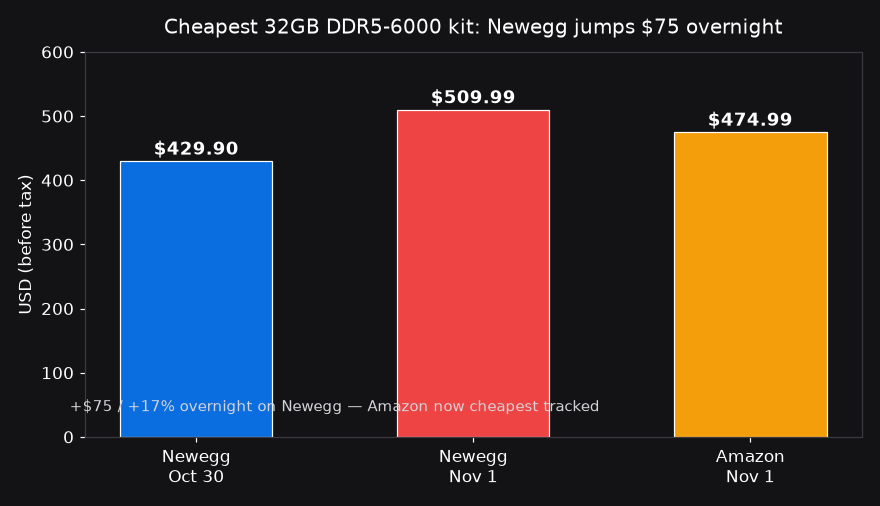
November arrived with a receipt nobody wanted. The cheapest 32 gigabytes of desktop DDR5 on Newegg woke up roughly seventy-five dollars more expensive than it was two days earlier, the index behind it confirmed a double-digit monthly climb, and contract desks overseas printed records. Graphics cards mostly stood still — which, at these prices, is its own kind of news — while the used market for 24GB cards served up two honest numbers that refuse to agree.
Savy pulled tracker snapshots, full-retailer pulls, completed-sale histories, and builder chatter across October 30 and November 1 for the US buyer paying dollars before tax. This page converts that video research into a written field guide with every figure dated. Last checked November 1, 2026 — all prices in US dollars before tax and shipping. Treat every figure as perishable and confirm it live at checkout, because this shelf reprices by the day.
The morning in one table
| Item | Going level with check date | Sense of it |
|---|---|---|
| 32GB DDR5-6000 desktop kit | $509.99 Newegg row (Nov 1), was $429.90 (Oct 30); Amazon $474.99 (Nov 1) | Overnight jump near 17 percent; Amazon now cheapest tracked |
| DDR5 price index | $18.11 median per GB, $19.64 mean, up 14.0 percent in 30 days (Nov 1) | Broad climb, not one listing |
| Memory chip, DDR5 16Gb | $60.55, up 6 percent in 30 days and 480 percent on the year (Nov 1) | Wholesale pressure behind retail tags |
| RTX 5060 Ti 16GB | $800 floor, third straight day (Nov 1); Amazon $829.99 | Feature buy at best, never a bargain |
| RX 9060 XT 16GB | $650 Newegg snapshot (Oct 31); Amazon $659.99 (Oct 30) | Cheapest new 16GB with a warranty |
| RX 9070 XT | $900 cheapest Newegg (Nov 1); Amazon $919.99; daily median $1,049.99 | Dearest it has looked; patience wins |
| Used RTX 3080 10GB | $441 median sold (Oct 30); $440 median asking (Nov 1); live rows $385 to $475 | Only working sub-$500 gamer play |
| Used RTX 3090 24GB | $1,061 average on 39 reads (Oct 31) against $1,449 median on 277 sales (Oct 30) | Two trackers, two answers; local-AI sidebar only |
| 2TB NVMe SSD | $239.97 cheapest Amazon (Nov 1), up about $38 in two days | Buy on need, not on sale-watching |
Memory is the story, and it is not subtle
Start with the number that changed the math on every build sheet. The lowest Newegg row for a 32GB DDR5-6000 kit touched $429.90 on October 30 across a 156-kit comparison, then November 1 search results showed nothing under $504.99 to $509.99 for the same capacity — a Corsair Vengeance RGB kit at $509.99 against a $637.99 list price marking the cheapest attributable row. That is on the order of $75, about 17 percent, in roughly two days.
Amazon refused to follow. Its floor sat at $474.99 across 22 tracked kits (Nov 1), a line flat since mid-October inside a $469.99 to $479.99 band — which quietly makes Amazon the cheapest tracked option this morning.
The jump has scaffolding underneath. RamRadar's November 1 read across 212 desktop DDR5 kits puts the median at $18.11 per gigabyte and the mean at $19.64, up from $17.23 on October 2 — plus 14.0 percent in thirty days, and plus 5.7 percent against October's average. DDR4 rose too, about 10.9 percent on the month. Upstream, MemoryIndex prices the DDR5 chip itself at $60.55, up 6 percent in thirty days and 480 percent year over year, with its contract basket up similarly. And TrendForce, via Korean press on October 30, guides fourth-quarter PC DRAM contracts 13 to 18 percent higher, with October prints at records — $275 for a 16GB DDR5 module and $165 for 8GB — and November talks expected higher still.
Translation for anyone pricing a build this weekend: re-price the memory first, because last week's number is gone. Waiting for 2024 pricing to return is not a strategy the wholesale data supports.
New cards for gamers: stillness at steep prices
The RTX 5060 Ti 16GB spent a third straight day at an $800 floor — a PNY card at B&H plus ASUS Dual and MSI Ventus rows at Newegg, across 33 tracked offers (Nov 1). Amazon's cheapest sat at $829.99, about 93 percent over the $429 launch price, and the daily median read $839.99 on October 31. Call the band $800 to $840 and the sub-$700 shelf a memory. At 5070 money for a 5060 Ti badge, frames-per-dollar is not the pitch — DLSS 4, path tracing, streaming encodes, and CUDA tooling are the only honest reasons to pay it.
The cheapest legitimate sixteen gigabytes stayed put. The RX 9060 XT 16GB held at $650 — a Sapphire Pulse at Newegg inside 19 tracked offers (Oct 31) — with an XFX Swift at $659.99 on Amazon from the October 30 full pull, roughly 89 percent over its $349 launch price. You may spot a $409 Newegg line on one weekly chart; it conflicts with the same retailer's own $650 snapshot, the listing match is unclear, and nobody has checked out at that number. Treat $650 as the floor and the $409 as noise until a second source or a cart screenshot proves otherwise. Whatever you do, buy the 16GB card — eight-gigabyte variants at these prices lose in every comparison that matters.
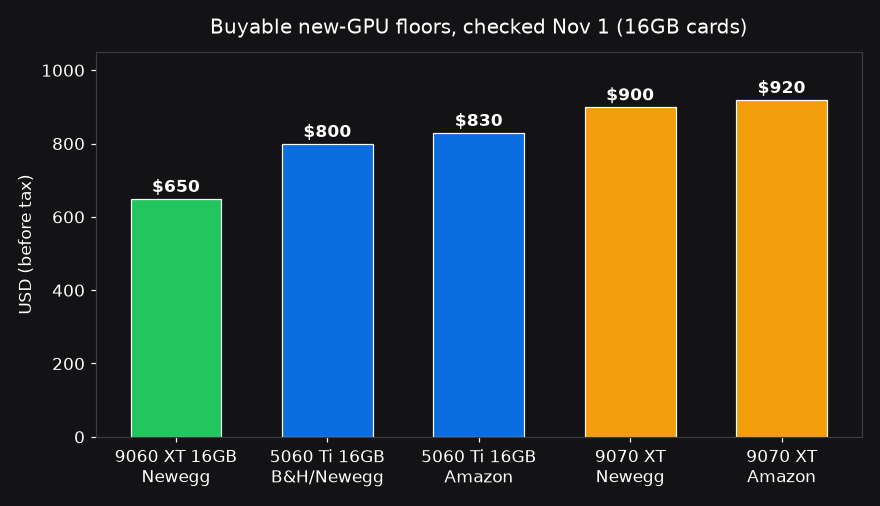
The RX 9070 XT moved the wrong way. Cheapest tracked is now $900 — an ASRock Steel Legend at Newegg with a PowerColor Reaper at $920 — across 35 offers stretching to $1,534 (Nov 1). Amazon sits at $919.99, the daily median printed $1,049.99 against a ninety-day median near $850, and a Micro Center Yeston row at $829.99 from October 29 has left the cheapest slot. One pull has the card up 16 percent since October 2. The standing rule hardens: wait unless $800 or less, all-in, at a seller you trust, verifies on a live page. A used-from line near $840 on eBay is one listing shape, not a market, and it carries seller risk.
Gamers on the used shelf: one anchor still holds
The used RTX 3080 10GB remains the only functioning play under five hundred dollars. Completed-sale history through October 30 shows a $441 median across 139 sales, up about 13 percent on seven days, while asking medians sit at $440 across roughly 345 listings (Nov 1). Live buy-it-now rows cluster where they should: $385 for a Gigabyte Aorus before shipping, $410 to $425 for Dell OEM pulls, $422 to $450 for EVGA FTW3 cards, $455 to $475 for Founders and Strix rows. Target $380 to $440 all-in; anything above $450 sits beyond where units actually close. Early auctions near $255 to $315 are opening bids, not comparable prices, and ten gigabytes remains a 1440p ceiling you should accept with open eyes.
Homework is the cost of the discount, and none of it is optional:
- Demand genuine photos of the exact card on offer
- Read the seller's history and volume before the price
- Get a stated return window in writing
- Pay only through buyer-protected rails — never crypto, gift cards, or friends-and-family transfers
Kept apart: the 24GB question for local-AI builders
Gaming logic stops at this line. What follows uses capacity math for hosted models, not frames-per-dollar, and it should not set gamer expectations.
The used RTX 3090 24GB now carries two defensible sold prints that disagree by roughly $390. GetPCParts printed fresh on October 31: an average of $1,061 across 39 observations, down a touch on the day. Pcprice.watch's October 30 series shows a median of $1,449 across 277 sales, typically $1,315 to $1,535. Different samples, different windows, different filters — not a one-day crash, and yesterday's declaration that the larger series had settled the debate was premature. Both numbers stay on the table with their sample sizes attached.
Asking behavior runs hotter: a median near $1,552 across 328 listings, a going-rate board at $1,796, active rows from $1,496 toward $2,000-plus. Guidance does not move: budget $1,400-plus or wait, and read lone sub-$1,000 buy-it-now rows as isolated listings rather than market proof. Apply the same per-listing diligence as the 3080 — photos, history, returns, protected payment — and treat the card as twenty-four gigabytes of model headroom, never as a gaming value.
Builders and storage: no relief in sight
Storage joined memory on the climb. The cheapest 2TB SSD on Amazon now reads $239.97 — about $120 per terabyte — against $201.99 two days earlier, a lift near $38. The cheapest new 2TB NVMe anywhere sits around $246, the middle of one 18-drive tracker is $297, and the under-$85-per-terabyte line that marks a genuine dip is nowhere visible on new drives. Buy storage because the build needs it, not because the price tempts you.
Builder sentiment on r/buildapc (Nov 1) sketches the coping strategies: five hundred dollars buys a used 3080 or 3080 Ti or it buys patience, $800 to $900 is treated as simply normal for a 9070 XT, a twelve-hundred-dollar premium for the competing 80-class card reads as unjustifiable outside ray-tracing work, and a $1,599 prebuilt built around a 7800X3D and a 5070 keeps getting called fair value — because the card alone costs $850 to $900. Bundle-hunting and prebuilt-hunting are the only value shapes left; no panic buying, just waiting with intent.
Before money changes hands
- Re-price RAM against a live page — overnight moves of $75 make week-old build sheets fiction
- Keep closed-sale medians and asking prices in separate columns — medians close deals, listings open negotiations
- Match the card to the workload — raster gaming favors the $650 AMD row, feature work justifies the $800 to $840 Nvidia band, and nothing near $920 to $1,050 earns urgency
- Fit memory to the job — 32GB finishes a gaming build while bigger capacities serve hosted models and virtual machines, and spare gigabytes at record prices help nobody
- Verify bundle and combo terms at checkout — discounts and codes lapse without warning
Sources
Research basis: project folder 2026-11-01_november-first-receipt (Savy's November 1 video package: narration in video/narr_parta.txt, video/narr_partb.txt, video/narr_partc.txt and video/script.md, research/2026-11-01_trends.md, research/offers.csv, verification.md, evidence captures).
Public sources reused, with the dates behind each claim:
- Newegg DDR5 32GB kit search — $504.99 to $509.99 cheapest rows (Nov 1) against $429.90 floor (Oct 30)
- basketprice RAM tracker — $474.99 Amazon floor, flat band since October 14 (Nov 1)
- RamRadar RAM price index — $18.11 median, $19.64 mean, plus 14.0 percent in 30 days across 212 kits (Nov 1)
- MemoryIndex DRAM prices — DDR5 die $60.55, plus 6 percent in 30 days, plus 480 percent year over year (Nov 1)
- EDaily on TrendForce October DRAM contracts — Q4 contracts up 13 to 18 percent, October module records (Oct 30)
- thecomparator RTX 5060 Ti 16GB tracker — $800 floor across 33 offers (Nov 1)
- basketprice RTX 5060 Ti page — $829.99 cheapest Amazon card (Nov 1)
- thecomparator RX 9060 XT 16GB tracker — $650 Sapphire Pulse cheapest of 19 offers (Oct 31)
- computingforgeeks GPU prices full-Amazon pull — $659.99 XFX Swift 9060 XT (Oct 30)
- thecomparator RX 9070 XT tracker — $900 ASRock Steel Legend cheapest of 35 offers (Nov 1)
- pctechvault RX 9070 XT market watch — $919.99 to $920 Amazon rows, $1,049.99 daily median, 90-day $850 median (Nov 1)
- getpcparts RTX 3090 market prices — $1,061 average on 39 observations (Oct 31)
- pcprice.watch RTX 3090 solds — $1,449 median on 277 sales (Oct 30)
- resaleprices RTX 3090 page — $1,552 median asking across 328 listings (Nov 1)
- gpupoet RTX 3090 shop page — 94 active rows averaging $2,003, cheapest $1,496 (Nov 1)
- dealhunter price index — $440 median asking on 3080 listings (Nov 1)
- eBay used 3080 listings — live buy-it-now rows $385 to $475 (Nov 1)
- basketprice SSD page — cheapest 2TB $239.97 (Nov 1)
- disk-scout 2TB NVMe ranking — cheapest new $246, from $204.50 used, across 165 drives (Oct 31)
- r/buildapc threads (Nov 1) — discussion signal only, single-poster anecdotes, no price evidence drawn
Fine print
Every row here is tracker, aggregator, press, or listing level — no checkout was completed and no unit was purchased. Seller identity, shipping, tax, and live stock inside aggregator rows were not independently confirmed. The $409 9060 XT weekly line and sub-$500 Newegg grid rows without seller attribution are single-source and unverified until a live page proves them. Sold history and asking prices were never blended. No new benchmarks, defect rates, or brand-reliability claims sit behind this snapshot, and no forecast is offered. Stale-price warning: October moved weekly and November opened with a $75 overnight step — recheck every figure at checkout before spending.
Findings in this guide follow Savy's video research; the prose, tables, and charts on this page are original to s-scottek.com.