October Receipt Check: The Sub-$700 16GB GPU Vanishes as Memory Hits Records
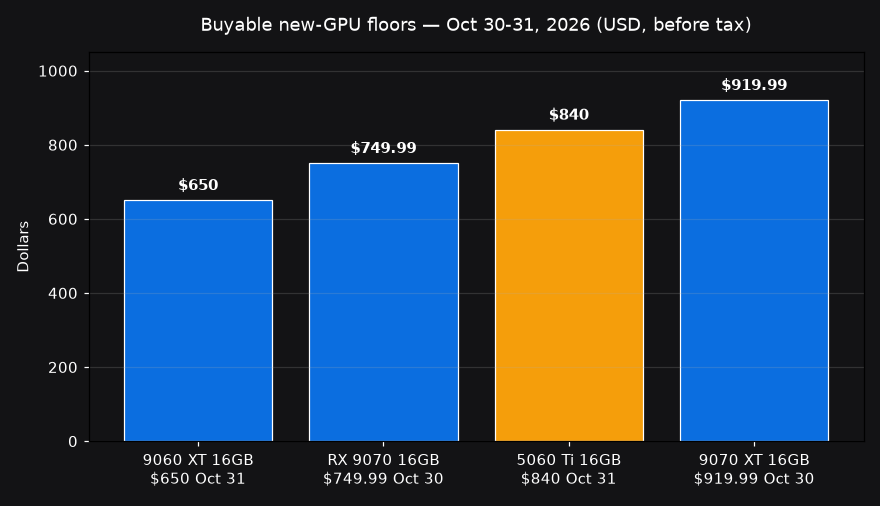
October closed with sellers rewriting tags faster than shoppers could refresh them. A card that sat under seven hundred dollars two mornings ago now asks eight-forty at two of the country's biggest stores. The cheapest new card with sixteen gigabytes of memory holds at six-fifty only because everything around it moved up. Used prices kept climbing underneath, memory contracts printed records, and one much-quoted figure from last week turned out to be stale.
Savy spent October 27 through 31 rechecking tracker snapshots, full-Amazon pulls, completed eBay sale histories, and builder commentary for the US buyer paying in dollars before tax. This page turns that video research into a written buying map with every number dated. Last checked October 31, 2026 — all prices in US dollars before tax and shipping. Treat every figure as perishable and confirm it live at checkout, because this shelf reprices by the day.
The shelf at a glance
| Buy | Buyable level with check date | Read |
|---|---|---|
| RTX 5060 Ti 16GB | $800 to $840 band (Oct 30 to 31) | Feature purchase only, never a value buy |
| RX 9060 XT 16GB | $650 verified (Oct 31) | Cheapest new 16GB card, 16GB or nothing |
| RX 9070 16GB | $749.99 brand store (Oct 30) | The calmer AMD buy under the XT |
| RX 9070 XT 16GB | $919.99 Amazon pull (Oct 30), $829.99 cheapest new (Oct 29) | Wait unless $800 or under verifies live |
| Used RTX 3080 10GB | $447 median sold, 166 sales (Oct 30) | Gamer value anchor, target $380 to $440 |
| Used RTX 3090 24GB | $1,449 median sold, 277 sales (Oct 30) | Local-AI sidebar only, corrected figure |
| 32GB DDR5-6000 kit | $429.90 floor (Oct 31) | First sub-$440 print in weeks, median near $580 |
| 2TB NVMe | $201.99 budget to $373.75 median | Under $85 per TB counts as a real dip |
The card that added $74 overnight
The RTX 5060 Ti 16GB now defines the top of the midrange by price rather than performance. An October 31 tracker read lists the cheapest buyable unit at $840, covering an ASUS Dual in white on Amazon and the black version of the same card at Best Buy, with three shops stocked between $840 and $850 (checked October 31). That identical Best Buy card read $766 on October 30 — a $74 overnight step on one SKU.
A full-Amazon pull from October 30 caught a PNY card at $799.99, sold by Amazon itself (checked October 30). Against a $429 launch price that is roughly 86 percent over sticker, while the $840 rows sit about 96 percent over. The tracker's ninety-day median near $789 and a daily median of $839.99 on October 31 confirm the direction. Read the card as an $800 to $840 band, with the $615 and $680 shelves behind it gone.
At 5070 money for a 5060 Ti badge, raster value is off the table. The only honest reasons to pay it are workload features — path tracing, DLSS 4, streaming encodes, or CUDA tooling. Shoppers buying frames per dollar should look elsewhere on this page.
The cheapest new 16GB card left
The RX 9060 XT 16GB holds its position by standing still while rivals climb. A tracker check on October 31 counted 19 offers across 5 retailers, with the cheapest a Sapphire Pulse at $650 at Newegg (checked October 31). The same October 30 Amazon pull prices an XFX Swift at $659.99 (checked October 30), about 89 percent over its $349 launch price.
Older low rows no longer clear. A $520 tracker row from October 27 now shows out of stock at every shop that tracker monitors, and a $519 snippet never gained a second source. Until a live listing proves otherwise, $650 verified is the floor for new sixteen gigabytes with a warranty.
One specification rule survives every comparison: buy the 16GB version or skip the line entirely. Eight-gigabyte variants above $500 lose on value in every scenario the tracker scores, so a cheaper suffix is not a discount.
The $170 question at the top
Two AMD cards now answer different budgets. The October 30 Amazon pull prices the RX 9070 XT at $919.99, with nine listings stocked up to $1,339.76 (checked October 30) — about 54 percent over its $599 launch price. A second tracker read $940 on October 29, up roughly 13 percent across thirty days. The cheapest new print anywhere is a Yeston Sakura at Micro Center at $829.99 (checked October 29), itself up from $799.99 on October 16.
Sitting $170 lower is the plain RX 9070 at $749.99 from the ASRock brand store via Amazon (checked October 30), a row described as barely moved through October and about 37 percent over its $549 launch price. For raster gaming that gap buys most of the performance for considerably less money, and one outlet's pull flags the plain 9070 as its current value pick.
Forum chatter on October 29 and 30 lands nearby — open-box 9070 XT units near $900 at Best Buy and Micro Center bundle talk recur as single-poster anecdotes, with broad sentiment that prices keep drifting upward. Anecdotes are not listings. The standing verdict holds: wait on the XT unless a checkout-verifiable $800 or under appears on screen.
Used cards for gamers: the anchor keeps firming
Nobody advertises the used RTX 3080 10GB, which is why it keeps anchoring gamer value. Completed eBay sale history through October 30 records a $447 median across 166 sales on a ninety-day basis, a $477 thirty-day median, and a $493 seven-day median — about 18 percent above where the series sat thirty days earlier (all checked October 30). The typical transacted band runs $395 to $504, with the cheapest live delivered unit near $375.
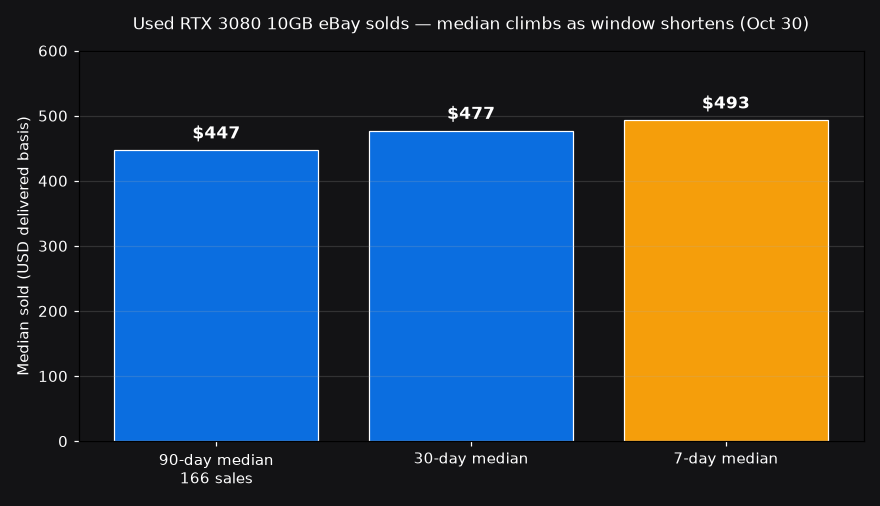
That slope sets the tactic. Aim $380 to $440; asking prices above $450 sit beyond where units actually close. Ten gigabytes still carries 1440p for roughly two hundred dollars less than the cheapest verified new sixteen-gigabyte row.
Diligence is the price of the discount and none of it is optional:
- Insist on genuine photos of the exact card being sold
- Read seller history and volume before reading the price
- Confirm a stated return window in writing
- Pay only through buyer-protected rails, never crypto, gift cards, or friends-and-family transfers
Fenced sidebar for local-AI builders
Gaming math ends here. This section uses different capacity logic and should not set gamer expectations.
The used RTX 3090 24GB figure quoted in the October 25 video — $1,093 from 38 observations (checked October 24) — is superseded. Fresher completed-sale data through October 30 shows a $1,449 median across 277 eBay sales, with a typical band of $1,315 to $1,535 and a thirty-day median of $1,504 (checked October 30). The older number was a week stale on roughly one-seventh the sample, so the larger and newer read replaces it.
Asking behavior runs hotter still, clustering near $1,800, while single sub-$1,000 buy-it-now rows are isolated watch-items rather than market evidence. Auctions show bids, not prices. Apply the same per-listing homework as the 3080 — photos, history, returns, protected payment — and treat this card as twenty-four gigabytes of local-model headroom, not as a gaming value play.
Builders: retail floor dips as contracts print records
Memory tells two stories at once. Retail first: the cheapest 32GB DDR5 desktop kit tracked on October 31 is a Corsair Vengeance 2x16GB DDR5-6000 CL38 at $429.90 at Newegg, drawn from 184 kits (checked October 31). That is the first sub-$440 print in weeks, with DDR5-6000 CL30 starting at $469.99 and the kit median near $579.98. A $276 Lexar row on one dashboard remains a single unverified listing and should be ignored until a second source confirms it.
Wholesale explains why relief may not last. October contract prices set records at $275 for 16GB DDR5 modules, up about 11 percent in a month, and $165 for 8GB modules, up about 24 percent. Fourth-quarter negotiations point up to 18 percent higher, and SK Hynix signals demand outrunning supply through 2030.
Storage still offers the week's hunting ground. Tracked 2TB NVMe spans $201.99 at the budget end to a $373.75 median across 92 drives. Treat anything under $85 per terabyte as a genuine dip. One bundle backdoor persists for buyers already committed to a full platform: a Newegg four-in-one built around the 9800X3D — processor, 32GB of TeamGroup memory, board, and 2TB SSD — at $1,180.99, working out near $151 effective for the memory after combo discounts (press basis October 27, four days old at lock, verify live). Only a builder already choosing that processor should treat it as cheap RAM.
What to do before you pay
- Confirm the exact card and kit are add-to-cart live — tracker in-stock flags are snapshots, not reservations
- Keep sold history and asking prices apart — medians close deals, listings open negotiations
- Match the card to the job — raster gaming favors the $650 AMD row, feature workloads justify the $800 to $840 Nvidia band, and nothing at $920 earns urgency
- Size memory to the workload — 32GB closes a gaming build, larger capacities serve hosted models and virtual machines, and unused gigabytes at record prices help nobody
- Recheck bundle and promo terms at checkout — combo discounts and codes lapse without notice
Sources
Research basis: project folder 2026-10-31_october-receipt (Savy's October 31 video package: narration in video/narr_parta.txt, video/narr_partb.txt, video/narr_partc.txt and video/script.md, research/offers.csv, research/sources.md, verification.md, evidence captures).
Public sources reused, with the dates behind each claim:
- computingforgeeks GPU prices, full-Amazon pull — 5060 Ti 16GB $799.99, 9060 XT 16GB $659.99, 9070 XT $919.99, RX 9070 $749.99, all checked October 30
- pctechvault RTX 5060 Ti 16GB market watch — $840 floor, $766 prior-day row, medians, checked October 31
- pctechvault RX 9070 XT market watch — $940 Amazon row, checked October 29
- thecomparator RX 9060 XT 16GB tracker — $650 Sapphire Pulse cheapest of 19 offers, checked October 31
- pricedropcatch Micro Center Yeston 9070 XT — $829.99, low $799.99 October 16, checked October 29
- pgrid 32GB DDR5 comparison — $429.90 floor across 184 kits, $469.99 cheapest 6000 CL30, $579.98 median, checked October 31
- pgrid 2TB NVMe comparison — $201.99 budget to $373.75 median across 92 drives
- pcprice.watch RTX 3080 solds — $447 median 166 sales, $477 30-day, $493 7-day, checked October 30
- pcprice.watch RTX 3090 solds — $1,449 median 277 sales, $1,504 30-day, checked October 30
- getpcparts RTX 3090 market prices — $1,093 on 38 observations October 24, stale and superseded
- getpcparts RTX 3080 market prices — October 24 context row
- datacenterdisk 32GB DDR5 boards — $276 Lexar single-listing outlier, unverified
- datacenterdisk SSD price forecast — $76.30 to $137.50 per TB floor trend context
- Chosun Biz on October DRAM contract records — DDR5 16GB $275 and 8GB $165 records, Q4 up to 18 percent higher, October 30
- Notebookcheck on SSD contract surge — 303 percent year-over-year contract context, mid-October
- Tom's Hardware — 9800X3D four-in-one bundle $1,180.99 coverage, October 27 basis
- r/buildapc threads October 29 to 30 — discussion signal only via search snippets, single-poster anecdotes, no price evidence drawn
Fine print
Every row here is tracker, aggregator, or press level — no checkout was completed and no unit was purchased. Seller identity, shipping, tax, and live stock inside aggregator rows were not independently confirmed. The $276 RAM row, open-box anecdotes near $900, and bundle terms are single-source and unverified until a live page proves them. Sold history and asking prices were never blended. No new benchmarks, defect rates, or brand-reliability claims sit behind this snapshot, and no forecast is offered. Stale-price warning: October moved weekly — $766 to $840 in a day on one SKU — so recheck every figure at checkout before spending.
Findings in this guide follow Savy's video research; the prose, tables, and charts on this page are original to s-scottek.com.