Used RTX 3090 24GB for Local AI: Why It Still Wins
Local AI has a memory problem, and memory has a price problem. A 27-billion-parameter model squeezed into usable quantization wants around 24GB of VRAM, and new cards with that much memory either don't exist or cost like a used car. The used RTX 3090 is the market's answer: three generations old, 24GB on board, and selling between $1,130 and $1,550 depending on which tracker you ask and which week you ask it.
This guide is built from Savy's October 20–22 hardware trends research — completed-sale trackers with dates, not checkout-verified listings — rewritten here as original buying advice. Treat every figure as research-level and re-verify at checkout.
The short version
The used 3090 band holds at roughly $1,130–1,550, or about $47–65 per gigabyte of VRAM — the cheapest 24GB path to Qwen-class 27–32B quants by a wide margin. The used 4090 sells near $2,589 and asks near $2,998 for the same 24GB ceiling: you pay double for speed, not capacity, and its week-to-week whiplash makes timing a gamble. New 16GB cards near $800 serve smaller models only. Buy the 3090 like an inspector, feed it a real power supply, and never pay the top of the band.
The band, with dates
| Read | Figure | Basis | Date |
|---|---|---|---|
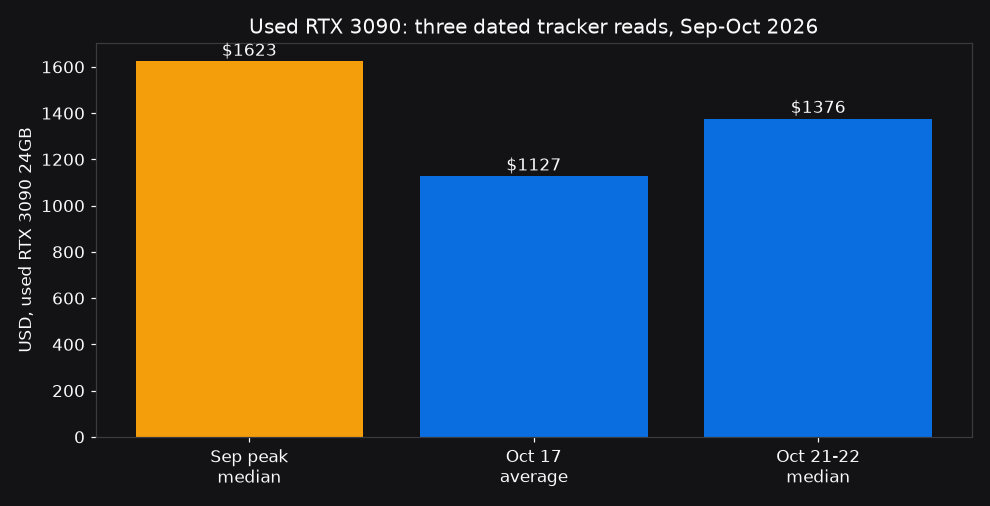
| pcprice.watch median | $1,376 (typical $1,275–1,494, n=235, 90d) | eBay sold | Oct 22 |
| GetPCParts average | $1,127 | eBay sold | Oct 17 |
| InsiderLLM band | $1,400–1,550 (n=161) | eBay sold | Oct 15 |
| localrig median | $1,499 (band $1,329–1,599) | eBay sold | Oct 6 |
| September peak | $1,623 | eBay sold | Sep |
Direction matters more than any point: up 4% on the week, down 9% from the September peak. Set alerts near the bottom of the band and refuse to chase the top — $1,550 for a four-year-old card with no warranty is peak money.
Dollars per gigabyte
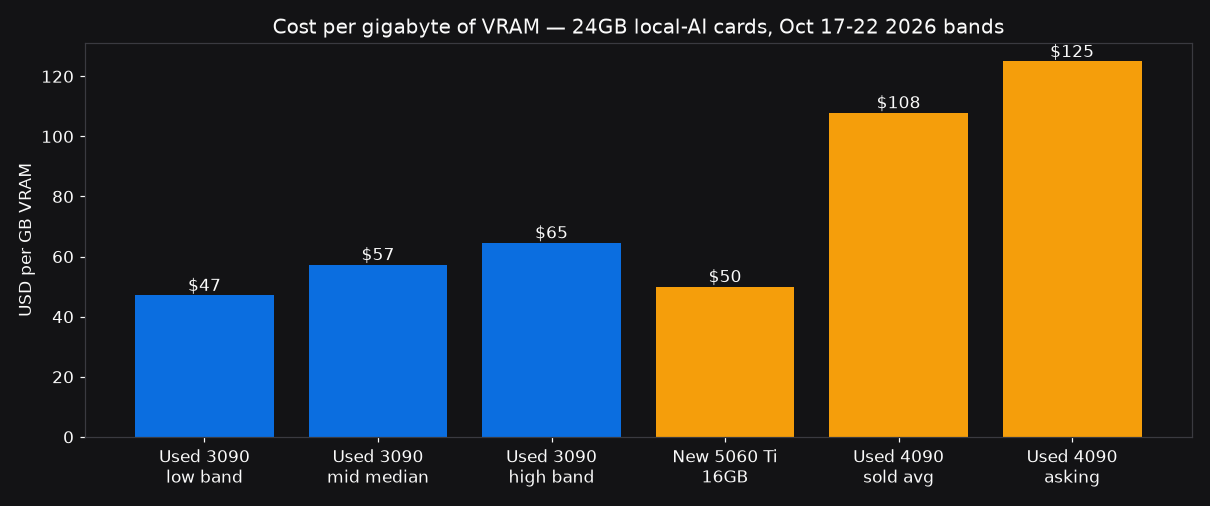
This is the chart that ends the debate. At 24GB, the 3090's band works out to $47–65 per gigabyte. The 4090's sold average is $108 per gigabyte and its asking price $125 — same ceiling, roughly double the money per gigabyte. A new 16GB card at $800 lands at $50 per gigabyte but caps you at 16GB, which is a different hobby: fine for 13–14B quants, not the room for 27–32B.
3090 vs 4090, honestly
The 4090 is the faster card and nobody disputes it. But this guide is about capacity per dollar, and there the 4090 loses twice: it costs roughly twice the 3090's money for the same 24GB, and its pricing is violent — up nearly 17% one week after falling 14% across the month. Volatility is itself a finding: there is no timing the 4090, only paying it. The 3090's band is boring by comparison, and boring is what you want in a purchase.
One more gap worth knowing: asking prices sit about $400 above sold prices on the 4090 ($2,998 asking vs $2,589 sold). Sellers anchor high and the market clears lower, which means offers below ask are not insults — they are the market.
What 24GB actually fits
The brief that started this project targets Qwen-class 27–32B quants, and that is the honest use case: 24GB holds big quantized models that 16GB cards simply cannot load. Do not buy VRAM for gaming frame rates here — gaming rankings measure a different thing than inference capacity, and a cheaper 16GB card wins at raster while losing at the one job this card is for.
Power and fit: the hidden price
A 3090 is a 350W card that expects a serious power supply — budget a quality 750W-plus unit with the right 12-pin adapter or native cable, and verify your case swallows a triple-slot card before the box arrives. Undervolting and power limits are the usual homelab moves for a card that will run inference for hours, and they double as a health check: a card that crashes at stock but survives limited is telling you something. None of this is optional homework — a $1,300 GPU on a $60 PSU is a $1,360 mistake.
Buy like an inspector
Used-market hygiene from the trends research, condensed: completed-sale medians are value, asking prices are hope — never confuse them. Demand temperature readings and repaste or pad history, since GDDR6X runs hot and miners ran these cards hard. Confirm the exact SKU in photos (3090 vs 3090 Ti share a name the way trouble shares a room). Stress-test on arrival with a VRAM-heavy workload before the return window closes. Prefer domestic sellers with free returns, pay with buyer protection, and walk away from anything near the top of the band — patience is the whole strategy at $1,500.
Fine print
All figures above are research-level: dated third-party tracker reads and deal-press reports from October 6–22, not checkout-verified listings — seller identity, shipping, tax, and live stock were not confirmed. Trackers disagree on levels because their methods and windows differ, so this guide reports bands with dates and never blends them into false precision. No sales-volume data, no timing calls, no price predictions. Last checked October 22, 2026 — recheck before spending a dollar.
Sources
- pcprice.watch RTX 3090 tracker — $1,376 median, Oct 22
- GetPCParts RTX 3090 used value — $1,127 avg, Oct 17
- localrig used 3090 guide — $1,499 median, Oct 6
- GetPCParts RTX 4090 used value — $2,589 sold avg, Oct 17
Findings follow Savy's October 20–22 trends research; the prose, tables, and charts here are original to this page. Research-level figures — re-verify every price at checkout.