Qwen 4 27B: What to Expect (Ledger + Landing Checklist)

This guide is a companion to Qwen 4 27B: What to Expect (Ledger + Landing Checklist), and the video is the starting point for everything below. The draft is grounded in the project research folder for this video, which holds the narration scripts plus a ledger separating tested numbers from hedged ones, checked against the official sources linked below. Watch the video first for the narrated run-through. Video claims and added research are labeled throughout, rumor-tier material is marked as such, and anything not verified here is marked untested rather than stated as fact.
The confirmed record is very short
- In the video: every claim lands in one of three buckets: confirmed by a primary source, reported by credible press with no document, or unconfirmed from a single account.
- In the video: as of October 22nd there is no Qwen 4 anywhere, verified with a live API query against the Qwen organization on Hugging Face searching Qwen 4, with zero results and the newest org repos an image model from October 9th plus the Qwen 3.8 family.
- Added from the sources: a fresh API check of the Qwen organization for this guide on October 22nd also returns zero hits for Qwen 4, with the most recently modified repos image and guard models, so the video core claim still holds and any benchmark numbers for a Qwen 4 27B remain invented until a file lands.
- In the video: three passes on October 16th, 18th, and 21st found nothing on Hugging Face, ModelScope, or the model studio changelog either.
- In the video: all Alibaba actually said is one slide on September 22nd at Apsara: Qwen 4 series coming soon, with four names, Max, Flash, Plus, and 27B, plus a three-word written line that Qwen 4 is in training, and that is the entire confirmed record with no date, specs, price, license, or benchmarks.
- In the video: positioning comes from reporters in the room, where Max is the capability ceiling, Flash and Plus trade price for efficiency, and 27B is the one built for local deployment, while the two October 10th developer posts name no model and no date, so reading small as 27B is the community inference, not their statement.
- In the video: the viral leak claims of Frontier-beating scores with 27B first trace to one account with no source and no samples, so every date and benchmark seen so far is a guess wearing a fact clothes.
Reported, not proven: the Apsara numbers
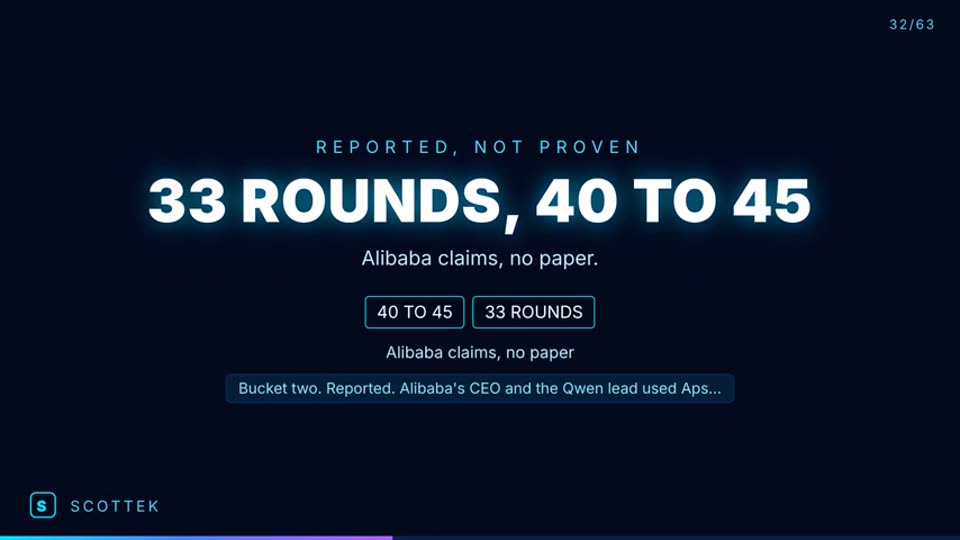
- In the video: Alibaba executives described how 3.8 got built with 33 automated cycles across a month, an Artificial Analysis score moving from 40 to 45 at about 12.5 percent, 60 hours and 10,000 EDA calls cutting one bus module area by 42 percent, and one inference stack gaining 96 percent throughput.
- In the video: there is no paper, no methods, and no technical report, and the zero-human-participation line was softened on stage by Qwen own engineer, so the honest phrasing is Alibaba claims rather than Alibaba demonstrated.
- In the video: the live Artificial Analysis index is version 4.3.2 and was rebased, so old scores do not compare and anyone quoting 12-point gaps from the old index is reading stale numbers.
- In the video: the current rungs that matter for a 27B are Qwen 3.8 27B at 33.7, DeepSeek V4 Pro at 36, Xiaomi MiMo Flash at 37.9, Flash Next class models near 40, Kimi K3 around 44, DeepSeek V4.1 Flash at 45.1, Qwen 3.8 Max at 45.4, and Xiaomi MiMo Pro topping open weights at 46.3, leaving about 13 points from today 27B to the top.
- Added from the sources: the current board is the Artificial Analysis leaderboard, and the rebasing warning above means never compare a future Qwen 4 score to anything measured before the rebase.
What the preview model card does confirm
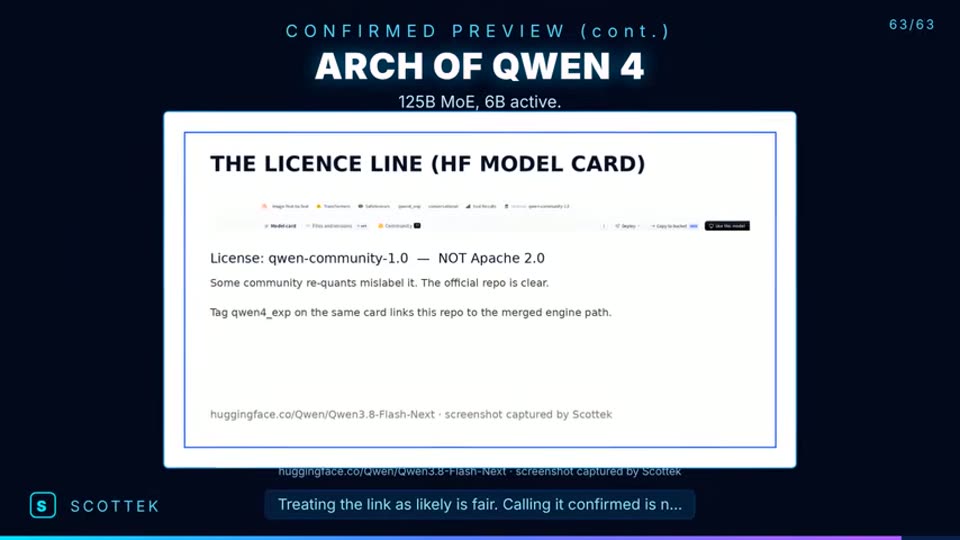
- In the video: Flash Next shipped in August and its own model card calls it an experimental preview of the architecture underpinning Qwen 4, at 125 billion parameters as a mixture of experts with 6 billion active per token, 48 layers, 512 experts, a 51-billion-parameter engram table beside the transformer, a 4-billion-parameter prediction head, and 262,000 tokens of native context extendable to a million.
- In the video: the license line matters because the card reads Qwen community license 1.0 rather than Apache 2.0, some community requants mislabel it, and if the 27B follows its preview instead of the 3.8 27B Apache license then commercial use terms change, which nobody can answer until the model card lands.
- Added from the sources: the card to watch is Qwen3.8-Flash-Next on the Qwen organization page, including the
qwen4_exptag the video shows linking that repo to the merged engine path. - In the video: the careful part is that Qwen never said the 27B uses this design, so treating the link as likely is fair while calling it confirmed is not, and if the 27B inherits that engram table then about 29 extra gigabytes must live somewhere, possibly memory-mapped on an SSD with only the transformer resident.
- In the video: the serving stack for this architecture is already merged, with vLLM base support landed and shipped across recent releases, transformers carrying the architecture module since late August, llama.cpp support merged August 27th, and community quants already existing, so current nightly builds would load it on day zero if it ships on this architecture.
- Added from the sources: the projects to track for that support are vLLM, transformers, and llama.cpp, and nightly-build behavior is untested here, so verify versions on landing day rather than trusting this snapshot.
- Untested here: the merged-path loading claim above is video-reported and not reproduced in this guide.
Hardware math, card picks, and the cloud alternative
- In the video: think of a 24 GB card as a suitcase, where the standard 4-bit build is 17.11 GB before typing a word and the rest is conversation memory at about 4.25 GB for 128,000 tokens with an 8-bit cache, landing near 21 GB total, so the suitcase closes and the over-24 claim is only true with a full-precision cache that doubles that memory.
- In the video: for 16 GB cards a 3-bit build near 11 GB is the comfortable pick with a few percent quality slip, while 12 GB evidence conflicts and stays unproven.
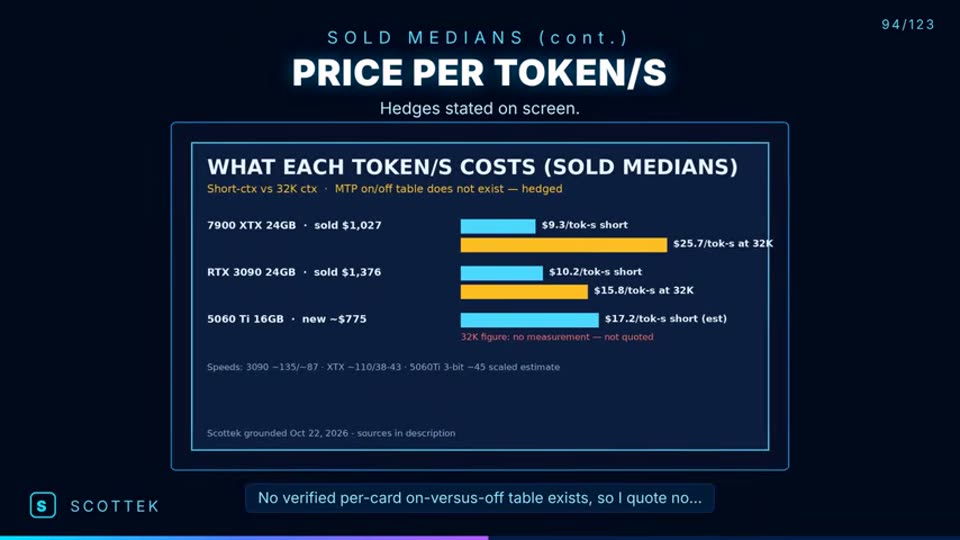
- In the video: sold medians rather than asking prices put the used 7900 XTX 24 GB near $1,027, the used RTX 3090 24 GB near $1,376, and the new 5060 Ti 16 GB around $760 to $790 at about 77 percent over its $429 print, all checked October 22nd and moving weekly, so recheck solds before acting.
- In the video: speeds with context lengths attached run roughly 135 tokens a second short and near 87 at 32K on the 3090, roughly 110 short and high-30s to low-40s at 32K on the XTX under ROCm, and near 45 on the 5060 Ti 3-bit figure as a scaled estimate rather than a measurement, with no verified per-card on-versus-off table quoted.
- In the video: the consumer AMD path is llama.cpp or Ollama on Linux with weaker long-prompt prefill and version-sensitive setup, since the official AMD server path covers data-center cards only.
- In the video: the cloud alternative is hosted Qwen-class models near 12 cents in and 50 cents out per million tokens, where a moderate day under $2 pays a $1,000 card back in about 500 days while a heavy agent day near $7.60 pays it back in roughly 130 days, so sustained heavy use inside one model generation favors buying while bursts belong to the cloud.
- Untested here as benchmarks or live prices: every speed, VRAM load, and dollar figure above is video-reported rather than reproduced for this guide.
Landing-day checklist and verdict
- In the video: run these five checks in order on landing morning: is the Hugging Face search still empty, Apache or community license, does it load on the merged
qwen4_exppath or something new, where does it score against the 33.7 rung and at what context, and is that score on the current 4.3.2 index rather than the old one. - In the video: timing has a pattern worth watching, with the 3.6 27B landing April 22nd and 3.8 following August 14th exactly 114 days later while cloud launches precede open weights by about 11 days, so watch the cloud headline and count days rather than weeks.
- In the video: the verdict is that running the 27B today means buying the 24 GB card now with the XTX near $1,027 as the value pick unless CUDA is needed, while waiting only for Qwen 4 means renting the cloud until the files land because the license, the architecture, and the memory footprint are all unconfirmed.
- This article contains no affiliate links.