Proxmox Update Killed Your GPU? Fix NVIDIA DKMS + NovaCore in 10 Min

Companion guide and video starting point
This article is a companion to the video, not a replacement for it, and the video is the starting point for everything below.
In the video: a Proxmox 9 kernel update leaves the NVIDIA GPU gone after reboot, with no nvidia-smi output and containers failing to start, and the fix is framed as one ten-minute session covering two root causes, a DKMS module that never rebuilt and a new open module called NovaCore that claims the card before the NVIDIA driver loads.
Added from the sources: the fix path traces to solved Proxmox forum threads, principally the SOLVED 9.2.2 NovaCore thread on kernel 7.0.2-6-pve with a second SOLVED 9.2.4 Quadro P2000 thread of the same shape surfaced on the NVIDIA GPU tag page. YouTube auto-subtitles returned HTTP 429 on retry, so captions are stated as unavailable and the Prag script.md narration is used as the transcript-equivalent, and the terminal sessions in the video are dramatized illustrations of the real thread commands per the session QC report, so every hands-on step below is untested here.
Diagnose first: which failure is yours
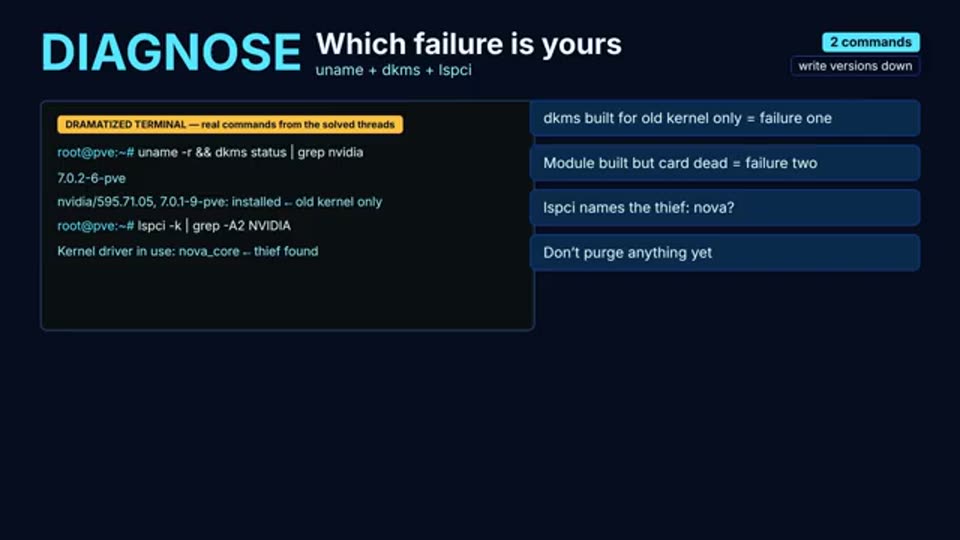
In the video: never fix blind, because two commands reveal which of the two failures you have, starting with uname -r for the running kernel and dkms status for which driver versions are built and for which kernels, plus an lspci check piped to grep that shows the card's kernel driver in use.
Added from the sources: the SOLVED 9.2.2 thread gives the exact decision rule, where a dkms status line showing the driver installed for an older kernel but nothing for the running one means the module never rebuilt, while a correctly built module plus a still-dead card points at something else claiming the card. The thread's own journalctl signature for the second failure is an NVRM line reporting the GPU as already bound to NovaCore with the probe routine never called, and the author describes Nova as the new open-source Rust-based kernel driver succeeding Nouveau on modern GSP-firmware GPUs. If the lspci driver-in-use line says nova, nova_core, or nouveau instead of nvidia, that is the thief, and the video's warning stands, so do not purge anything yet because both fixes are non-destructive and ripping out the driver mid-diagnosis turns ten minutes into a weekend, with all of this untested here.
Fix one: headers plus DKMS rebuild
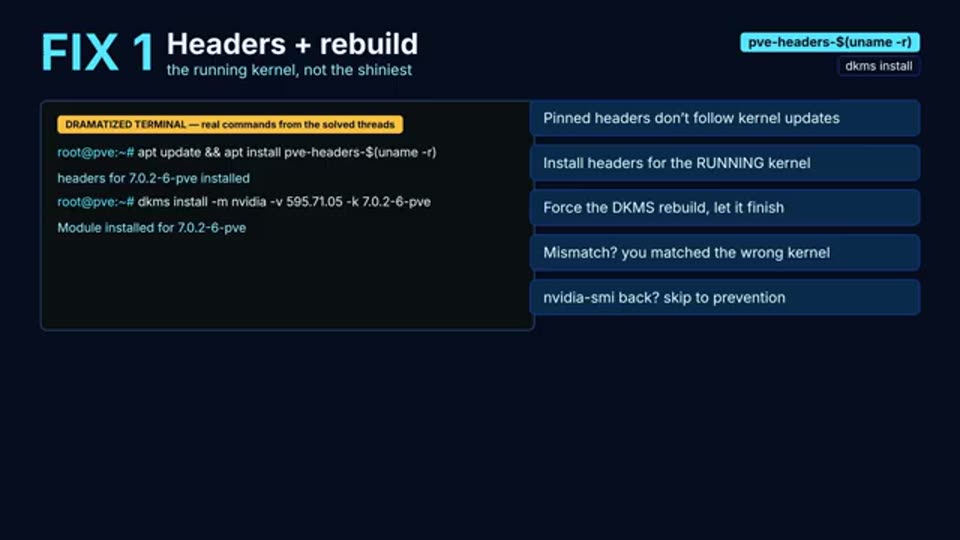
In the video: failure one is usually self-inflicted version-pinned headers, where the driver was installed against headers for one specific kernel and the next kernel update left DKMS with nothing to compile against, so the cure is updating apt, installing pve-headers for the RUNNING kernel from your notes, and forcing the rebuild with the driver version and kernel version from your notes, with dpkg-reconfigure nvidia-kernel-dkms named as the Debian-tooling equivalent and dkms status as the confirmation that the driver shows installed for the running kernel.
Added from the sources: the SOLVED 9.2.2 thread shows the concrete pair as apt install pve-headers-$(uname -r) followed by dkms install -m nvidia -v 595.71.05 -k 7.0.2-6-pve, where the driver and kernel versions are that thread's examples and you must substitute your own from dkms status and uname -r. The general mechanism is corroborated beyond Proxmox, since the NVIDIA driver FAQ states that kernel updates frequently arrive without matching headers and that manually invoking the dkms build and install commands before rebooting is the standard recovery, and the ArchWiki DKMS page documents dkms status and dkms install -m with the same headers-must-match-the-kernel requirement. If the build itself errors, read it before retrying, because nine times out of ten it reports missing headers for the booted kernel rather than the newest installed one after an update, and if nvidia-smi now shows the card, skip to prevention, with the rebuild untested here.
Fix two: blacklist NovaCore and rebuild initramfs
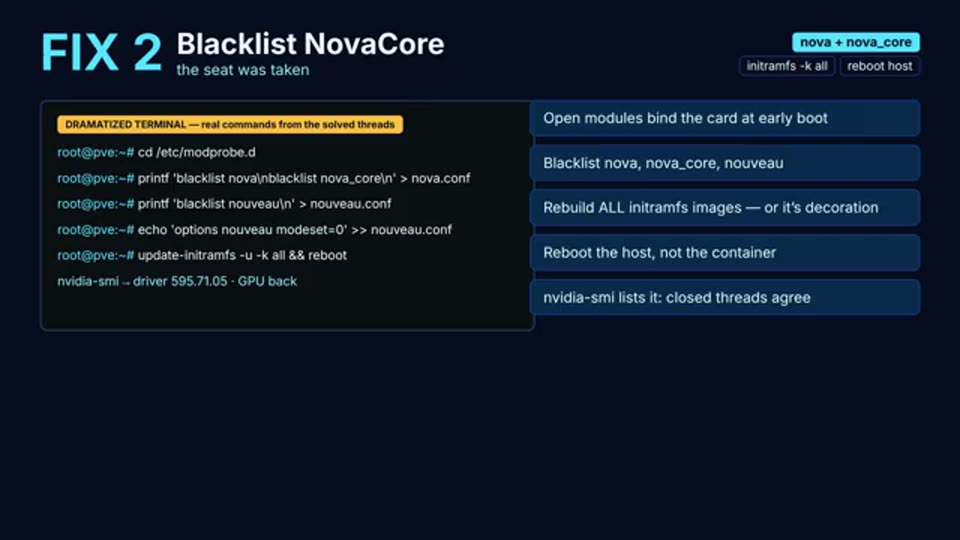
In the video: if the module built fine for the running kernel and the card still will not attach, the seat is taken, because an open module binds the card during early boot before the proprietary driver loads, so the fix is a modprobe blacklist file covering nova, nova_core, and nouveau with modeset zero, then rebuilding the initramfs for ALL kernels, then rebooting the whole host rather than any container.
Added from the sources: the SOLVED 9.2.2 thread lists the five appended lines as blacklist nova plus blacklist nova_core plus options nova modeset=0 plus blacklist nouveau plus options nouveau modeset=0 in a modprobe blacklist conf, noting that existing nouveau entries only need the nova lines added, and the final thread edit aligns the location with the official Proxmox blacklisting pattern after starting in an nvidia.conf file. That official pattern per the Proxmox PCI passthrough wiki is appending blacklist lines to a file under /etc/modprobe.d/ followed by a reboot, while the NVIDIA README on nouveau conflicts documents the blacklist nouveau plus options nouveau modeset=0 pair and explains that blacklists baked into the early-boot image require rebuilding the initrd, which grounds the video's most-forgotten step. After the host returns, nvidia-smi should list the card and lspci should show the driver in use as nvidia.
Destructive-operation warning: everything in this section touches host boot configuration, since a wrong modprobe file, a skipped initramfs rebuild, or the mandatory host reboot can leave the GPU or the host itself unreachable until fixed at the console, so confirm you have host shell access and re-read each line before running it, with all steps untested here.
- Append the five blacklist lines to the modprobe blacklist conf and rebuild with
update-initramfs -u -k all, thenrebootthe host and validate withnvidia-smi.
Never again: the meta-package plus validation
In the video: one package prevents the sequel, namely installing pve-headers as the meta-package with no version suffix so every new PVE kernel pulls its headers automatically, then verifying DKMS tracks the driver and glancing at dkms status after each kernel update before panicking.
Added from the sources: the prevention claim is corroborated twice on the Proxmox forum, first by the drivers-not-surviving-kernel-update thread, whose accepted guidance is that headers are not installed with kernel updates unless the meta-package is present and that apt install pve-headers is the piece making DKMS rebuilds survive updates without manual intervention, and second by a follow-up comment on the SOLVED 9.2.2 thread recommending the proxmox-default-headers meta-package alongside the running-kernel headers plus dpkg-reconfigure nvidia-kernel-dkms as the forced-rebuild alternative. The recap stands as diagnose with uname -r and dkms status, rebuild against the running kernel's headers, blacklist the open modules, rebuild all initramfs images, reboot, validate with nvidia-smi, and pin the meta-package, at a cost of ten minutes and one reboot, all untested here.
Sources
- SOLVED fix thread for NVIDIA drivers on Proxmox 9.2.2 with NovaCore conflict
- Proxmox forum thread on NVIDIA drivers not surviving kernel updates
- Proxmox forum NVIDIA GPU tag page
- Proxmox PCI passthrough wiki on blacklisting drivers
- NVIDIA README on nouveau conflicts and initrd handling
- NVIDIA driver installation FAQ on post-update DKMS recovery
- ArchWiki Dynamic Kernel Module Support