DeepSeek V4.1-Flash-1017: Frontier Agents, MIT Weights

This companion guide starts from the video DeepSeek V4.1-Flash-1017: Frontier Agents, MIT Weights and adds grounded detail from the DeepSeek changelog, the Hugging Face repos, and the launch discussion. Watch the video first for the full narrated walkthrough, then use the sections below as the written reference. This guide keeps In the video: claims apart from Added from the sources: research, and every benchmark number below is vendor-run on DeepSeek's own harness, never an independent measurement.
What 1017 actually is
- In the video: DeepSeek released V4.1-Flash-1017 on October 17th as a refreshed post-training checkpoint of September's V4.1 Flash, with the same model ID, the same pricing, and the same 1-million-token context.
- Added from the sources: the DeepSeek changelog confirms the October 17th entry with the full bench table, checked October 2026.
- In the video: DeepSeek claims better scores nearly everywhere while writing shorter answers, and all benchmark numbers in the video are vendor-run with nobody outside the company having measured the new weights yet.
- Added from the sources: the web and app models were updated to the new checkpoint at the same time, per the changelog entry, checked October 2026.
Vendor-run benchmark deltas
- In the video: on Terminal-Bench 4.0, run under a Claude Code harness, the vendor-reported score jumps from 31.2 to 42.3, and these are DeepSeek's own numbers, not independent results.
- In the video: ProgramBench nearly doubles from 20.3 to 29.1 vendor-reported, and DeepSWE gains about three points to 77, with automation, NL2Repo, chartography, baby vision, and ZeroBench all moving up.
- Added from the sources: the changelog table gives the fuller vendor-run picture, with DeepSWE v1.1 moving 74.2 to 77.0, NL2Repo 65.4 to 68.2, Automation-Bench 54.8 to 60.5, Agents Last Exam 31.8 to 35.4, Chartography with tools 78.9 to 83.0, BabyVision with tools 89.6 to 92.5, ZeroBench-main with tools 49.0 to 51.0, plus new readings for Apex at 72.1 and HLE without tools at 42.6, all checked October 2026.
- Added from the sources: DeepSeek claims shorter outputs and faster task completion, framed as a better performance-per-cost shape, and says the checkpoint is optimized for its own harness, Tencent CodeBuddy, and WorkBuddy, per the changelog, checked October 2026.
- In the video: the presenter treats every chart, including the video's own, as a press release with nice fonts until independent harnesses publish, and this guide does the same.
Why it is cheap to run
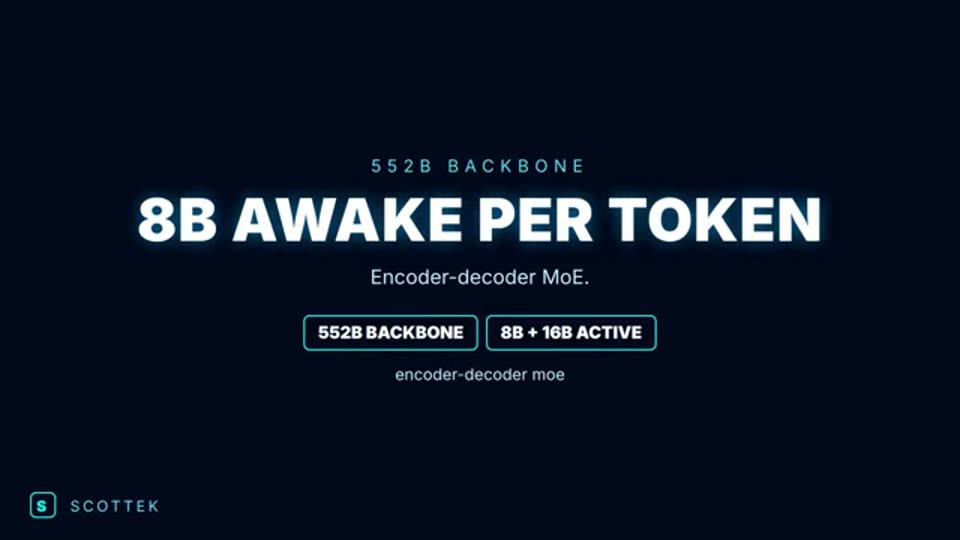
- In the video: the backbone is 552 billion parameters built as a causal encoder-decoder, a 20-layer encoder feeding a 20-layer decoder, with only 8 billion parameters active per token on input and 16 billion on decode.
- In the video: the mixture has 384 routed experts with six awake at a time, plus sparse attention, a 4-bit main key-value cache at under 900 bytes per token, and a 196-billion-parameter n-gram memory table, with thinking effort adjustable from low to max.
- Added from the sources: the architecture is unchanged from September and matches the tech report on key-value cache compression plus the model card, as summarized in the Local AI Zone deep dive and the Orcarouter leak writeup, checked October 2026.
- In the video: that sparse design is what makes million-token agent loops affordable, since agents that burn input tokens like furnace fuel only wake a fraction of the model per prefill token.
The honest hardware math
- In the video: the full MIT weight release is roughly 510 GB of safetensors, which is datacenter class, not a single-GPU download.
- In the video: community size estimates put a running footprint near 265 GB at 2-bit and 445 GB at 4-bit, with the smallest working full-weight setup reported as 496 GB of cards under vLLM with the engram tables offloaded to host RAM.
- Added from the sources: the official repo DeepSeek-V4.1-Flash-1017 is MIT licensed with dozens of safetensor shards totaling around 510 GB, and one aggregator page that still says the 1017 weights are not disclosed is stale, with the model timeline entry confirming the MIT release, checked October 2026.
- In the video: a single 24 GB card is not running this model, and anything in this guide about self-hosting the full weights is untested by the presenter and by this guide, so budget hundreds of gigabytes, not tens.
Path one is the API
- In the video: the API is the path DeepSeek actually wants users on, with the same model ID
deepseek-flashand the same rate card, where the V4 family bills peak and off-peak with off-peak at half price. - In the video: the API carries 1 million tokens of context with native image input and tool calling, and the refreshed checkpoint lands behind it with zero migration work.
- Added from the sources: the current rate card lives on the DeepSeek pricing page, and the changelog confirms the same-ID swap, checked October 2026.
- In the video: for agents that burn input tokens heavily, 8 active billion parameters per prefill token is exactly the cost shape to want, though this guide has not run billing tests itself, so treat the savings math as vendor-framed and untested.
Path two is Ollama Cloud
- In the video: the tag
deepseek-v4.1-flash:1017-cloudruns the new checkpoint on Ollama-managed hardware, with per-million-token pricing on the library page of 30 cents in and 1 dollar 20 out at peak, halved off-peak. - Added from the sources: the tag is listed on the Ollama library page, checked October 2026.
- In the video: the cloud tag plugs straight into agent harnesses like Claude Code, OpenCode, and Hermes-style agents, giving a local-feeling workflow with datacenter muscles.
- In the video: nothing in the video demonstrates a live run of this tag, and this guide has not tested it either, so treat setup smoothness as untested.
Path three is community GGUFs, with a flashing caveat
- In the video: day-one quants exist under the mrfakename account, MIT licensed, with familiar one-liners for Ollama and llama dot cpp documented on the repo.
- Added from the sources: the quant repo is mrfakename DeepSeek-V4.1-Flash-1017-GGUF, checked October 2026.
- In the video: as of the recording, those quants only load in llama dot cpp's unmerged v4.1 development branch, and that branch cannot convert the vision part yet, so text only.
- Added from the sources: Unsloth shipped polished quants for the earlier July build within days, so their changelog is the place to watch for 1017 before committing disk space, checked October 2026.
- In the video: pulling these GGUFs means living on a pull request, so self-hosters on principle should wait for merged llama dot cpp support and finished quants, while tinkerers can treat the text-only branch builds as a fine weekend experiment, all untested by this guide.
Same-day side quest is Search plus Fetch
- In the video: DeepSeek opened its in-house Search and Fetch API the same day, its own engine handling hundreds of millions of requests a day over hundreds of billions of pages, with spam, manipulation, and AI slop filtering, plus Fetch for pulling page content straight into an agent loop.
- Added from the sources: the feature is documented in the Search API guide, checked October 2026.
- In the video: for homelab agents that do research, this is a cheap purpose-built alternative to gluing a search engine onto a pipeline by hand, though this guide has not tested the endpoints.
Reception and the honesty angle
- In the video: the launch thread front-paged on Hacker News, with the top comment noting it beats a much pricier competitor on 10 of 11 coding benches, which are vendor numbers again, so salt accordingly.
- Added from the sources: the main thread is this Hacker News discussion, checked October 2026.
- In the video: the sharpest observation in the thread is the honest one, that nobody outside DeepSeek has measured the new weights at all, and until independent harnesses publish, every chart is a press release with nice fonts.
- Added from the sources: the Orcarouter writeup likewise notes that no outside measurement of the new weights existed at launch time, checked October 2026.
What to actually do
- In the video: if agent work ships tonight, point at
deepseek-flashor the Ollama Cloud 1017 tag and enjoy the cheaper cost curve. - In the video: self-hosters on principle should wait for merged llama dot cpp support and Unsloth quants, and budget real RAM in the hundreds of gigabytes, not tens.
- In the video: tinkerers can try the text-only branch GGUFs as a weekend experiment, matching the path to their hopes.
- In the video: the verdict is that this is the best kind of release, with better scores, lower cost per task, the same price, open MIT weights, and zero migration, while the full model was and remains datacenter class, so the story for homelab users is sharper API and cloud paths with weights that stay free.
Sources
- Watch DeepSeek V4.1-Flash-1017: Frontier Agents, MIT Weights
- DeepSeek API changelog, October 17th 1017 entry
- DeepSeek pricing page for the deepseek-flash rate card
- DeepSeek Search API guide
- Official MIT weights on Hugging Face
- Community GGUF quants by mrfakename
- Ollama Cloud 1017 tag library page
- Hacker News launch discussion
- Orcarouter V4.1 Flash writeup
- Local AI Zone 1017 deep dive
- AI model timeline 1017 entry
- Unsloth changelog for quant availability