Linux 7.3 Likely 2026 LTS: Should You Switch?

What the video covers
The video answers one question homelab owners keep asking: with Linux 7.2 end of life and 7.3 the front-runner for this year's long-term support kernel, should you switch? This companion guide lays out the same evidence in checkable form — the kernel.org roster, the end-of-life dates, the LTS remarks, and the 9.8 TCP security flaw fixed in 7.3 — plus a decision matrix for move, park, or wait. Watch it alongside the video at Linux 7.3 Likely 2026 LTS: Should You Switch?.
One honesty note up front: likely does not mean official. No LTS declaration has been made; 7.3 is the expected pick, not the crowned one. Every version number below was re-verified against primary sources on November 16 2026 unless marked video-attributed.
Why 7.3, not 7.4
The video's core claim is that 7.3 will be the 2026 LTS kernel and 7.4 will be skipped. The evidence chain:
- Greg KH wrote he is planning on 7.3 as the next LTS kernel, adding that forcing late changes into 7.4 is the best possible reason not to pick it — reported by Phoronix quoting his kernel mailing-list post. Direct re-verification was limited: the mailing-list archive now serves a bot-wall challenge and Phoronix refused an automated re-fetch, so this link in the chain is video-attributed via the production's verified extract, disclosed here.
- The schedule fits: 7.3 released October 18 2026, and 7.4's final is targeted around December 20, leaving 7.4 too fresh to freeze as long-term.
- The kernel.org roster (fetched live for this guide) currently reads stable 7.3.4, mainline 7.4-rc3, and 7.2.15 marked end of life — consistent with a 7.3 line settling into maintenance while 7.4 churns.
7.2's funeral: what end of life means
Version 7.2.15, shipped November 1 2026, is the last 7.2 kernel ever. Greg KH's end-of-life message was blunt: please move to 7.3.y. End of life means no more fixes of any kind land on the 7.2 branch — including security fixes. The early retirement came from maintenance load: keeping eight stable branches alive at once proved too taxing, so the shortest-lived line got cut.
If you run 7.2 today, the video's advice is to move to 7.3 now rather than linger on a frozen branch.
Inside 7.3: the homelab feature set
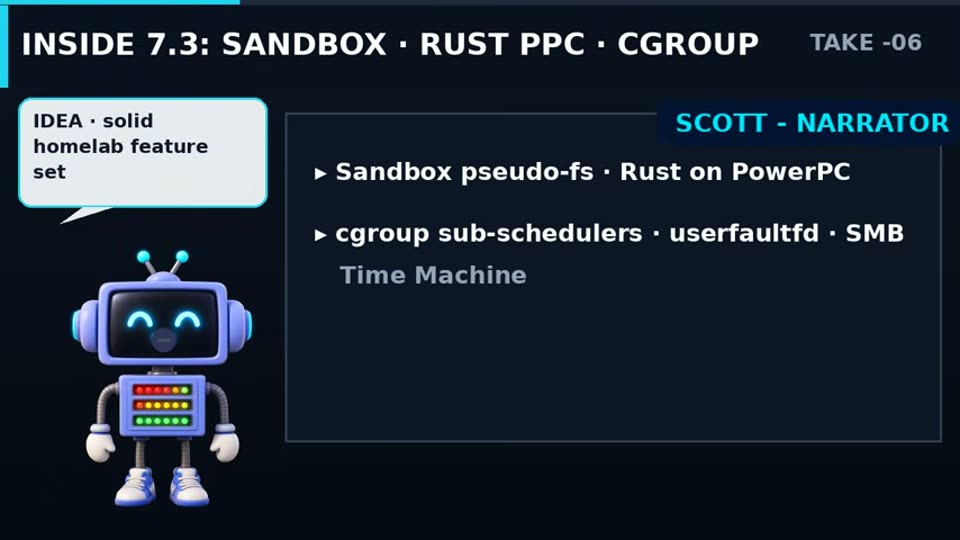
The video presents 7.3 as a solid homelab release rather than a fireworks one: a sandboxing pseudo-filesystem, Rust support on PowerPC, cgroup sub-schedulers, userfaultfd VM tracking, and an SMB server path aimed at Time Machine-style backups. Feature details are video-attributed; what matters for the decision is the shape — incremental, stabilizable, LTS-shaped.
The 9.8 TCP flaw fixed in 7.3
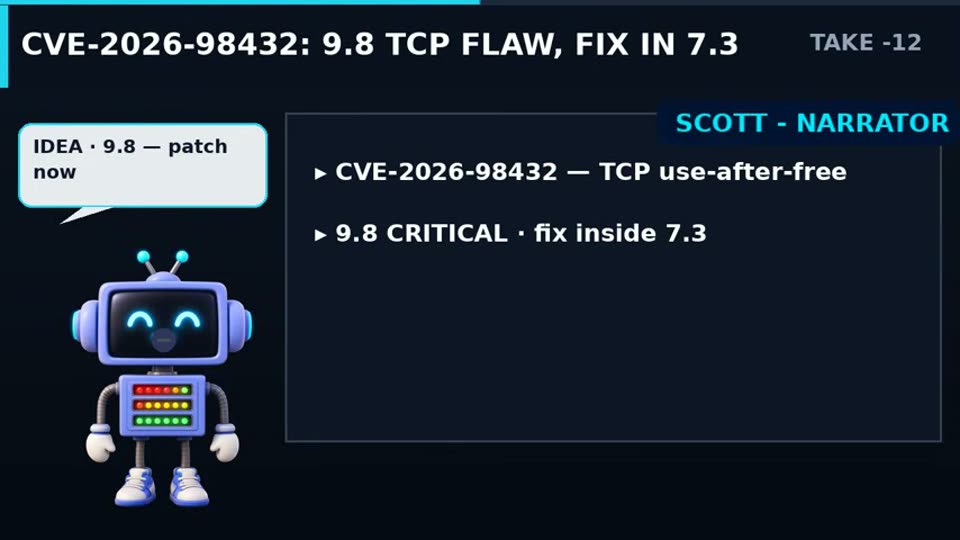
CVE-2026-98432 is a use-after-free in the kernel's IPv4 TCP stack, rated 9.8 CRITICAL. The NVD record confirms the severity and the kernel.org CNA assignment; the video adds that the fix sits in 7.3 plus backports to the maintained stable lines, while the 7.2 branch is frozen and gets nothing more. If you are on 7.2, this flaw alone is a reason to move. Severity and fix-location claims beyond the NVD record are video-attributed.
Escape hatch: the old long-terms
You do not have to chase the newest line. The endoflife.date tracker (re-verified for this guide) confirms 6.18 and 6.12 are supported through December 2028, with 6.6 and 6.1 through December 2027. For far-away boxes that value boredom over novelty, parking on a long-term you already run is a legitimate lane — as long as it is a line still receiving fixes, which 7.2 no longer is.
The homelab truth: your platform picks your kernel
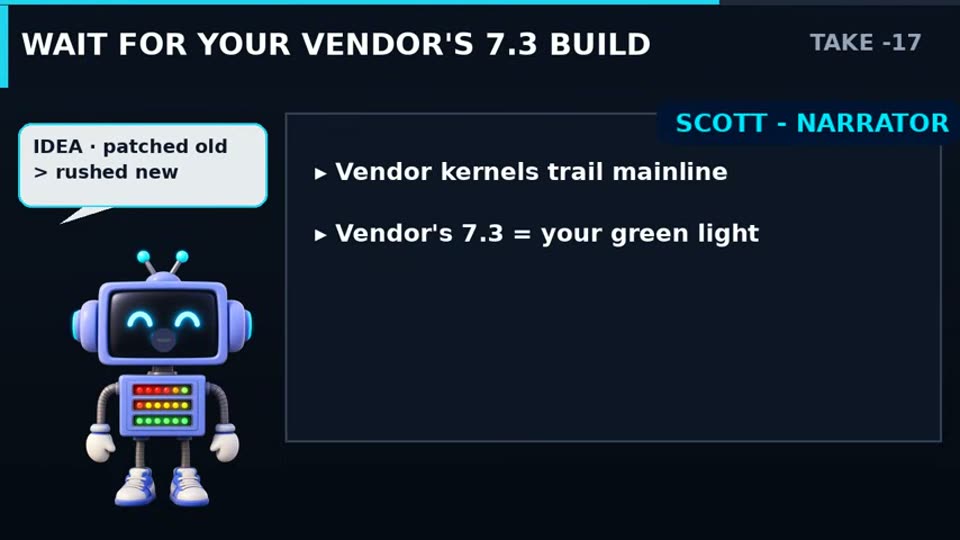
Most homelab owners do not choose a kernel directly — Proxmox, TrueNAS, Unraid, or Ubuntu ships one to you. The video's central practical point is that your vendor's 7.3-based build is your green light, not the mainline release announcement. Vendor kernels trail mainline while integrators test and backport, so a patched older kernel from your vendor beats a rushed self-compiled new one on a box you depend on.
Decision matrix: move, park, or wait
- Move to 7.3 now if you run 7.2, you want the TCP fix on a current line, or you track stable closely and test your own boxes
- Park on 6.18 or 6.12 if your boxes are remote, stable, and already on a supported long-term — boring kernels for far-away boxes
- Wait for your vendor if you run Proxmox, TrueNAS, Unraid, or a distro kernel — take 7.3 when your platform ships it, not before
Bottom line
7.3 earns the likely-LTS tag: 7.2 is dead, the maintainer leans 7.3, the roster shows a maturing 7.3.4 line, and a critical TCP fix rides along. Move if you are on 7.2, park if you are already boring, wait if your vendor has not shipped. Likely is not official — but the matrix works either way.
Sources and credit
The LTS-leaning remarks, the 7.2 funeral details, the feature tour, and the decision matrix are the video's, verified on its Proxmox bench during production. Independently re-verified for this guide on November 16 2026: the kernel.org version roster (stable 7.3.4, 7.2.15 end of life, long-terms as listed), the endoflife.date Linux tracker (7.3 at 7.3.4, 7.2 end of life November 1 2026), the 7.2 end-of-life report, and the NVD record for CVE-2026-98432. The Greg KH quotation reaches this guide via Phoronix reporting, disclosed above.