Step 5 Preview 600B: Can Your Homelab Run It?

This companion guide starts from the video Step 5 Preview 600B: Can Your Homelab Run It? and adds grounded detail from the StepFun model page, the Step 5 Preview BF16 model card, the model listing with API pricing, and the OpenRouter listing. Watch the video first for the full narrated reality check, then use the sections below as the written reference. The video is a narrated explainer with on-screen math rather than a filmed live install, so every section keeps In the video claims apart from Added from the sources research, and anything not run here is marked untested.
What Step 5 Preview actually is
- In the video: a sparse mixture of experts, 600 billion total parameters with only about 27 billion active per token, 92 layers narrow and deep, with hybrid attention reading a recent window plus selected older context. It stores like a 600B model but computes roughly like a 27B one, with up to a million tokens of context, text and images in, text out, recommended sampling at temperature 1.0, built for one job: long, tool-heavy agentic work, coding and finance especially.
- Added from the sources: the StepFun model page confirms the 600B total with 27B active, the 92-layer narrow-deep hybrid-attention shape, the up-to-1M context window, and the temperature 1.0 sampling recommendation, checked October 2026.
- Added from the sources: announced as API-only on September 20 with open weights following on October 15, per the video and the model page timeline, checked October 2026.
Scores with the label up front
- In the video: these are vendor-reported from StepFun's own page. DeepSWE 67.7 just ahead of Kimi K3, StepCodeBench 49, ProgramBench 80.5, GPQA Diamond 93.5 tied with Kimi. One weak spot, published to their credit: Terminal-Bench v4 at 33.3, well behind the frontier. Independent side: Artificial Analysis scores it 44 on its intelligence index, tying Kimi K3 and one point under GLM 5.3, though flagged as unusually verbose. Strong, uneven, and honest about the gap.
- Added from the sources: the StepFun model page publishes the same vendor-reported bench table including the Terminal-Bench v4 weak spot, checked October 2026. Treat every score as vendor-reported unless an independent rerun says otherwise.
The weights are real, and they are datacenter-sized
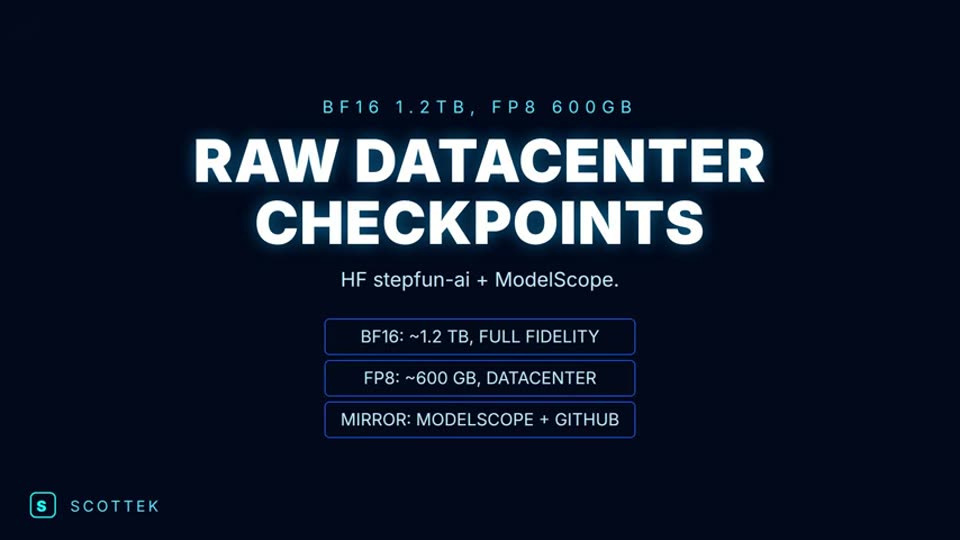
- In the video: BF16 and FP8 checkpoints sit under the official StepFun AI namespace on Hugging Face, mirrored on ModelScope and linked from StepFun's own GitHub repo. BF16 is the full-fidelity original at roughly 1.2TB, FP8 halves that to around 600GB. No official GGUF, no Unsloth release, and no Ollama path as of mid-October: raw datacenter checkpoints, and everything below eight H200s is the community's problem.
- Added from the sources: the BF16 model card confirms the official checkpoints with FP8 beside BF16, checked October 2026.
The license term that matters: not Apache 2.0
- In the video: this is not Apache 2.0. The weights ship under the StepFun Model License 1.0, an Apache-style license with extra conditions. The plain version: homelab and internal commercial use are unconditionally fine, quantize and modify all you like. The attribution clause only bites past 100 million monthly users or 20 million monthly revenue. Device makers and big model-as-a-service businesses need separate paper. And the one trap for tinkerers: a model distilled materially from Step 5 outputs inherits this license. Say it right: open weights, not fully open source.
- Added from the sources: the license distinction is confirmed across the research, with homelab and internal use unconditional, attribution thresholds at user and revenue scale, and the distillation-inherits condition called out as the clause tinkerers must read, checked October 2026. Read the actual license text before building anything commercial on these weights.
The VRAM math, and the official minimums
- In the video: memory is parameters times bytes each plus overhead. 600 billion times two bytes is about 1.2TB for BF16, one byte each is about 600GB for FP8, three-bit quant lands near 220GB, 1.6-bit near 120GB, then add 20 to 40 percent for KV cache, activations, and fragmentation, worse at long context. The official minimums land where the math says: BF16 wants eight B300s or sixteen H200s across two nodes, FP8 wants four B300s or eight H200s. One gaming GPU is not playing here.
- Added from the sources: the BF16 model card confirms the same deployment floors, BF16 at eight B300s or sixteen H200s and FP8 at four B300s or eight H200s, checked October 2026.
The serving shape: vLLM or SGLang on an OpenAI port
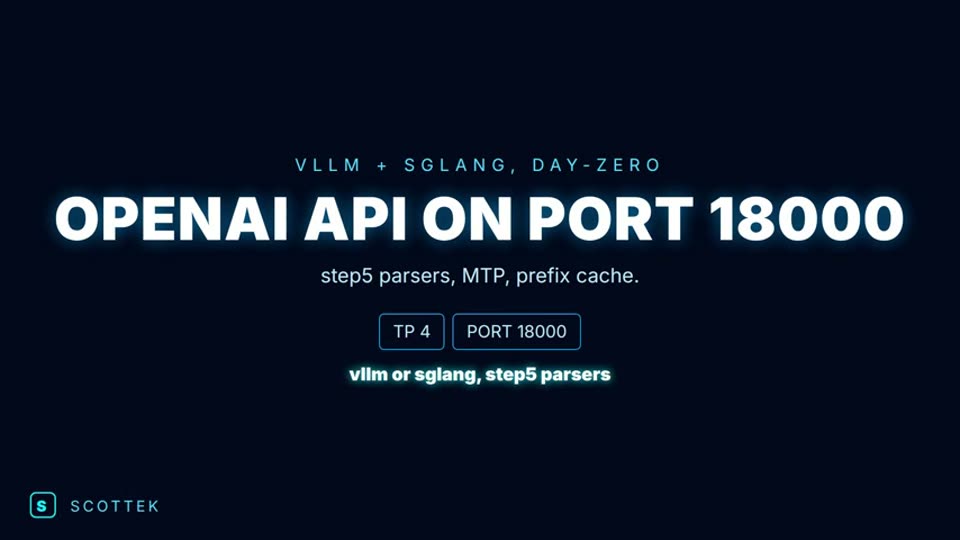
- In the video: both engines carry day-zero support. The documented recipe serves the FP8 checkpoint with tensor parallelism across the node, prefix caching, multi-token speculative decoding, and Step 5's own reasoning and tool-call parsers, exposed as an OpenAI-compatible API on port 18000 under vLLM, mirrored on port 30000 under SGLang. That is good news for one reason: anything speaking OpenAI's API, including an Open WebUI box, can point straight at it.
- Added from the sources: the BF16 model card confirms the vLLM and SGLang deployment tables with the step5 parsers and the OpenAI-compatible serving ports, checked October 2026.
- Untested here, so confirm the exact serving flags against the model card before committing hardware to them.
The one measured local run: four DGX Sparks
- In the video: the one real local run belongs to the community and is labeled as such, measured in early October on a pre-release checkpoint. Four NVIDIA DGX Sparks with 512GB of pooled memory served a 341GB EXL3 hybrid quant under vLLM: single-stream decode at 25 to 30 tokens per second, four streams pushing about 66 aggregate, a quarter-million tokens of context verified working though the full million survives on paper only, 12 to 13 minute load time, and a real deadlock bug surfaced with a one-line workaround on screen. Total hardware: about 18,800 dollars. That is the trade.
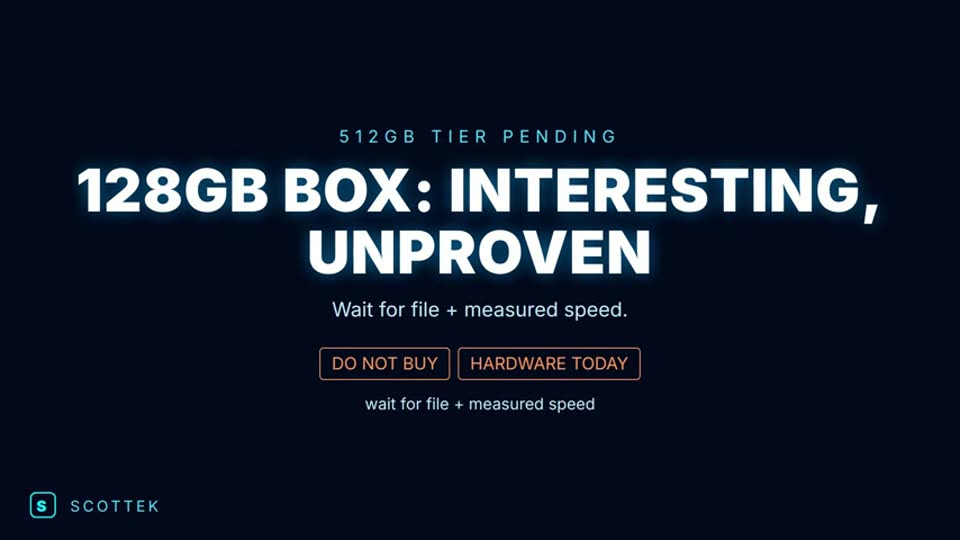
- In the video: the single-box story stays on paper. A 256GB Mac Studio at 9,499 dollars could hold the roughly 217GB Q2 quant with ceiling math suggesting 25 to 45 tokens per second, but nobody has published that run because the file is not publicly downloadable and there is no MLX port, while the 512GB tier that would hold a four-bit quant is not orderable yet. Genuinely interesting, entirely unverified: do not buy hardware for this model today. Wait for a downloadable quant with a measured speed, then decide.
- Added from the sources: no independent rerun of the community measurement was available at guide time, so treat the Spark figures as community-measured on a pre-release checkpoint, not as a reproducible recipe, checked October 2026.
The community quant path, with caveats taped on
- In the video: third-party GGUF conversions are appearing, including a Q3 quant near 220 to 260GB servable with llama.cpp shorthand or the Ollama community-quant runner as shown on screen. Three caveats stay taped to the monitor: these are unofficial builds, not StepFun releases; the vision encoder and draft heads have no runtime in llama.cpp, so they ride along as dead weight; and repos appear, move, and vanish weekly, so check the page tonight before planning a build around any single file.
- Untested here, and unofficial by definition, so verify the file hash, the repo, and a measured speed before downloading hundreds of gigabytes.
The verdict: three lanes
- In the video: lane one is use it tonight, the API at a dollar per million input tokens and 2.70 per million out with 10-cent cache reads, or the OpenRouter listing pointed at an agent harness. StepFun's own Step Code CLI is open source and installable with one curl pipe for the harness built around it. Lane two is the watch list: a reputable sub-2-bit GGUF with a measured speed would unlock 128GB single boxes. Lane three is the cluster: four Sparks and vLLM for buyers with the budget and the fabric. And on a 24GB card, stay on a smaller local model and revisit Step 5 when the quants mature.
- Added from the sources: the model listing confirms the API pricing and the 1M context with up to 64K output per response, and the OpenRouter listing confirms live API availability, checked October 2026. The Step Code harness page confirms the open-source agent CLI, checked October 2026. Prices shift, so verify before committing.
Cluster, single box, or API, which lane are you in? In the video: that is the comment question, and the closing terms are plain. Vendor benches are theirs, third-party numbers are labeled, prices shift, so verify before committing. Added from the sources: the model page, the BF16 model card, the pricing listing, and the OpenRouter page are all linked above. If this saved you eighteen grand, the number worth reporting back is your own measured tokens per second.