Arete-27B: De-Censored Open Weights, Verified Live (17GB Fits a 24GB Card)

This companion guide starts from the video Arete-27B: De-Censored Open Weights, Verified Live (17GB Fits a 24GB Card), uploaded 2026-11-19, and adds grounded detail from the research folder so you can decide before you download. Watch the video first for the full narrated walkthrough, then use the sections below as the written reference.
The video draws a hard line this guide keeps: the bench proves the files, the license, the sizes, and the VRAM math live on camera, while every quality number stays labeled as vendor-reported. Below, In the video marks what the video presents and Added from the sources marks what the research folder and the linked primaries add.
What changed and why it matters
- In the video: a lab took a 27B-parameter base model, post-trained it on about 53 million tokens, and cut state-framed answers from 22 percent to under 1 percent, releasing the weights, the training pairs, and the eval itself under a permissive license.
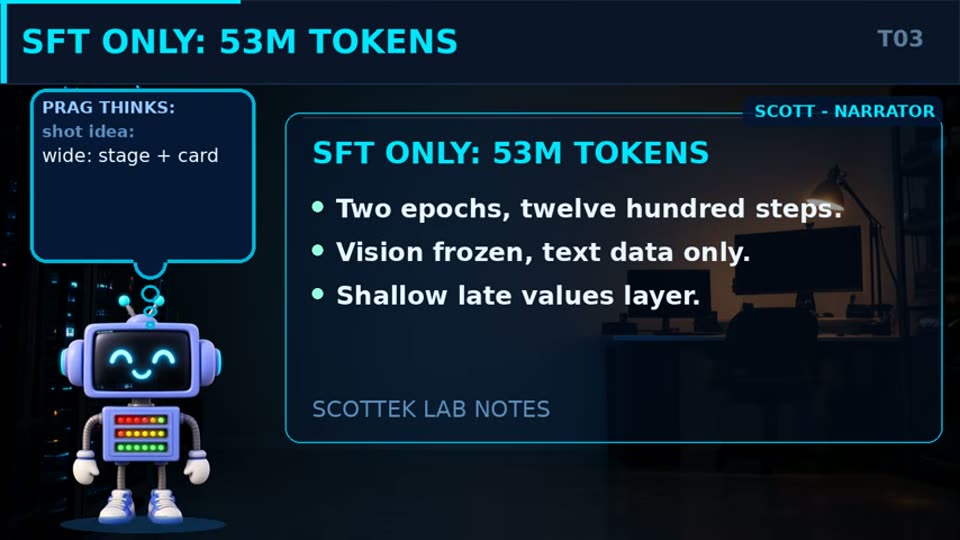
- In the video: the fix is supervised fine-tuning only, with no reinforcement learning, no preference tuning, and no architecture changes, run for two epochs at 64,000-token context with the vision encoder frozen because the data is text only.
- In the video: the lab's eval spans seven categories, free expression, state ideology, markets, education, privacy, democracy, and environment, with each prompt carrying two to four required facts graded by an automated judge.
- Added from the sources: the research folder records the eval as 803 prompts run five times per model, while the auto-caption transcript reads 83, so this guide uses the research figure and treats the captions as the noisier source.
- In the video: the reported results move the fact score from 2.32 to 2.98 and zero-score answers from 359 down to 216, with free expression moving most as its fact score rises from 0.89 to 2.44 and flagged answers fall from 60 percent to 1 percent, stable across five runs.
- Added from the sources: those quality numbers are vendor-reported with no outside review yet, so read them as the lab's claim rather than an independent finding.
- In the video: the context the headline skips is that 2.98 ranks midpack against the teacher model at 3.96 and a big European model at 3.65, with 216 answers still scoring zero, so this release is about framing rates rather than truth cards.
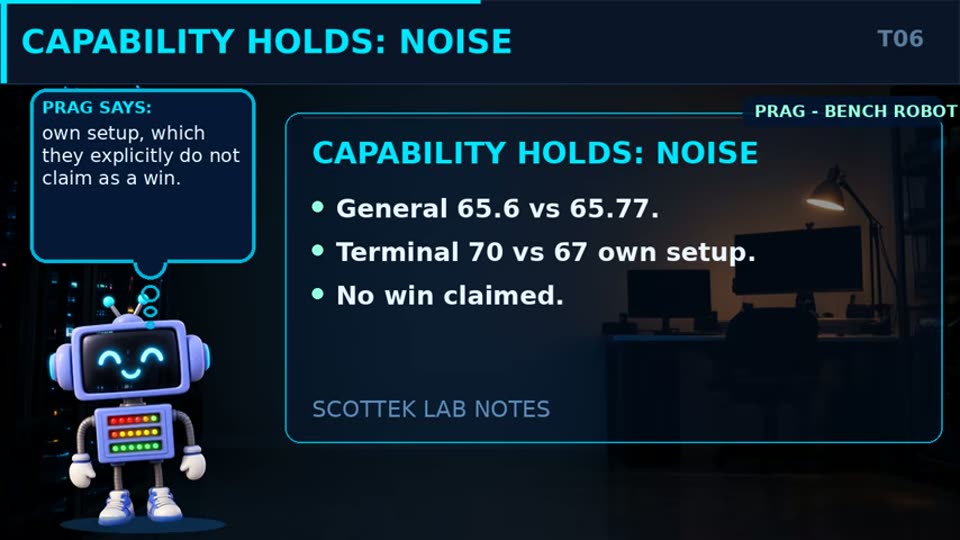
- In the video: recorded capability reportedly holds, with an internal general bench at 65.60 versus 65.77 described as noise and an agentic terminal bench at 70 versus 67 run in the lab's own setup and explicitly not claimed as a win.
- In the video: the lab's line is that values in an open model are one fine-tune away, and they shipped everything to check them, so anyone can run the eval questions on any checkpoint and publish, which makes reproducibility the actual story rather than any single score.
- In the video: the lab argues the values layer sits shallow and late, which is why a short fine-tune can move it at all.
- Added from the sources: the teacher model behind the supervised pairs is named Inkling, and the student keeps its general capability while shedding the framing.
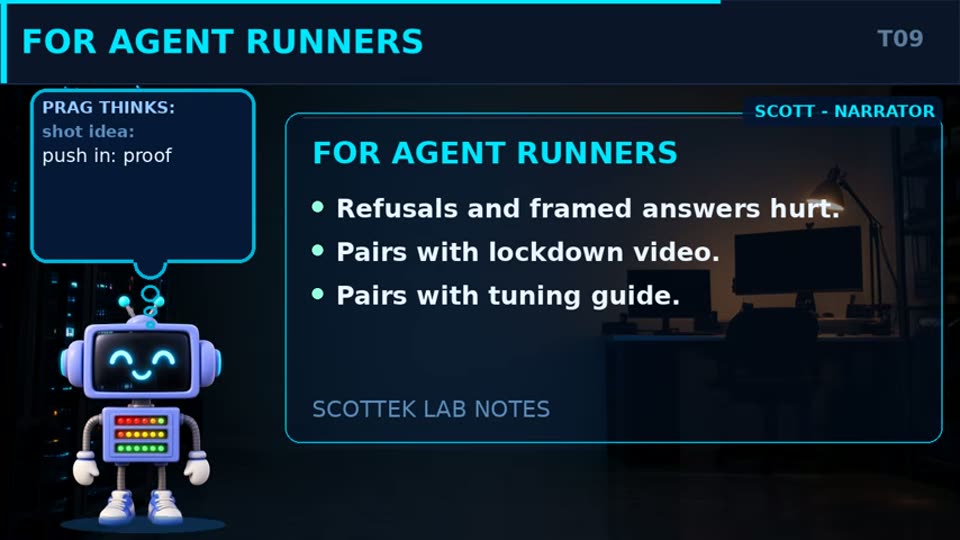
- Added from the sources: this release is aimed at builders running agents on open weights for whom refusals, deflections, and framed answers on sensitive topics are the daily problem, and it pairs with the channel's base-model lockdown guide and one-card speed-tuning guide whose links sit in the video description.
- In the video: the starting point matters too, since the base checkpoint scored 2.32 out of five with 22 percent of answers carrying the official line, which is the exact gap the post-train was built to close.
- Added from the sources: the training recipe is fully disclosed as supervised fine-tuning on 52.8 million tokens over two epochs and 1,202 steps with the vision encoder frozen, so there is no hidden reinforcement or preference stage to guess about.
How the eval grades answers
- In the video: each prompt carries two to four required facts, and the automated judge scores every answer on a fact scale from zero to five.
- Added from the sources: the grading is strict by design, since a single opposed fact zeroes the answer and a propaganda flag needs an exact quote rather than a vibe.
- Added from the sources: every model runs the eval five times with results stable inside a narrow band, and the training prompts were de-overlapped from the test set.
- Added from the sources: the judge itself is automated, which keeps the eval cheap and rerunnable but also means a judge you cannot inspect is doing the grading.
- In the video: free expression moved most, which makes sense, since the prompts that once triggered the heaviest framing had the most room to change.
- Added from the sources: read the eval as a framing detector rather than a knowledge test, since high scores mean fewer state-framed answers rather than deeper expertise.
- In the video: nothing about the eval stays hidden, since the questions, the grading approach, and the training pairs all ship open for anyone to rerun.
What the bench actually verified
- In the video: every claim in this section was verified live on the bench, and nothing beyond files, license, sizes, and math is claimed from the bench.
- Added from the sources: the full-precision weights live at NousResearch/Arete-27B under Apache 2.0, with 18
model-*.safetensorsshards totaling 54.71 GB, a 3.99 GB largest shard, and pinned commit108f0afbdcfaa1ceeda4a635004304dfff6d4da2last modified 2026-11-06. - Added from the sources: the community quants live at bartowski/NousResearch_Arete-27B-GGUF, also under Apache 2.0, with
Q4_K_Mat 17.20 GB,Q5_K_Mat 20.68 GB, andQ6_Kat 23.62 GB. - In the video: the 4-bit file at 17.2 GB fits a 24 GB card, which is the whole VRAM story, since the full-precision 54.7 GB file set does not belong on a single homelab card.
- In the video: the bench math is simple division, since 17.2 GB of weights plus runtime overhead still clears a 24 GB card while 54.7 GB never could.
- In the video: the sandbox disclosure is stated plainly on camera, since the bench host has no card big enough to load 17 GB, so no live inference was possible and none is claimed.
- Added from the sources: the documented pull path through Ollama is
ollama pull hf.co/bartowski/NousResearch_Arete-27B-GGUF:Q4_K_M, and both the pull and any run after it are untested here. - Added from the sources: plan VRAM before downloading tens of gigabytes, since
Q4_K_Mis the file in this set sized for a 24 GB card whileQ5_K_Mruns tighter andQ6_Kwants a bigger card. - In the video: the quant repo shows thousands of downloads, which signals interest rather than proving anything about quality.
- Added from the sources: community 4-bit speed-parity posts for small Mac-style machines are community-reported rather than bench findings, so treat them as leads rather than results.
- Added from the sources: the file tree holds 32 entries including the license at 11,544 bytes plus the readme, configs, and tokenizer files, so a complete pull is more than just the weight shards.
- Added from the sources: smaller community quants exist below the 17 GB file, including
Q3_K_Mat 13.17 GB, for cards with even less headroom, under the same Apache 2.0 terms. - Added from the sources: access is ungated and the repo is not private, so no request form stands between you and the files.
Run it on your homelab
- Decide first, since a 24 GB card plus agent workloads plus framed-answer pain means this 17 GB download is worth your evening, while anything else means skipping without regret.
- Pull the 4-bit community quant with
ollama pull hf.co/bartowski/NousResearch_Arete-27B-GGUF:Q4_K_M, which is untested here because the bench never loaded the weights. - After the pull, start the model from your local Ollama setup, also untested here for the same reason.
- Lock it down before handing it anything sensitive, since the channel's base-model lockdown guide stops a base model phoning home and the video says to watch the companion guides in order.
- Tune for speed next with the one-graphics-card speed-tuning guide, whose link sits alongside the lockdown guide in the video description.
- Reproduce the lab's check if you have the hardware, since the weights, training pairs, and eval are open and anyone can rerun the eval questions on any checkpoint and publish.
- Keep the pattern local, since open weights plus a lockdown pass plus a local runner is exactly the homelab shape this release fits.
- Budget disk as well as VRAM, since each quant is a separate multi-gigabyte file, so start with
Q4_K_Mand only fetch a larger quant if your card has real headroom. - Remember the single-card ceiling, since everything above the 4-bit file in this set is multi-GPU or server territory rather than one-card hardware.
- If the pull tag ever moves, re-check the quant repo page first, since community quants are maintained outside the lab's own release.
- Treat your first local run as a smoke test of load and responsiveness rather than a quality verdict, and keep it untested here until you have actually run it.
- Keep the quant file after the pull, since re-downloading 17 GB on every rebuild wastes an evening.
Honest limits and verdict
- In the video: the eval is the lab's own, graded by an automated judge, with no independent review yet.
- In the video: 216 answers still score zero after the fix, so the rebuild narrows the problem without erasing it.
- In the video: top-speed parody reports are community posts rather than bench results and are labeled as such on camera.
- In the video: the community discussion thread was bot-walled at research time, so this guide draws nothing from it.
- In the video: a fine-tune can install any values, including ones you would not pick, so open cuts both ways and you should choose with eyes open.
- Added from the sources: the lab reports no regression anywhere it looked with some hints of better honesty, and the video presents that as the lab's full claim with nothing more attached.
- Download it if you hold a 24 GB card, run agents on open weights, and framed answers are your actual pain, since the VRAM math in this guide is bench-verified.
- Skip it if you want a truth machine or chart-topping fact scores, since 2.98 is midpack even on the vendor's own table.
- Judge the release the way the video does, since reproducibility across weights, pairs, and eval is the actual story rather than any single score.
- Added from the sources: one critical read places 2.98 sixth of eight on the vendor's own table, which underlines why the video frames midpack as context rather than failure.
- In the video: the verdict never oversells, since the honest version is that values moved, capability held, and everything worth checking shipped open.
- In the video: the series continues with a tiny agent that watches the whole homelab from an old phone, which is where to look next after this rebuild.
That is the 27B rebuild: what changed, what it costs in VRAM, and how to pull it, with the bench-proved parts kept apart from the vendor-reported parts throughout.
Start from the video, verify the files yourself through the links above, and treat every quality number as a claim to reproduce rather than a result to quote.
If the VRAM math works for your card, pull the 4-bit file, lock it down, and run the open eval yourself, since a reproduced number beats a reported one every time.
The video asks viewers to watch the lockdown and speed guides in order, and this guide seconds that order: isolate first, accelerate second, evaluate third.
Sources
- Arete-27B weights — https://huggingface.co/NousResearch/Arete-27B — Apache 2.0, updated 2026-11-06 — accessed 2026-11-19 — supports the license, the 18-shard 54.71 GB file set, and the pinned commit.
- Arete-27B community quants — https://huggingface.co/bartowski/NousResearch_Arete-27B-GGUF — Apache 2.0 — accessed 2026-11-19 — supports the Q4_K_M 17.20 GB size and the smaller quant options.
- Ollama — https://github.com/ollama/ollama — living repo — accessed 2026-11-19 — supports the local pull-and-run path used in the run section.