Clover 35B: 2x Faster Local AI on One GPU

This guide is a companion to Clover 35B: 2x Faster Local AI on One GPU, and the video is the starting point for everything below. Watch the video first for the full narrated walk-through, then use this page as the written reference with links you can check.
One sourcing note up front: YouTube auto-subtitles for this video returned a rate-limit error at guide time, so the narration scripts from the project research folder stand in as the transcript-equivalent. In the video lines below follow that narration, and Added from the sources lines add what the linked primary sources confirm. Every benchmark and speed figure in this guide is vendor-reported, and anything not run here is marked untested.
What Clover 35B is and why diffusion matters
In the video: the presenter introduces Clover 35B A3B Preview as the first diffusion language model from DiffuSpace, with 35 billion total parameters and about 3 billion active per token, and explains the core trick. Instead of writing one token at a time, the model drafts a whole block at once and denoises every position in parallel with bidirectional attention.
Added from the sources: the official GitHub repo confirms the shape. It is a hybrid Gated DeltaNet plus full-attention mixture-of-experts design built on Qwen3.6-35B-A3B, with bidirectional attention inside blocks, a causal prefix, and 128K context up to 131,072 tokens. The DiffuSpace launch blog traces the lineage to the HKU NLP Dream 7B team, whose Dream family passed 2.7 million Hugging Face downloads, and the model is distributed under Apache-2.0, confirmed on the repo and the Hugging Face model card.
- Diffusion decoding is the whole performance story: parallelism where autoregressive models queue in single file, which is why the video frames speed as an agent capability rather than a vanity metric.
- Thinking mode is supported through the chat template's documented
enable_thinkingoption, per the repo quick start. - If diffusion language models are new to you, read this section twice before touching downloads. Everything about VRAM math and runner choice below follows from the block-at-once design.
Scores and speed, labeled exactly as aired
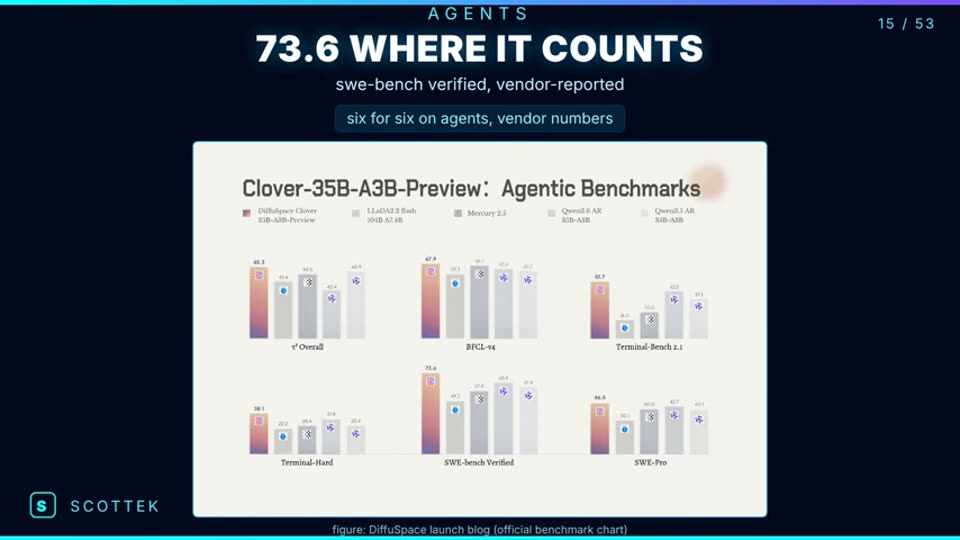
In the video: the narration labels every number in this section as vendor-reported from the launch blog, with no independent replication yet. It reports top scores in all six compared agent benchmarks: 73.6 on SWE-bench Verified, 51.7 on Terminal-Bench 2.1, and 65.3 on tau-cubed Overall, measured against LLaDA 2.2 flash, Mercury 2.5, and both Qwen 35B autoregressive baselines.
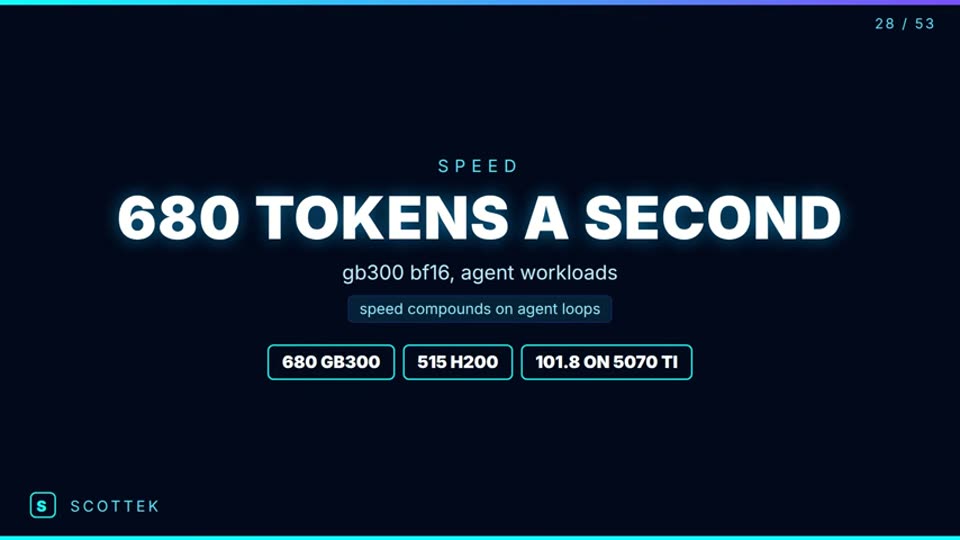
Added from the sources: the launch blog and its English mirror carry the same figures, with general scores of 83.8 on GPQA Diamond, 95.8 on ZebraLogic, 72.0 on AA-LCR, 84.8 on MMLU-Pro, and 67.9 on BFCL-v4, plus 6 of 9 wins against lightweight rivals including MiniCPM-V 4.7, LFM 2.5, Nemotron 3.5 Lightning, and Gemma 4. Speed figures from the same vendor source: 680 tokens per second on one GB300 in BF16 on internal agent workloads, 515 tokens per second on H200 against 365 for an accelerated Qwen setup, and 101.8 tokens per second in INT4 on a 16GB RTX 5070 Ti on MATH-500 versus 48.5 for same-size rivals, roughly double.
- Treat every ratio above as vendor-reported until an independent party reproduces it. The video says exactly this on camera.
- The vendor demos follow the same rule: route planning in 28 steps and 169.9 seconds, a 49-task WebMCP median agent time of 1.52 seconds, and sub-second parallel parsing of a compound drone-dispatch message are all vendor-reported demonstrations, not third-party measurements.
- Independent press cross-check: PC Watch covered the launch with figures matching the vendor blog, and a Webdiga hands-on status check documents the honest launch-day integration gaps repeated below.
What you can actually run today
In the video: the presenter draws a hard line between datacenter and homelab. The full-precision path needs about 69GB of GPU memory, while the home path is the official GGUF quants, with Q4_K_M at 21.42GB comfortable on a 24GB card like an RTX 3090 or 4090 and Q4_0 at 18.24GB as the 16GB-class option, all with the warning that weights math is not the whole story because context and KV cache need headroom.
Added from the sources: the official GGUF repo lists the three quants with checksums. Q8_0 at 35.26GB fits 48GB cards or dual 24GB setups, Q4_K_M at 21.42GB, and Q4_0 at 18.24GB. The catch, confirmed in the repo backend table: local support lives in pull-request branches, SGLang PR 46927 for serving and llama.cpp PR 31306 with self-speculative decoding, so you build the branch rather than installing from mainline, and no Ollama or LM Studio build existed at research time.
- Start small on context, the repo example uses a short context you grow to fit memory, because the KV cache bites hardest in long agent sessions.
- If you want one-click simplicity today, the video's own fallback is the Qwen 3.6 base, which runs everywhere already, and every local path below is untested here.
- The repo's Transformers quick start documents
transformers 5.19.0with PyTorch 2.10 or later for single-GPU BF16 inference, which is datacenter territory at about 69GB, so treat that path as reference rather than a homelab plan, and it is untested here.
Honest limits, announced extras, and the verdict
In the video: the narration names two things as announced but not shipped. An agent execution harness plus a desktop coding client, and a decision-model variant with a joint mode that answers related questions in one denoising pass, quoting 95.0 percent single accuracy in internal validation. The presenter promises to cover both when there is code to run.
Added from the sources: the launch blog confirms both items are in development, with joint mode validated internally on 500 groups and 2,420 related questions, so read those accuracy figures as internal until code and methods land.
- Verdict from the video, kept intact: with a 24GB card and coding or tool-using agents, Clover is the month's most interesting open-weights drop, with state-of-the-art diffusion scores, a downloadable GGUF, and double the tokens per second where agents feel it. With 8GB or a need for one-click Ollama simplicity, sit this one out and let the integrations land.
- Either way the trend line in the video holds: diffusion is presented as a deployment option now, not a research toy, with repo, quants, and press cross-check linked above.
- If Clover is your first diffusion model, re-check the two integration pull requests before downloading anything. Merged mainline support changes the entire setup story, and this guide reflects the branch-build state of October 30, 2026.