Debian APT Root Exploit: Patch Every Homelab Now (2026)

Watch the walkthrough in Debian APT Root Exploit: Patch Every Homelab Now (2026), published 2026-11-14. This companion guide collects the check, the safe patch command, and the lockdown steps in one place. Everything the video demonstrates comes from its description and two live test boxes, and every version number below is cross-checked against the Debian security tracker entry, the Ubuntu announcement, the Ubuntu CVE page, and the CVE.org record. Added research beyond what the video shows is labeled as such. No exploit was attempted on camera anywhere in this process, check-and-patch only.
What broke
CVE-2026-109518 is a flaw in APT's HTTP transport, reported by researcher Max Justicz and disclosed November 4 2026. In plain terms, when APT downloads a package over plain HTTP and the download is interrupted, it retries and resumes, and a redirect can point the retry at the same file path so the attacker's file replaces the package after it was verified. Then dpkg installs it and its setup scripts run as root. Three ingredients are needed: HTTP transport, redirects followed, and retries enabled. The CVE record rates it CVSS 4.0 7.7 High. As of November 9 to 10 there was no public exploit code and no reported real-world exploitation, and it is not in the CISA known-exploited catalog, which comes from added research for this guide rather than from the video.
Are you affected
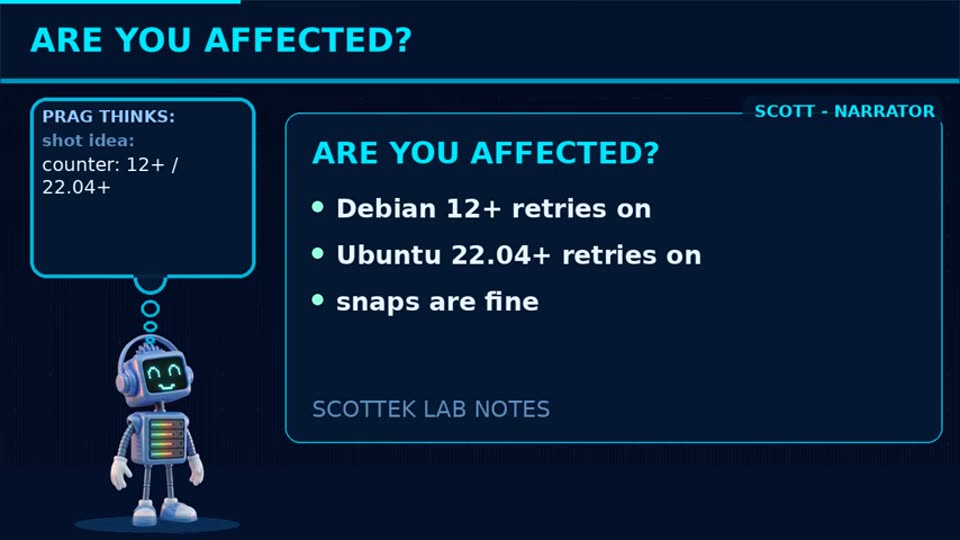
Probably, if you run anything modern. Debian 12 and newer and Ubuntu 22.04 and newer retry downloads by default, so they are exposed out of the box. Older releases default to zero retries and are only exposed if someone turned retries on. Snaps are not affected, they use a different update system, and FTP and other transports are not affected either. If automatic security updates are switched on, and they are by default from Ubuntu 16.04 onward, the fixed APT may already have arrived through the security pocket. But if your sources say http, and most default installs do, that is the attack path, so keep reading.
Live proof on two test boxes
The video bench-verified the flaw's footprint on two fresh containers on a Proxmox sandbox, and the ledger backs every number. Before refreshing package lists, the Debian 12 box carried vulnerable apt 2.6.1 and the Debian 13 box carried vulnerable apt 3.0.3, and both pointed at plain-HTTP mirrors by default. After apt-get update, the security pocket offered exactly the documented fixes: 2.6.2 from bookworm-security and 3.0.4 from trixie-security. That match matters, because it means the advisories describe the real world and not just theory.
The safe patch command
This is the critical detail, and the part to get exactly right. The update that fixes you downloads over the same HTTP you are worried about, so run it with retries forced to zero for that one command. That single flag removes the precondition for the whole run. Do this from a network you trust, a home LAN or another known-good connection, not public Wi-Fi. This changes system packages, so treat it as a maintenance action, not background noise.
- Refresh lists, then upgrade everything safely with
sudo apt update && sudo apt upgrade -o Acquire::Retries=0 - Or replace APT alone, exactly as demoed live:
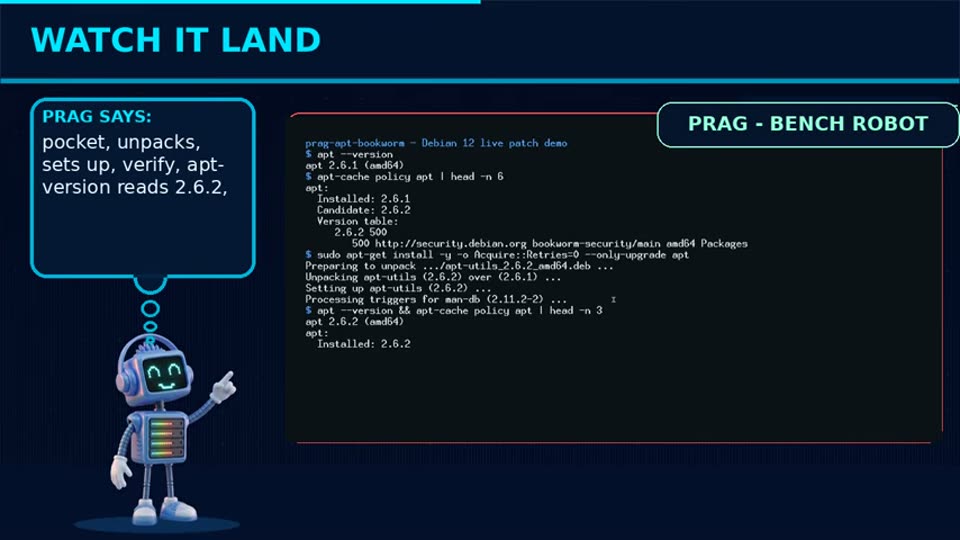
sudo apt-get install -y -o Acquire::Retries=0 --only-upgrade apt - Confirm the landing with
apt --versionandapt-cache policy apt
On the Debian 12 bench box the demoed command pulled 2.6.2 from the security pocket, unpacked it, and set it up, and verification read installed 2.6.2 with candidate 2.6.2. The Debian 13 box follows the same path to 3.0.4. Where unattended-upgrades is enabled, many boxes already fixed themselves from the security pocket, but check anyway.
Lock down with HTTPS
Updating APT is the real fix, but HTTPS shrinks the whole attack class afterward. The video's recommended move follows Ubuntu's own post: rewrite the archive, security, and ports hosts from http to https in your sources files, then run sudo apt update and confirm zero errors. Back up your sources files first, because a typo in a sources file breaks every install until you fix it, so read each changed line afterward. If a mirror errors out, it does not speak HTTPS, so either keep that one on HTTP and accept the residual risk or switch to a mirror that does. Country mirrors and small community mirrors are the usual holdouts. Note the honest limit: HTTPS stops someone on the wire, but it does nothing if the mirror itself is malicious, which is why you update first. This migration step is untested on the bench boxes for this guide; it is presented as shown in the video and documented by Ubuntu.
Fixed versions
Write these down, and compare with apt --version on every box. Debian entries track DSA-6607-1 and DLA-4880-1, Ubuntu entries track USN-8996-1, with extra releases from added research.
- Debian 13 trixie: fixed in apt 3.0.4, vulnerable are 3.0.3 and earlier 3.0.x
- Debian 12 bookworm: fixed in apt 2.6.2, vulnerable are 2.6.1 and earlier
- Debian testing forky and unstable sid: fixed in apt 3.3.6
- Ubuntu 26.10: fixed in apt 3.3.3ubuntu0.1
- Ubuntu 26.04: fixed in apt 3.2.1ubuntu0.1
- Ubuntu 24.04 noble: fixed in apt 2.8.4ubuntu0.1
- Ubuntu 22.04 jammy: fixed in apt 2.4.15ubuntu0.1
- Ubuntu 20.04 and 18.04: fixed through ESM, which needs an Ubuntu Pro subscription
- Ubuntu 16.04 and 14.04: need the Legacy Support add-on on top of ESM
- Mint, Pop!_OS, and Raspberry Pi OS: inherit the upstream fix, so patch them the same way
Containers and fresh images
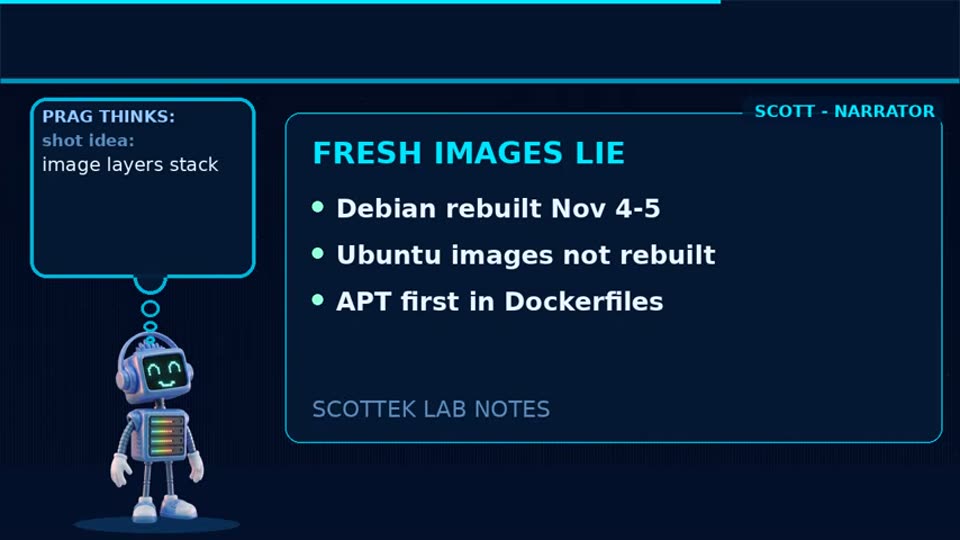
Fresh images can ship the old APT, which is the trap. Debian rebuilt its images on November 4 to 5, so new pulls are clean, but as of the video's research window the official Ubuntu Docker images and several Ubuntu cloud images had not been rebuilt and still carried vulnerable APT. The fix is a habit: at the top of every Dockerfile or cloud-init build, update APT itself first with retries forced to zero before installing anything else, and only then proceed to the rest of your packages. Then your golden images stop minting vulnerable clones. Rebuild anything you baked before November 4, because that image is guilty until proven patched.
Verify you are clean
A thirty-second audit per box, all from the video with research corroboration:
- Run
apt --versionand compare against the fixed-version list above - Run
apt-cache policy aptand confirm the installed line matches a fixed version from the security pocket - Glance at your sources files, since any line starting with
httpis a candidate for the HTTPS switch - Check that automatic security updates are actually on, because that is what saves you next time while you sleep
If all four read clean, you are done and can prove it to anyone who asks. For ongoing assurance, consider scanning your estate with something like the Trivy vulnerability scanner guide.
Homelab order of operations
Do it in this order and you will not miss a box:
- Patch the hypervisor and the network-facing boxes first, from a trusted LAN
- Patch templates and golden images next, or every clone inherits the hole
- Patch containers and long-forgotten sidecars, the Pi-hole, the download box, the camera VM
- Flip HTTP sources to HTTPS where the mirror allows it
- Re-run the version check everywhere and write it down
Boring, fast, and complete beats clever every time.
What the video shows versus added research
The video is the starting point: the mechanism in plain words, the affected scope, the live two-box proof, the retries-off patch command, the terminal demo, the HTTPS lockdown, the version table, the image warning, the audit, and the patch order all appear on camera or in the description. Added research for this guide contributed the CVE record details such as the CVSS score and the no-known-exploitation status, the forky, sid, and ESM or Legacy Support rows in the version list, the AWS bulletin and the ThreatDefence write-up as cross-checks, and the community discussion thread, which is discussion only and whose unverified claims are not repeated here. Secondary coverage includes the Phoronix report.