OpenBSD 8.0 Companion Guide: Install, Upgrade, and What's New

This is the companion guide to Watch the companion video. The video frames OpenBSD 8.0, released October 20, 2026, as the release where a firewall box can also host a small lab, and this guide expands that framing with the documented install, upgrade, and patch steps plus links to the primary sources.
Nothing here was tested on a live OpenBSD 8.0 install for this guide, and every hands-on step below is marked untested. Check the linked release notes and upgrade guide before you act, since errata move fast in the first days.
What the companion video covers
The companion video is a what's-new tour of OpenBSD 8.0, the 61st release, plus a full install and upgrade walkthrough and a verdict on who should run it. This guide follows the same arc — virtualization, graphics and memory, networking and security, ARM and RISC-V, desktops and the Wine proposal, then install and upgrade — and adds the documented commands and caveats around each claim.
The short version is that three things matter for a homelab: guest VMs grow to 64 vCPUs, Intel Arc A-Series graphics land with room for big VRAM, and a new rtrd daemon brings RPKI-to-router validation to the base system. The OpenBSD 8.0 release notes document all three directly.
Virtual machines grow up with up to 64 vCPUs
The headline for homelabbers is virtualization. The built-in hypervisor VMM with the vmd daemon previously pinned each guest to essentially a single virtual CPU, and 8.0 raises that ceiling to 64 vCPUs per guest with the plumbing that makes SMP guests actually work: x2apic guest mode, MSI/MSI-X interrupts for virtio devices, checksum offload, and split virtqueues. The release notes list each of these VMM improvements.
Smaller fixes round it out: 32-bit Linux guests get working lapic and ioapic emulation, qcow image handling improves, and VM ownership moves to plain files instead of obscure state, so normal backup and scripting habits just work. No VM performance numbers are claimed anywhere here — this is a capability unlock, documented in man pages, not a benchmark.
Graphics and memory headroom for Intel Arc
The DRM drivers sync to Linux 6.18.53, which brings support for Intel Arc A-Series (DG2/Alchemist) cards through inteldrm, plus a workaround for GuC firmware timeouts seen on some Alder Lake systems. Underneath sits the change that makes it possible: on amd64 the kernel virtual address space jumps from 4G to 512G, so the system can finally map more than 4GB of VRAM. The kernel also randomizes its direct map placement, a quiet hardening win, and swap encryption gets faster via CPU AES instructions on both amd64 and arm64. All of this is stated in the release notes.
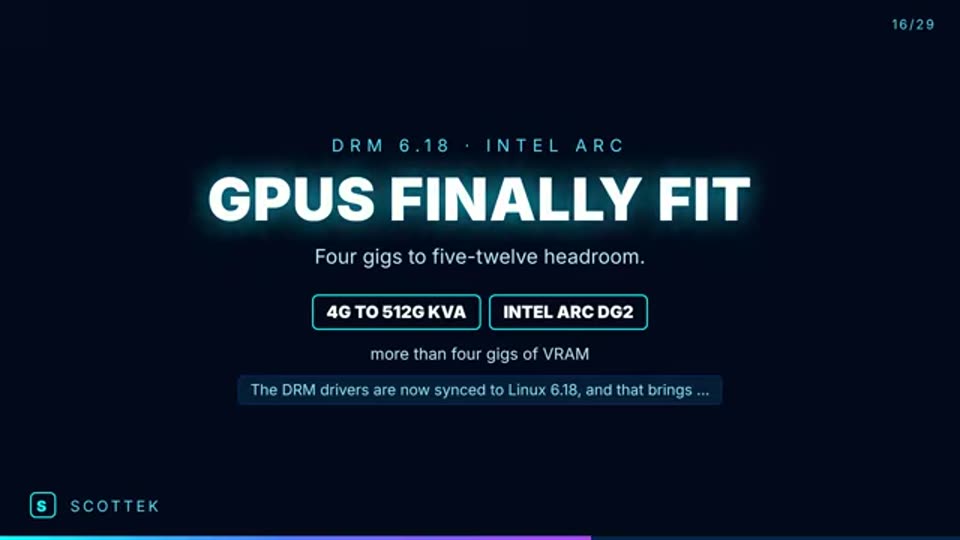
If you ever wanted OpenBSD on a machine with a serious GPU, this is the release that stops saying no — though new and exotic hardware outside this list still deserves a compatibility check before you commit.
Networking and security with rtrd and day-one patches
For the network crowd there is a genuinely new daemon: rtrd with its control tool rtrctl, speaking the RPKI-to-router protocol between the rpki-client validator and BGP routers, so a homelab can do real route-origin validation like the big networks do. Around it sit smaller upgrades: httpd learns custom headers with its default TLS moving to the secure setting, relayd gains ECDSA certificates and Lua-pattern filters, acme-client gets external account binding, and the base moves to OpenSSH 10.6 and LibreSSL 4.4.0 with WPA3 wireless support and pf reliability fixes. The daemon and TLS changes are in the release notes, with LibreSSL 4.4.0 and OpenSSH 10.6 confirmed there.
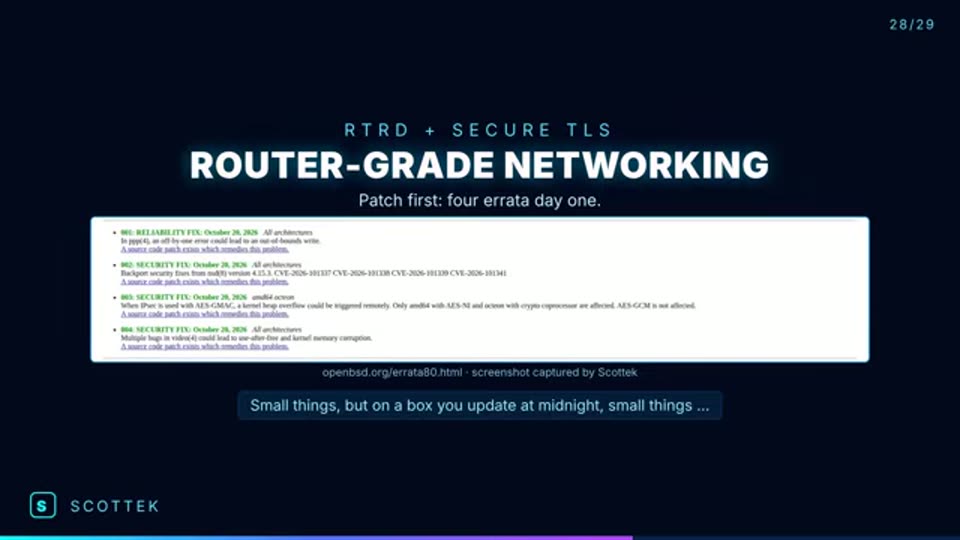
Patch before you brag: the release shipped with four day-one errata — a ppp reliability fix, nsd security backports, an AES-GMAC IPsec heap overflow on AES-NI amd64 and octeon, and video use-after-free fixes — all applied with syspatch. Untested here, but the documented first act after any install or upgrade is syspatch, then re-check the errata page on upgrade day since further entries have already appeared.
ARM laptops, RISC-V, and one honest retirement
Portable and small-board users get real love: arm64 gains hibernate support, suspend and resume fixes land for Snapdragon laptops such as the Galaxy Book4 Edge and HONOR MagicBook Art 14, and Samsung hardware picks up touchscreen, battery, and storage drivers. On riscv64 the kernel learns the V vector extension, the Advanced Interrupt Architecture with imsic and aplic drivers, and the Sstc timer, plus bounce buffers for picky hardware. And one retirement: loongson support is gone because that port could not move to the new Clang 22 toolchain, while sparc64 did make the LLVM jump. OpenBSD adds platforms slowly and drops them honestly, and that trade is part of why people trust it on the machines that matter.
Desktops, ports, and the Wine proposal that is not in 8.0
The ports tree ships current desktops — KDE Plasma 6.7, GNOME 49, Xfce 4.20, Firefox 157, Chromium 154 — with Wayland compositors ready, and the video notes tmux gained floating panes, so a daily-driver install is genuinely pleasant. Treat the port versions as the ports tree at release time rather than promises about any given mirror today.

The wildest story is not in 8.0 and this guide keeps it out of the feature list on purpose: on October 18, 2026, a developer proposed an experimental Wine port for OpenBSD with the segment-register problem emulated in software, testing dozens of 64-bit Windows programs including a recent Witcher remaster. 32-bit software still does nothing, and the port is a draft awaiting review, not a package you can install — file it under things to watch, per the video's framing and the press coverage linked below.
Install and upgrade walkthrough
Installing is refreshingly old school, and every step in this section is untested on this workstation — it restates the documented flow, not a performed install.
- Fresh install: fetch
install80.imgorcd80.isofor your architecture from a mirror, verify it withsignifyusing the published 8.0 keys, write it to USB, and boot — the text installer asks its questions and full-disk encryption is one prompt away, untested. - Upgrade from 7.9: the documented easy path is one command,
sysupgrade, which fetches the new sets, verifies signatures, and reboots into the installer automatically — untested, and upgrades are only supported from the immediately previous release per the upgrade guide. - After either route: run
sysmergeto reconcile configuration files, remove nothing the guide does not list, upgrade packages withpkg_add -u, refresh firmware withfw_update, and apply errata withsyspatch— all untested here and all documented in the upgrade guide. - Enable only what you need with
rcctl, since OpenBSD enables almost nothing by default and that is the point — untested.
Verify downloads with signify before trusting them, because trusting your download is the whole point of this operating system.
Verdict of the companion video
The honest index-card version matches the release notes. Run it if you want a router, firewall, or VPN box you configure once and trust for years, a virtualization playground where every config file fits on one screen now that 64-vCPU guests exist, or the strictest possible Unix teacher. Skip it if your lab revolves around Docker, gaming, or brand-new hardware needing day-one drivers. The cheapest experiment is two gigs of RAM in a VM this weekend — it is free, donation-funded, and never phones home. For the virtualization muscle around it, see the Proxmox host guide.
Sources
- OpenBSD 8.0 release notes — release facts, VMM, DRM, rtrd, toolchain versions; accessed 2026-10-22
- Upgrade Guide 7.9 to 8.0 —
sysupgradeflow,sysmerge,pkg_add -u,fw_update; accessed 2026-10-22 - OpenBSD 8.0 errata — patches 001 through 004 at release,
syspatchguidance; accessed 2026-10-22 - Undeadly 8.0 release summary — cycle context cross-check; accessed 2026-10-22
- The Register on OpenBSD 8.0 and the Wine proposal — Wine draft-port framing; accessed 2026-10-22
- Companion video