Northflank Breach: Rotate Secrets, Self-Host Keys (Oct 30th 2026)

Start with the video
This guide is a companion to the video Northflank Breach: Rotate Secrets, Self-Host Keys (Oct 30th 2026), which is the starting point for everything below. YouTube auto-subtitles were unavailable when this article was prepared, so the owner's own video narration stands in as the transcript-equivalent source for what the video says, and this article says so openly.
In the video: the minute-by-minute Oct 30 timeline, the rotation order that locks the attacker out, the Nov 2 status delta, the Black October context, a live public verification plus a local OpenBao vault demo, and the per-key drill checklist.
Added from the sources: corroboration and extra detail from the Northflank status history, independent reporting, the Qovery rotation writeup, the Wiz Black October list, the Hacker News thread, and the OpenBao repo and docs, all linked inline and in Sources.
One honesty note up front, carried over from the video: the bench held no Northflank account, so nothing here is a demonstrated rotation inside Northflank itself. What was publicly verified is the live status page text and the thread consensus, plus a local vault. Anything not independently verified is marked untested.
What happened on Oct 30, and what changed by Nov 2
In the video: at 11:43 UTC on Oct 30, cloud security company Wiz sent Northflank a threat alert, engineers picked it up a minute later, network policy patches landed at 12:02, 12:50 and 13:05, Wiz incident response was called in at 13:00, the status page said to rotate environment variables immediately at 13:40, escalated at 13:58 to assume all environment variables have been decrypted and to disable and rotate all keys, opened one-click rotation for Postgres and MongoDB at 15:12 while noting multiple users confirmed their AI keys had been used, and by that night advised revoking keys at the issuing provider and checking usage and billing logs. On Oct 31 audit logs were switched on for everyone including free accounts, and rotation opened for MySQL and Redis, then MinIO, then RabbitMQ.
Added from the sources: the Northflank status page history corroborates that timeline, and its Nov 2 update adds that the attack vector is believed contained within an hour of the first alert, with no sign the attacker stayed in the environment afterward, running workloads unaffected with no sign workload data was touched, evidence pointing at secrets held in the control plane rather than app servers, forward-deployed and dedicated control-plane customers unaffected, the fleet patched for CVE-2026-98432 including connected clusters, Northflank's own keys rotated with access tokens and sessions plus source-control integrations and cross-account cloud roles revoked where it could act, independent forensic auditors reviewing, and a root-cause write-up promised but not yet published. Independent reporting from BleepingComputer confirms the same core facts and adds that Northflank had not responded to its questions.
Rotate in this order, and revoke at the issuer
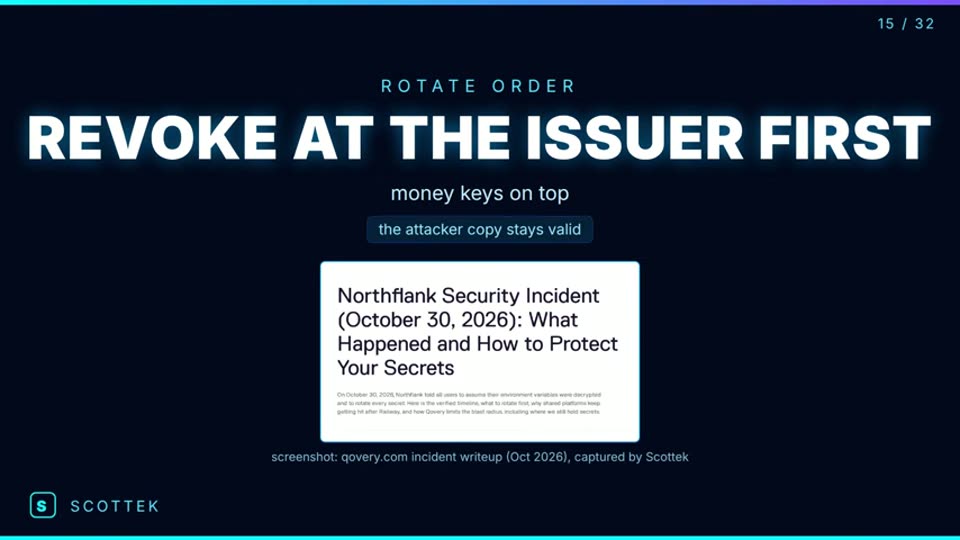
In the video: changing a value inside Northflank does not invalidate the copy the attacker already holds, so the order is money and reach first. AI provider keys first because they were already being abused, then payment and billing keys, then cloud credentials, revoking each one at the issuer, generating the replacement, and then updating the secret in Northflank. Then rotate what Northflank now rotates for you, meaning Postgres, MongoDB, MySQL, Redis, MinIO and RabbitMQ add-ons, then every secret group and global secret. Then switch off public exposure on any add-on where you enabled it.
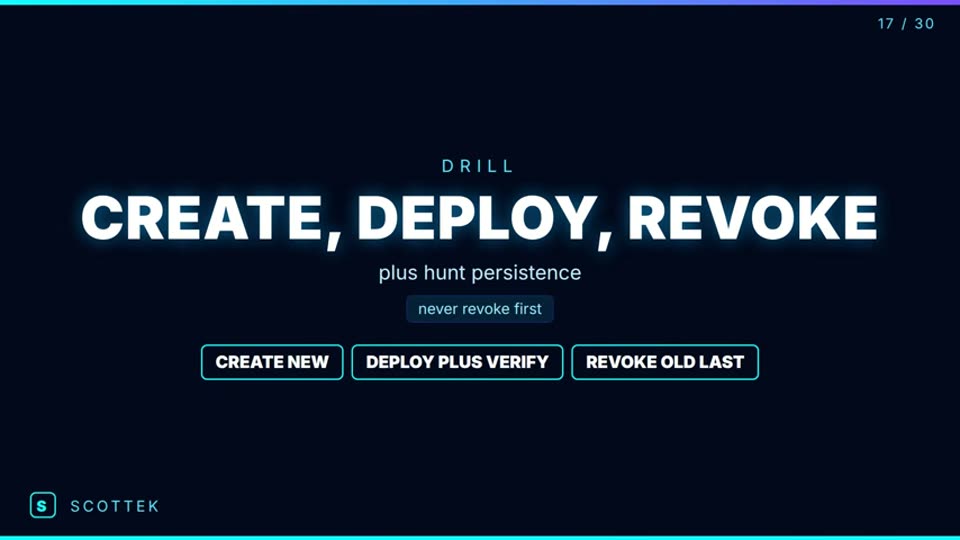
Added from the sources: the Qovery incident writeup gives the same ladder in more detail, ordering AI keys, payment and billing, cloud credentials, databases, session and signing keys, then OAuth, webhook, git and registry tokens. Two patterns in that writeup prevent self-inflicted outages. Stripe-style providers let old and new keys overlap so you can deploy before you revoke, and for databases the pattern is create a second user, deploy it, then delete the first. The per-key drill for every key is create the new one, deploy it, verify the app works, then revoke the old one, because revoking first is the fastest way to cause your own outage. Two follow-ons from the same writeup: set spending limits and model scopes on the new AI keys, since in one Wiz case a region-scoped key blocked thousands of calls, and expect one planned logout, since rotating session and signing keys signs every user out, so schedule it. Then hunt for persistence the attacker may have bought with your keys, meaning new API keys, new users, new SSH keys, and new OAuth apps or webhooks you did not create. The exact provider-side install steps for your own stack were not independently verified here and should be treated as untested until you confirm them against your provider docs.
Check the quiet window, and note what is still undisclosed
In the video: read the provider side for the quiet window, not just the loud one, because in the cases Wiz studied, stolen keys were tested within thirty minutes but the heavy spending started four and seven days later. Absence of weird bills is not proof your keys are safe, so rotate everything even if you see nothing.
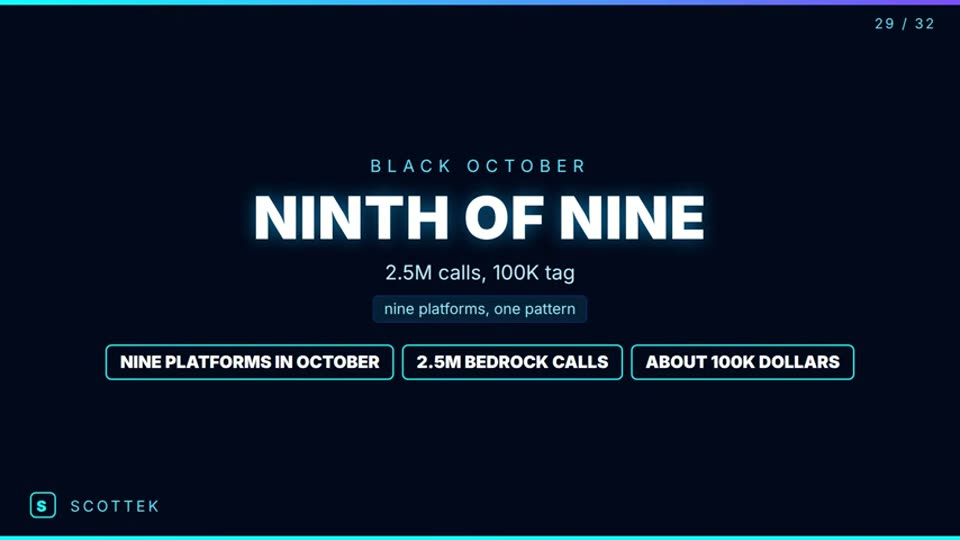
Added from the sources: the Wiz Black October writeup is the origin of that 30-minute versus 4-to-7-day pattern, and it places Northflank as the ninth October disclosure on its list, after Fireworks AI on Oct 6, Andromeda on Oct 9, Zeabur on Oct 14, Lightning AI on Oct 15, OpenCode on Oct 16, Railway on Oct 20, Warp on Oct 23 and CommandCode on Oct 28, with Brev and Trigger.dev also noted. The same writeup says there is no single vulnerability linking them, listing credential access here, build-system privilege escalation there, a vendor dependency and a legacy system elsewhere, and it documents why AI keys are the prize, with about 2.5 million Bedrock calls worth roughly 100,000 dollars in two tracked cases plus observed resale infrastructure for model access. One data point to sit with, added from the sources: Zeabur published a full write-up and is shutting down because of its incident, which is what a platform breach can cost.
Three things Northflank has not disclosed, stated plainly: no root cause has been published, no customer count has been named, and there is no statement on whether anything beyond AI keys was abused. Treat every unknown as exposed until it is answered in writing. Audit logs being switched on for everyone is genuinely useful and genuinely not proof, since logs show what to investigate, not what the attacker read, so read them for changes you did not make. The Hacker News thread, score 484 with 363 comments verified via the API on 2026-11-03, shows this is front-page consensus rather than niche worry, including one user facing new RevenueCat, Apple and AI keys. If you run the bring-your-own-cloud option, the status page never separated that answer out, so ask Northflank directly whether you are in scope and rotate while you wait.
Self-host your secrets with OpenBao
In the video: a shared deployment platform has to hand your app its secrets, so somewhere it stores them, decrypts them, or both, and one shared store holds every customer's secrets at once, which is why one break-in pays off many times over. The fix is to keep secret values in infrastructure you control and give the platform a reference instead. Your app runs in your own cloud account, the platform reaches it through a role you can delete, and secret values live in your own manager. For the homelab that is OpenBao on your own box, with dynamic database credentials and policies for when you outgrow static keys, and real hardening like swap disabled so secrets never page to disk.
Added from the sources: OpenBao is the community Vault fork that followed the license change, with a bao command line that mirrors Vault, and its GitHub repo and install docs cover package installs, the container image, precompiled archives and Helm. The video demo wrote one secret to a local dev vault and read it back with no cloud involved, using a throwaway token from a dev server, and that local demo path was not independently reproduced here, so treat any OpenBao setup steps as untested and follow the official docs for your machine. The positioning contrast from the sources is worth keeping: reviewers who run apps in their own cloud accounts note the platform going down stops new deploys, not running apps, which is a very different blast radius from secrets living in someone else's control plane.
Tonight's checklist
- Revoke at the issuer starting with AI and payment keys, then cloud credentials, then databases and every secret group and global secret.
- For every key, create the new one, deploy it, verify the app works, then revoke the old one.
- Scope the new AI keys with spending limits and model or region limits, and schedule the planned logout from session key rotation.
- Check usage and billing logs for the quiet window days after the incident, not just the first hours.
- Hunt for persistence: keys, users, SSH keys, OAuth apps and webhooks you did not create.
- Turn off public access on add-ons you exposed, confirm audit logs are on, and put your next secret in a vault you run.
Sources
- Northflank status page
- Northflank status history
- BleepingComputer: Northflank security breach leads to abuse of customers AI API keys
- Qovery: Northflank security incident writeup
- Wiz: Black October for AI developer platforms
- Hacker News: Northflank Breached thread
- OpenBao on GitHub
- OpenBao install docs
- Companion video