Self-Host One AI Gateway for Every Model: Respan 0.2.0 Guide

Companion guide and video starting point
This article is a companion to the video, not a replacement for it, and the video is the starting point for everything below.
In the video: the presenter explains why every provider SDK locks you in, traces Respan's origin as a rewrite of a 100,000-line LiteLLM wrapper layer, states the launch facts, tours providers and config, runs a live zero-key bench test with real routing output, covers MCP tools and plugins, voice and image translation, vendor benchmarks with caveats, and gives a homelab verdict.
Added from the sources: install commands, SDK base URLs, config keys, and route behavior were checked against the official Respan quickstart and configure docs, plus the respan-gateway repo and the HN launch thread. Live model completions with real vendor keys were untested here, so this guide proves routing and translation, not paid inference.
What Respan Gateway is and what it replaces
In the video: every AI vendor ships its own client library with its own request shape, so switching models means rewriting calls, hand-building outage fallbacks, and scattering secrets across projects.
Added from the sources: Respan Gateway is an open-source Rust binary that accepts calls in OpenAI, Anthropic, and Gemini client formats and routes them to many model providers, translating chat, images, speech, transcription, embeddings, video jobs, and realtime voice plus routing, fallbacks, MCP tools, and a request log. The stated origin story is that Respan served thousands of organizations on LiteLLM since 2024, outgrew a wrapper layer past 100,000 lines, hit unexplained connection errors after a routine January upgrade, and rewrote around a tiny core where providers and tools are plugins on one public interface.
- Point the SDK you already use at
http://localhost:8080/v1for OpenAI-style clients orhttp://localhost:8080for Anthropic and Google-style clients, name any model, and the gateway picks the provider. - Keys stay in your environment or nearest
.envfile, and the gateway log records model, provider, latency, tokens, and cost per call. - Anything the gateway does not understand it relays untouched instead of breaking, per the docs.
Launch facts, license, and pre-alpha warning
In the video: Respan, a Y Combinator 2024 startup, launched on Hacker News on October 20th with v0.2.0 after a v0.1.0 the night before, under a dual MIT or Apache 2.0 license, with the repo past 100 stars in launch week and the founder answering hard questions in a long launch thread.
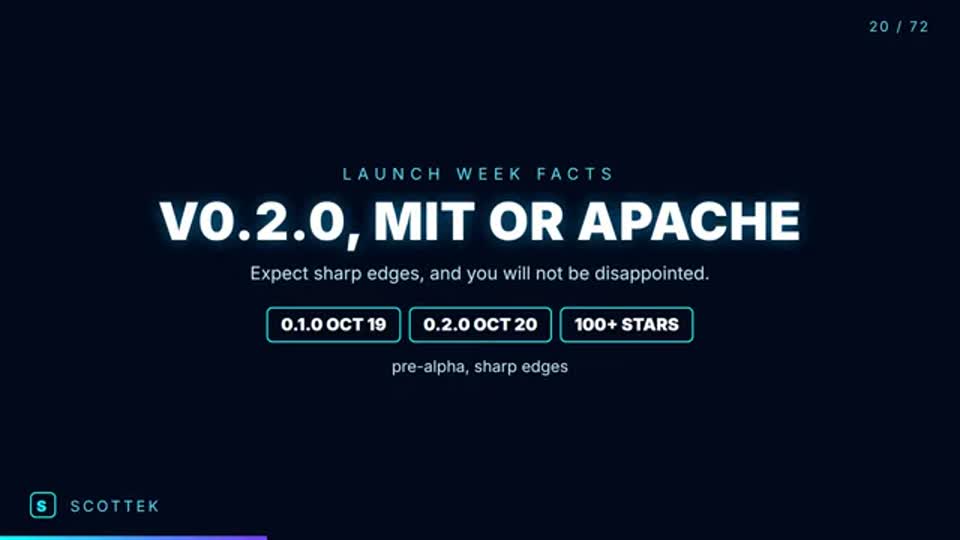
Added from the sources: the releases page confirms v0.1.0 on October 19 and v0.2.0 as latest, and the docs state verbatim that respan-gateway is pre-alpha and its config and APIs may still change. Say 16-plus built-in vendors rather than exactly 16, since the vendor table has grown past the sentence that says 16.
- Dual MIT or Apache 2.0 at your option, so self-hosting stays free forever.
- Pre-alpha means breaking config changes are expected, and the docs never claim production readiness.
- The founder's own quote from the video belongs in every plan: not every feature translates, so demo your exact path before committing.
Install the binary and start with zero config
In the video: install is one binary, with a shell installer, pip, cargo, or a small distroless Docker image, and the web UI rides inside the binary with no separate frontend to deploy.
Added from the sources: the quickstart installs by release asset, and a source build needs Rust 1.88 or later and ships with no web UI unless you build it first. Set VERSION to the release you want and confirm the asset name exists before running the download.
- Linux x86_64 install uses
VERSION=v0.2.0withcurl -fsSLagainst the release tarball URL, pipes totar xz, then movesrespan-gatewayonto yourPATH. - From source, the documented form is
cargo install --git https://github.com/respanai/respan-gateway respan-gateway, and the Docker form pullsghcr.io/respanai/respan-gatewaylistening on$PORTwith 8080 as default. The Docker path is untested here. - Check with
respan-gateway --version, which should printrespan-gateway 0.2.0. - Zero-config start means exporting one key per provider with
export OPENAI_API_KEY="sk-..."orexport ANTHROPIC_API_KEY="sk-ant-..."orexport GEMINI_API_KEY="...", then runningrespan-gatewaywith no file. Every key found in the environment becomes a provider. - With no client keys the gateway answers loopback only and refuses to start on a public address, so you cannot accidentally expose it. Remote access needs a reverse proxy, which is untested here.
One endpoint for every SDK, plus local models
In the video: 16-plus providers are built in, including OpenAI, Anthropic, Gemini, xAI, DeepSeek, Mistral, Groq, OpenRouter, Together, Fireworks, Cerebras, Perplexity, Azure, and Cloudflare, plus Ollama and vLLM for local models and any OpenAI-compatible endpoint you rack yourself.
Added from the sources: the configure docs list the built-in vendors and the base_url plus formats pattern for anything else speaking an OpenAI, Anthropic, or Gemini-style API. Client key material can be any value until you set client_keys.
- OpenAI SDK clients use
http://localhost:8080/v1and can ask forclaude-sonnet-4-5-20250929. - Anthropic SDK clients use
http://localhost:8080and can ask forgpt-5.5. - Google GenAI clients use
http://localhost:8080and can ask for a Claude model, while plaincurlposts tohttp://localhost:8080/v1/chat/completions. - Force a vendor with a
provider/modelprefix such asopenai/gpt-5.5, which is handy when two vendors serve the same model name. - Local path from the docs pattern is a provider block with
base_url = "http://localhost:11434"for Ollama orbase_url = "http://localhost:1234/v1"withformats = ["openai-chat"]for LM Studio style endpoints. Local-model routing against a live Ollama server is untested here. - Beyond chat, the gateway bridges realtime voice between OpenAI and Gemini clients, with Mistral covering transcription, plus images, speech, transcription, embeddings, and video jobs. The video's voice bridge demo is untested here.
Live bench with zero keys and real routing proof
In the video: the bench machine holds no API keys and no local model server, which makes it the perfect honest test. respan-gateway --version prints 0.2.0, a six-line config pointing at a local Ollama provider passes check, serve prints endpoints and a curl to try, and chat calls in OpenAI and Anthropic formats both route, translate, and fail honestly at the missing backend.
Added from the sources: the sandbox record in the research folder matches this shape exactly: check prints version, config, provider line, six endpoints for chat, messages, embeddings, models, health, and UI, plus defaults, route rules, auth off, and gateway.toml: ok. Serve on loopback, curl against /healthz returning ok, /ui/ returning HTTP 200, and /v1/models returning a structured upstream error naming the unreachable provider all confirm routing without pretending inference worked.
- Write the keyless file with
respan-gateway init, validate withrespan-gateway check, optionally call every provider withrespan-gateway check --online, then serve withrespan-gateway. - Inspect the request log at
http://localhost:8080/ui/requestsand explain any model name withhttp://localhost:8080/ui/api/routes/explain?model=smart. - Live completion against paid vendor keys or a running Ollama backend is untested here, and the video is honest about that limit.
Routing, MCP tools, plugins, and the request log
In the video: named routes group model families, with fallback, retries, cheapest-or-fastest picks, and hedged requests that race a slow call against a second provider. MCP servers and built-in tool vendors sit behind the gateway so plain chat calls can use web search, memory, and sandbox tools whatever the client or model.
Added from the sources: the configure docs show a routes.smart block with to candidates and hedge = "800ms" racing them, an mcp.search block with a server URL, a plugins.tool_loop block giving those tools to every model, and a plugins.respan block sending one trace per request. Hot reload works via SIGHUP, --watch, or the web UI reload, with in-flight requests finishing on the old config.
- Route resolution order is exact route name, then
provider/modelprefix, then first matching glob route, then the provider whose model list contains the model, then the default provider. - Every feature is a plugin on one public Rust API with one trait and four hooks, and the repo ships guardrail, PII masking, and billing examples each under 1,000 lines.
- The honest catch from the launch coverage is that custom plugins compile into the binary, so adding one means maintaining code and rebuilding. No hot-loaded sidecars exist in this pre-alpha, and that flow is untested here.
- The web UI request history is always on, and an optional file block appends one JSON line per finished request with no bodies or keys. Treat the log like a secret store anyway, since the gateway inherently sees every prompt and key that passes through.
Vendor numbers, caveats, and the verdict
In the video: read the numbers slide carefully, because the headline figures are vendor-run with no published methodology, not independent results.
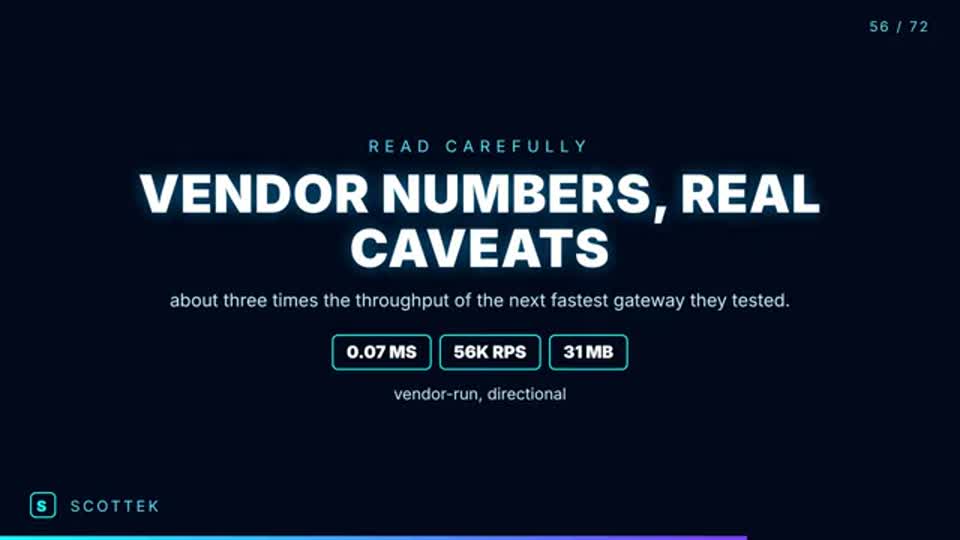
Added from the sources: the project claims 0.07 ms added p50 latency, 56,734 requests per second, 31 MB of memory, and about 3x the next-fastest gateway versus Bifrost, Portkey, and LiteLLM, all self-reported. Present them as vendor claims with the vendor-run, directional label, or omit the numbers.
- No built-in TLS termination is documented, so remote access means a reverse proxy like any homelab HTTP service. That setup is untested here.
- Conversation state lives in one gateway's memory for an hour by default, so replicas need sticky routing. Multi-instance setups are untested here.
- Local and yellow-tier vendors are maintained but not yet live-verified end to end per the project's own table, so confirm your exact Ollama, vLLM, Groq, or DeepSeek path before relying on it.
- Keep the open binary, which is your keys on your machine, distinct from hosted Respan, which sells observability, evals, and unified billing for 1000-plus models behind one key.
Verdict and next step
Run this if you juggle providers and want one endpoint for code, agents, and automations with keys in one place on your hardware and per-call cost in the log. Local-only chat shops should keep Ollama plus Open WebUI for pure offline chat, since this gateway happily fronts them instead of replacing them. Skip it if you need stable plugin APIs today, because pre-alpha means the ground moves.
Sources
- Respan Gateway repo
- Respan releases
- Respan quickstart
- Respan configure
- Respan introduction
- Respan connect
- Respan vendors
- Respan plugins
- HN launch thread
- Video demo link from HN post