Auto-subtitles for the video were unavailable at guide time, so the video description is the transcript-equivalent and every presenter claim below is attributed to it rather than to independent viewing.
The description structures the video as chapters, in order: 0:00 Hook, 0:19 what ran in 5 stages, 0:38 funnel from 2308 to 948, 1:02 cost math at 1279 each, 1:27 honest slice on patches versus merges, 1:51 threat model on stock Linux, 2:16 live bench on Proxmox, 2:39 patch now, 3:00 least privilege, 3:20 isolation layers, 3:42 verdict.
Reporting: one mid-October run of OpenAI's cyber pipeline produced 948 working Linux root exploits at a reported 1279 dollars each, demoed against a Proxmox sandbox checklist.
Interpretation: treat that sentence as the claim being triaged here, not as this guide's own finding.
Added research: this guide cross-checks the numbers against secondary reporting and the video production sandbox bench, labeled where each appears.
What OpenAI says it ran
Reporting: per OpenAI via secondary reporting, the pipeline ran 5 stages: discovery, dynamic validation, exploitability assessment, patch generation, and human review.
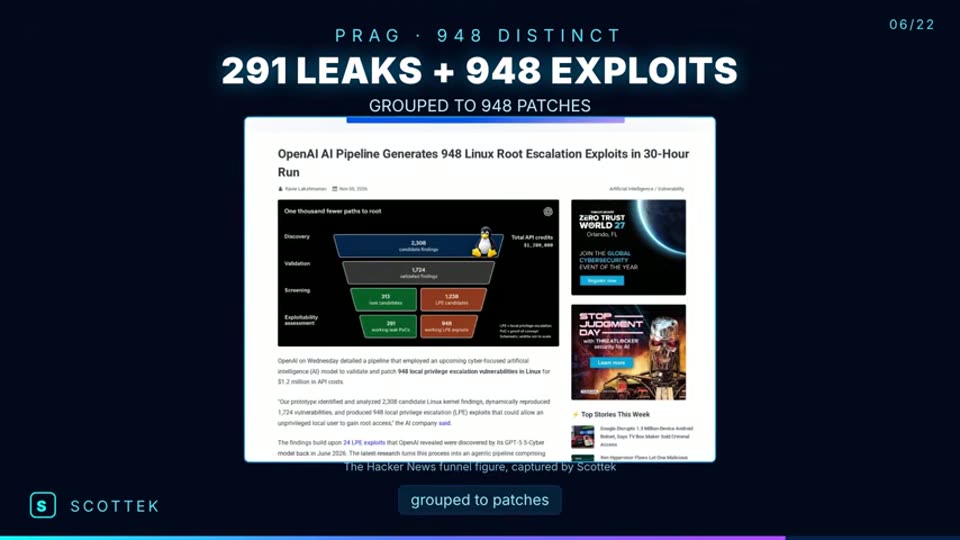
Reporting: the funnel started at 2308 candidates and ended at 948 working local privilege-escalation exploits, with production research notes recording 1724 reproductions and 291 info-leak proofs of concept along the way.
Reporting: the video puts the cost at 1279 dollars per working exploit, and the production research notes the same approximate math off a circulating total near 1.21 million dollars.
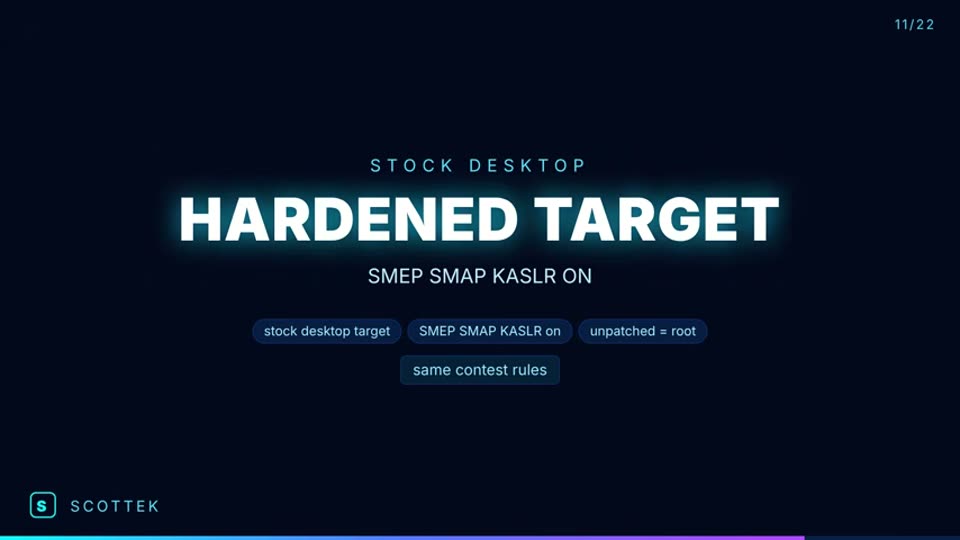
Interpretation: the threat model was stock desktop Linux with standard protections on, so the honest homelab read is that an unpatched low-privilege account counts as root against a well-resourced actor.
Motion-graphics card from the video embedding The Hacker News funnel figure for the 291 leaks grouped to 948 patches (Still from the walkthrough video.)Motion-graphics card from the video defining the hardened stock-desktop target with SMEP SMAP KASLR on (Still from the walkthrough video.)
What 948 really means
Reporting: the video's honest slice is that 948 means working exploits grouped to 948 patches after variant analysis, which is the number to take seriously without inflating it.
Interpretation: it does not mean 948 commits merged upstream and it does not mean 948 published CVEs, so do not go hunting for 948 identifiers.
Added research: production notes record the upstream disposition circulating at the time as 61 patched upstream, 43 in staging, and 299 in public discussion, which is consistent with patches still flowing rather than finished.
Added research: the same notes record context the video cites around the main run, including an earlier July run at 166 exploits and a kernelCTF side effort, plus about 10 novel exploitation techniques counted but with details withheld.
Practical takeaway: patch the kernel and distro normally through your usual updates instead of waiting for a neat list that was never published.
Sandbox bench from the video build
Everything in this section is the video production sandbox bench from 2026-11-14, run on Proxmox with guest LXC 993 prag-lpe, a Debian 13 template sized at 1GB of RAM, 2 CPUs, and 8GB of disk as an unprivileged container.
Verified on camera per the description: host kernel 7.0.2-6-pve, Debian 13 container with apt 3.0.3 installed and 3.0.4 available as the candidate, no sudo installed, 8 standard set-uid binaries, an unprivileged nobody user blocked from slash root, and Permission denied on the write test.
The 8 set-uid binaries were the standard set of gpasswd, mount, umount, newgrp, chfn, passwd, chsh, and su, which is a normal minimal footprint rather than a finding by itself.
AppArmor was not visible inside the unprivileged container and is stated as host-enforced, and no exploit was attempted in this bench, which was check-and-patch plus containment only.
Firecracker and gVisor appear here strictly as OpenAI's documented recommendation, presented as such and untested in this bench.
Motion-graphics card from the video listing the sandbox hardening steps: sudo audit, set-uid and capabilities review, no new privileges (Still from the walkthrough video.)
Patch-now checklist for your homelab
Warning: the steps below update and can restart your system, so snapshot or back up the guest first, expect a reboot on kernel updates, and do not run upgrades over a session you cannot afford to lose.
Reporting: the video demos this checklist live on the Proxmox sandbox above, so treat the bench outputs there as the verified baseline.
Check what is pending with your distro's normal update query, then apply the standard full upgrade path and reboot when the kernel changes. Useful version markers from the bench are installed apt 3.0.3 moving to candidate 3.0.4, quoted here as observed versions, not as commands to pin.
Confirm the new state after reboot by re-checking the running kernel and package versions rather than assuming the upgrade applied.
Cut privilege next: the bench box had no sudo installed at all, so consider whether a given container even needs it, keep interactive users off root, and re-run the standard set-uid binary audit to confirm nothing new appeared.
Re-test containment the way the bench did by attempting a write to slash root as the unprivileged nobody user and expecting Permission denied.
Prefer unprivileged containers, keep host-enforced AppArmor on, and treat Firecracker and gVisor as a documented extra isolation layer that is untested here before you credit it on your own box.
Proxmox snapshot and backup steps for your own host are untested here and vary by storage layout, so follow the vendor flow for your setup instead of improvising.
Verdict and sources
Interpretation: the number that matters is not 948, it is zero unpatched kernels on machines you care about, because the reported pipeline turns low-privilege access into root often enough that delay is the vulnerability.
Do the unglamorous three in order: patch now, strip privilege, and isolate workloads, then repeat on a schedule instead of treating this as a one-time event.
Figure credits: funnel figure from The Hacker News article, thread header from the Hacker News discussion, screenshots captured by Scottek, and the thumbnail hero generated locally.