This Repo Unlocks 85% More GPU Compute (KohakUnlock)

This is the companion guide to the video This Repo Unlocks 85% More GPU Compute (KohakUnlock) — the video is the starting point, and this text version keeps video claims visibly separate from added repo research. Watch the video here. Anything below that the video did not show comes from the linked repo docs, and anything not run for this guide is marked untested.
All throughput figures in this guide are repo-reported or video-reported, not independently re-measured. Nothing here was run on lab hardware for this guide.
What the video covers, and what this guide adds
The video walks through the KohakUnlock repo beat by beat: the boundaries, the three unlocks, the NOT-established list, the safety doc, and an illustrated homelab takeaway. The transcript was fetched from the video's auto-subs and matches the published research script, so this guide follows that same order.
What this guide adds is the citable layer underneath: exact repo-reported numbers from the results doc, the fail-closed defaults from the safety doc, and the tested-boundary details from the repo README. The repo was published in October 2026 and is licensed GPL-2.0, per the repo README.
What KohakUnlock is and is not
KohakUnlock is source-first research into volatile NVIDIA tensor-compute unlocks, and it is not a universal unlocker. It ships Turing unlock source, offline tests, ROM analysis tooling, inventory scripts, and a fail-closed boot-hook template, per the repo README.
What it does not contain matters more: no firmware blobs, no ROM dumps, no signing keys, no prebuilt kernel or EFI binaries, no flash utility, and no automatic installer. By default the build compiles with hardware execution disabled, and turning it on requires an explicit opt-in flag plus runtime parameters — nothing in the repo installs modules, edits boot config, or flashes anything, per the repo README.
The correction the README states twice: the 22-gig cards are physically VRAM-modded — someone soldered the memory — and the software adds zero VRAM. Both the unlocked card and the locked comparison card already had that modification, and there is deliberately no soldering guide in the repo, per the repo README. Soldering memory and flashing firmware are destructive warranty-voiding operations that can permanently destroy a card, and this guide gives no instructions for either. Anything resembling a reproduction is untested in this guide.
The safe offline entry points need no GPU at all. The repo documents make test for Linux with Python plus a C compiler, and inventory plus ROM-analysis helpers, per the repo README.
make test— offline tests with no GPU or sudo needed, per the repo docsmake module ENABLE_EXPERIMENT=1— opt-in compile flag that still requires runtime parameters before anything executes, per the repo docspython3 tools/inventory.py— inventory via OS metadata andnvidia-smi, never BAR mmap or resets, per the repo docs
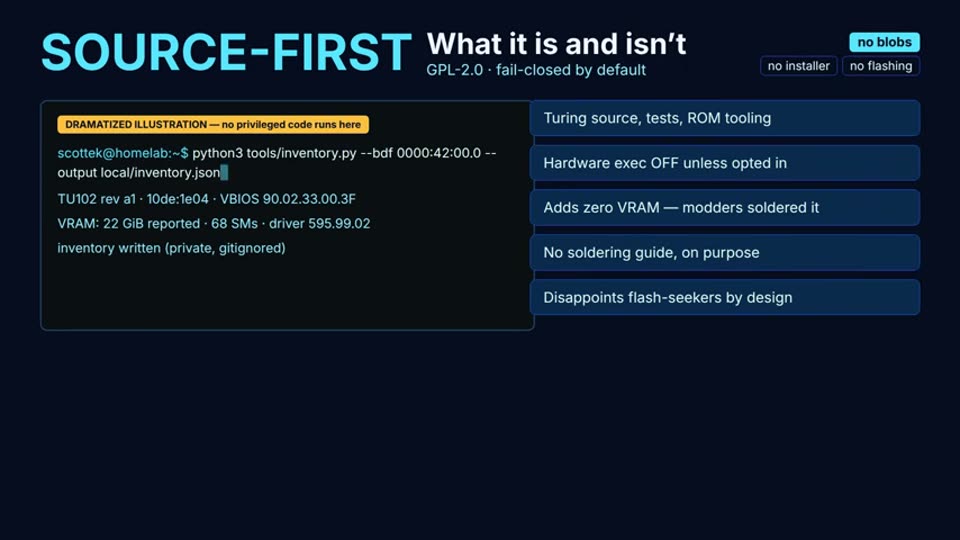
These commands are documented, not run for this guide. Untested in this guide.
The three unlocks in the repo's own numbers
One: the 2080 Ti over Linux initramfs. Two Leadtek TU102 cards physically modded to 22 GiB, kernel 6.8.0-147 with the NVIDIA open driver 595.99.02 at a 250 W power limit on both, unlocked through a one-shot initramfs boot in a local sequential implementation, per the repo README and the results doc. Both cards then validated together with bidirectional peer access and NCCL all-reduce passing from 1 KiB to 64 MiB, hitting repo-reported 36.77 GB/s at 64 MiB, per the repo README.
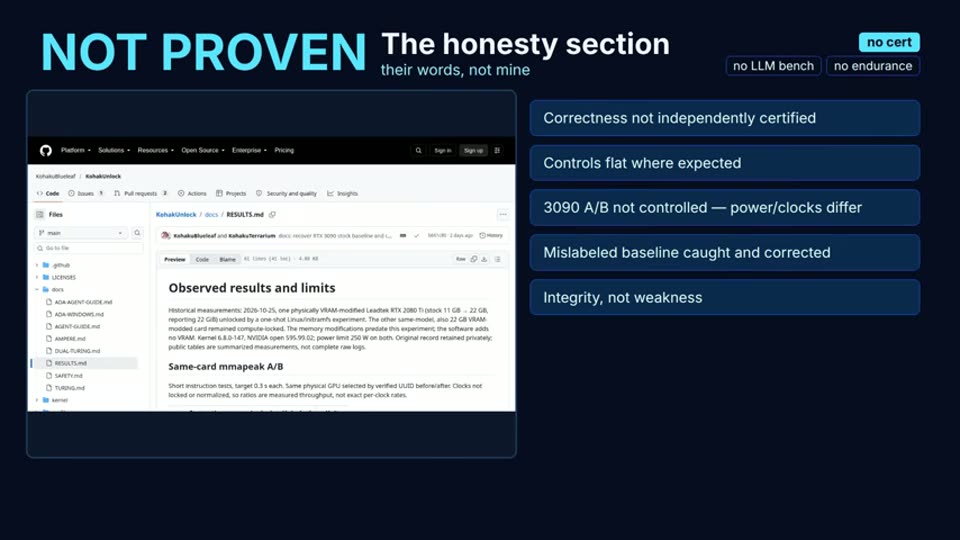
The same-card benchmark is the headline: FP16 accumulating to FP32 at 59.9 TFLOPS locked versus 111.0 TFLOPS unlocked, repo-reported plus 85.3 percent on the same physical GPU selected by verified UUID. The controls stayed flat — plain FP16 at 119.5 versus 118.5 TFLOPS and INT8 at roughly 237 versus 237 TOPS — which is exactly what you would expect if only the locked path got opened, per the results doc. Clocks were not locked or normalized, so these are measured throughput ratios, not exact per-clock rates.
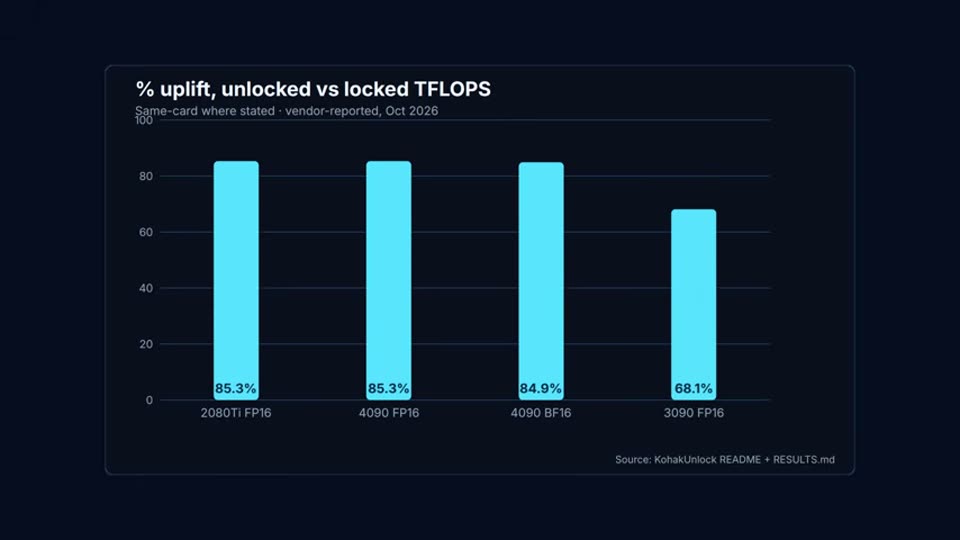
Two: the 4090 over Windows UEFI. A manual USB EFI transaction with handoff to the stock NVIDIA driver, then runtime-randomized instruction benchmarks — randomized because the original benchmark let the compiler collapse zero-input tiles while counting full flops — per the repo README. Repo-reported result on the same card and same binary: 178.9 to 331.5 TFLOPS, plus 85.3 percent, with BF16 at 179.0 to 330.9 TFLOPS, plus 84.9 percent. The tested setup was a single RTX 4090 on an ASUS Pro WS board with NVIDIA driver 621.01 at 450 W, per the repo README.
Three: the 3090s on the upstream Ampere path. Four cards ran the upstream Ampere implementation credited to Zagitta gpu-unlock, which is not vendored in this repo, per the repo README. One card's recovered stock baseline shows repo-reported 73.03 to 122.76 TFLOPS in FP16, plus 68.1 percent, at a slightly lower 360 W cap versus 370 W stock. The repo itself flags this as not a controlled A/B — different power caps, clocks, cooling, and thermal history — and notes the early baseline capture was mislabeled and corrected to the right physical card, per the results doc. No individual stock baselines were recovered for the other three cards.
A separate two-card MAMF sweep hit repo-reported best medians of 57.71 versus 88.24 TFLOPS, plus 52.9 percent — but across two different cards, not a same-card A/B, so silicon and cooling differences remain possible, per the results doc.
What is not established
The repo publishes its own NOT-established list, and this guide repeats it verbatim because it is the most trustworthy part of the project. Turing numerical correctness has not been independently certified — these are throughput runs and healthy-driver checks, not proof the math is right. No game speedup measured. No LLM inference speedup measured. No long-duration stability certification, no endurance testing, and no second-card TU102 rerun claimed. BF16 and TF32 were not added to Turing. This is not a claim of double your framerate. A drafted local validation script has no recorded successful execution, so the repo explicitly says not to turn that into a pass claim, per the results doc.
For homelab purposes the takeaway is precise: tensor throughput demonstrably unlocks on the tested profiles, and everything downstream — tokens per second, render times — remains unmeasured until someone measures it on your exact card. That downstream testing is untested in this guide.
Safety first, because bricking is on the menu
Experimental privileged firmware execution can hang your GPU or host, prevent boot, corrupt data, or damage hardware, with no guarantee of recovery. The repo requires physical or BMC console access plus power control, forbids experimenting on active workloads, and states that editing IDs or removing guards does not validate a new card, per the safety doc. Treat every unlock step as a destructive warranty-voiding operation on a sacrificial host you can afford to brick.
The workflow is fail-closed by design. Inventory uses OS metadata and nvidia-smi, ROM analysis is file-only, the public executor stays single-target, there is no module unload path so reboot is the lifecycle boundary, and the boot hook must halt before udev and NVIDIA if handoff is not safe, per the safety doc. The shipped code pins the exact historical target — BDF, subsystem IDs, firmware hash, 22 GiB capacity — and the same marketing name or VBIOS version is not sufficient, per the safety doc.
The video shows dramatized terminal illustrations labeled on-screen, not a live flash, and nothing here ran privileged code on the video's machines either. No safety procedure in this section was exercised for this guide. Untested in this guide.
What it could mean for a homelab, illustrated
Clearly labeled as illustration, not measurement: picture a 2080 Ti that already got its memory mod, with 22 gigs of VRAM and its tensor path open. The video's illustration is that the class of model that fits changes completely — a Q4 32-billion-parameter model wants roughly twenty gigs, and suddenly the card that used to top out at smaller quants is in the conversation. The on-screen inference session showing the unlocked path serving tokens dramatically faster is dramatized — the repo measured GEMM throughput, not tokens per second — and the video says so directly.
The analogy is the point: VRAM mods raise the ceiling, tensor unlocks raise the floor, and together they move a 2018 card two weight classes up — if your kernels, clocks, and cooling cooperate. Whether any of that reaches your workload depends on the three things no video can benchmark for you. That workload translation is untested in this guide — measure, do not assume.
Verdict and where to read next
KohakUnlock is the best kind of dangerous repo: honest about the danger, generous with the evidence, and allergic to hype it cannot cash. It proves specific tensor paths unlock on specific profiles, publishes everything including the misses, and keeps the guardrails default-on. It is not a universal unlocker, not a VRAM adder, not a gaming speedup, and not a flashing tutorial.
Read in this order, exactly as the repo insists: the safety doc first, then the repo README, then the results doc, with the upstream Zagitta gpu-unlock project for the Ampere side. This verdict follows the video's and the repo's own framing; no independent hardware verdict was rendered for this guide.