10 GitHub Projects That EXPLODED in October 2026 (verified numbers)

Why this list matters for your homelab
This guide is a companion to the video 10 GitHub Projects That EXPLODED in October 2026 (verified numbers), and the video is the starting point for everything below. Watch it for the full countdown, then use this page to decide which repos deserve space on your hardware.
Step back and the pattern is hard to miss. The video reports that 8 of these 10 repos are agent infrastructure, with one local voice AI tool and one creative tool alongside them, and zero SaaS dashboards. The community is voting with stars for a future where the compute lives with you, with local models, local voices, local agents, and skills you can read.
All star, fork, license, language, and push-date figures below come from a GitHub API pull ~26 Oct 2026, will drift — check live counts. Monthly-gain figures are the video's own reported numbers, attributed as such, not independent measurements.
How the ranking was built
The ranking is star velocity, not all-time totals, meaning what the community got excited about in October rather than what accumulated stars over a decade. Per the video, every number comes from two places, GitHub's own trending trackers for stars gained over the last 30 days, plus the GitHub API for exact counts, license files, and last-push dates.
Licenses were read individually, because open source means nothing until the license file says so. One repo in the video's longlist had no license at all and was cut regardless of stars, a rule worth adopting for anything you pull into your own lab.
#10 deepseek-ai/deepseek-harness
261,356 stars, MIT, TypeScript, pushed 2026-10-23 (GitHub API pull ~26 Oct 2026)
DeepSeek's official agent harness, built on one pitch, everything is a plugin. Models, tools, and memory are all swappable, which answers the question every homelab owner is asking, how to run a capable agent stack against your own infrastructure without marrying one vendor's cloud.
Who should try it: self-hosters who want a vendor-neutral agent runtime they control end to end.
#9 openclaw/openclaw
393,051 stars, 82,617 forks, MIT, TypeScript, pushed 2026-10-26 (GitHub API pull ~26 Oct 2026)
The personal AI assistant that runs on any OS and any platform, and the establishment giant of this list with the biggest community in the agent space. Agent runtimes execute code, so treat it as infrastructure, not an app.
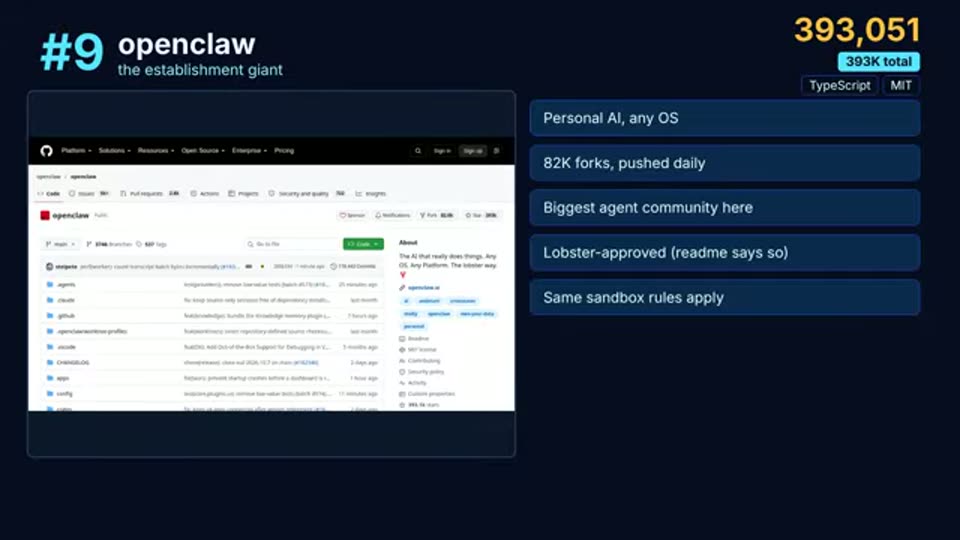
The frame above is the video's card for this pick: the star count, language and license tags, and the community notes behind the ranking.
Who should try it: anyone wanting one assistant across all their machines, provided it gets sandboxed first.
#8 heygen-com/hyperframes
72,150 stars, 6,518 forks, Apache-2.0, TypeScript, pushed 2026-10-26 (GitHub API pull ~26 Oct 2026)
A TypeScript CLI with the tagline write HTML, render video, built for agents. It turns HTML and GSAP timelines into real video frames and is designed so an AI agent can drive the whole pipeline. The video reports it gained almost 19,000 stars this month, and states that every graphic in the video itself was rendered with it. The homelab angle is real, it renders headless on a server with no GPU needed for capture, and output is deterministic enough to diff frame by frame. Echoing the video's own disclosure, there is no relationship with the project.
Who should try it: homelabbers who want programmatic video, such as release notes as video, dashboard recordings, or automated demos.
#7 stablyai/orca
105,806 stars, MIT, TypeScript, pushed 2026-10-26 (GitHub API pull ~26 Oct 2026)
Orca is the fleet manager, one place to run a whole crew of coding agents side by side. If you have ever had four agent sessions open and lost track of which one is about to rewrite your database config, that is the problem it solves.
Who should try it: anyone already juggling multiple agent sessions who needs coordination before something breaks.
#6 DietrichGebert/ponytail
176,178 stars, MIT, JavaScript, pushed 2026-10-18 (GitHub API pull ~26 Oct 2026)
A behavior layer for agents. Its readme says it makes your agent think like the laziest senior dev in the room, because the best code is the code you never wrote. Deeper planning and fewer redundant tool calls mean cheaper runs, and for self-hosters every wasted agent loop is tokens out of pocket or cycles off your GPU.
Who should try it: self-hosters running agents on metered APIs or their own GPUs who feel the cost of wasted loops.
#5 mattpocock/skills
303,234 stars, 25,510 forks, MIT, Shell, pushed 2026-10-22 (GitHub API pull ~26 Oct 2026)
A curated set of agent skills drawn from the author's agents directory, meaning reusable instruction packs that steer coding agents toward doing things the way a senior engineer would. October was the month the ecosystem figured out that skills, not prompts, are the unit of reuse. You no longer paste a workflow into chat, you install it.
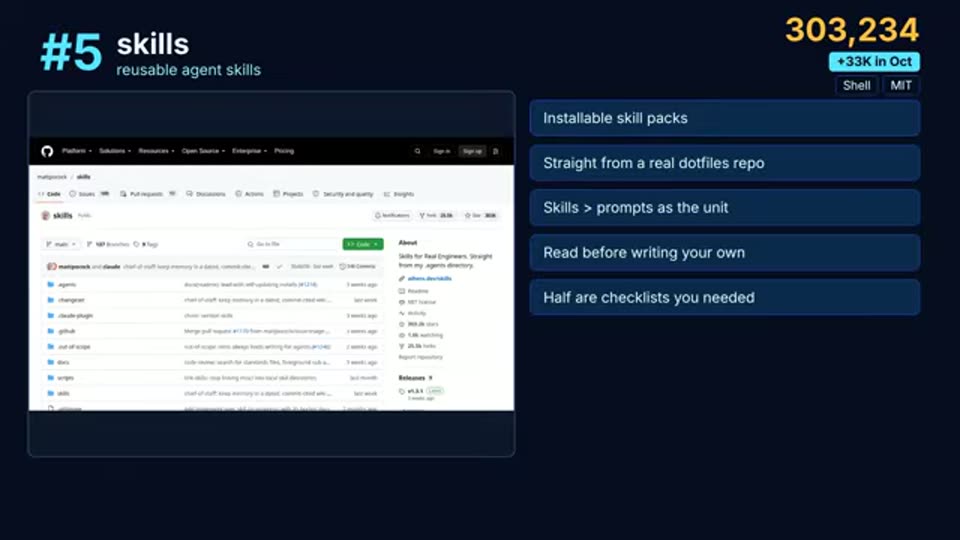
The frame above is the video's card for this pick: the star count with its October gain badge and the read-before-you-write-your-own guidance.
Who should try it: users of OpenCode, Claude Code, or anything that loads skills, who should read these before writing their own.
#4 boykopovar/AnyPS5
48,243 stars, 4,538 forks, GPL-2.0, C++, pushed 2026-10-26 (GitHub API pull ~26 Oct 2026)
A C++ tool that automatically ports PlayStation 5 executables to Linux and Windows. The video reports it gained 45,000 stars in about two months. Two honest caveats come with it. First, you still need to own the games, since this is a porting tool and not a piracy pass, and the repo lives or dies on that distinction. Second, GPL-2.0 carries copyleft forward, so if you build on it, your derivative work carries the license too.
Who should try it: Linux-gaming homelabbers who own PS5 titles and want to follow the most audacious porting project around.
#3 debpalash/VoiceStudio
86,785 stars, 9,607 forks, AGPL-3.0, Python, pushed 2026-10-26 (GitHub API pull ~26 Oct 2026)
The readme calls it the fully-local open-source alternative to ElevenLabs, covering voice cloning, voice design, video dubbing, dictation, transcription, and audiobook creation. The video reports it gained nearly 50,000 stars this month, up 140 percent, with support claimed across 646 languages, all on your own hardware. For a narration-heavy audience that is the whole ballgame, dubbing and accessibility without a per-character invoice and without audio leaving the LAN. Note the AGPL-3.0 network-service share-alike term, meaning if you offer it as a network service you share your modifications, while home self-hosting is unaffected. One technical reality check from the video, local voice quality lives or dies on your GPU and input audio.
Who should try it: homelabbers who narrate, dub, or transcribe and want it all kept on the LAN.
#2 storytold/photocraft
72,822 stars, 12,908 forks, Apache-2.0, Rust, pushed 2026-10-26 (GitHub API pull ~26 Oct 2026)
An open-source photo editor written from scratch in pure Rust, not a wrapper and not an Electron shell around web tech. The video reports that 72,000 of its stars arrived this month, that it was created in September, and that five projects from the same author sit in the top fifteen. For homelabbers the appeal is the missing piece argument, since photos are covered by self-hosted tools but editing still means a subscription or a desktop app phoning home. The caveat is youth, so expect sharp edges, missing features, and a roadmap longer than the codebase.
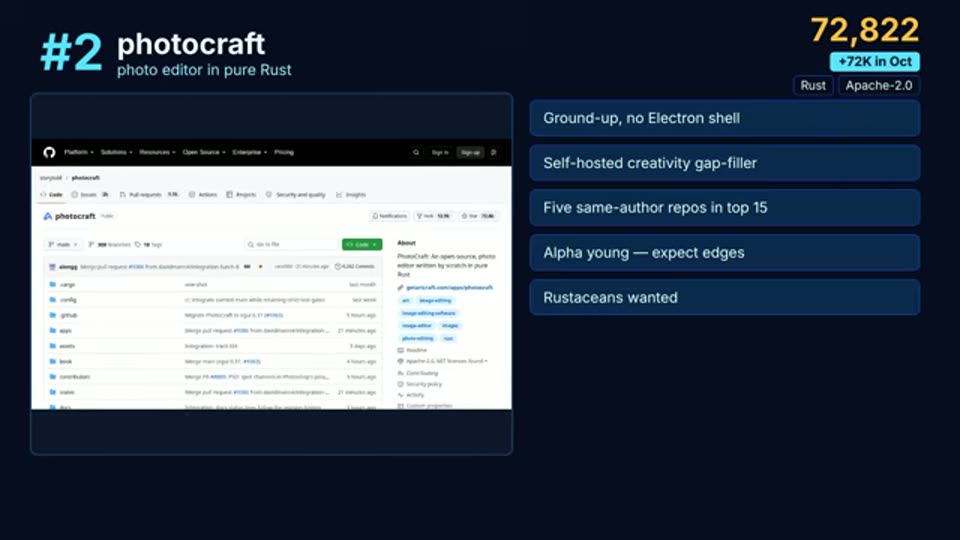
The frame above is the video's card for this pick: the star count, language and license tags, and the young-project caveats.
Who should try it: self-hosters chasing a fully local creative stack, especially anyone who can contribute Rust.
#1 morluto/rea
384,597 stars, 96,260 forks, MIT, TypeScript, pushed 2026-10-25 (GitHub API pull ~26 Oct 2026)
The runaway number one. The video reports 378,000 of its stars arrived in October alone, roughly a fifth of all trending stars that month. Point an agent at a running application and get back how it behaves and how it is structured, down to native binaries. Reverse engineering flipped from a specialist skill to an agent workload, namely observe, probe, disassemble, and document. The security implications are openly dual-use, of real value to defenders mapping their own attack surface, and to everyone else too.
Who should try it: security-minded homelabbers and analysts who want to understand the agent-as-analyst shift, handled with care.
Safety rules before you run any of this
These are the video's own rules, and they apply doubly on a home server.
- Sandbox agent runtimes in containers, since agent runtimes execute code and sandboxing is not optional.
- Constrain tool access for every agent before giving it a real job.
- Read the skill files first, before granting anything they ask for.
- Keep voice and media processing on your LAN unless you have a reason not to.
- Check the license file before productizing anything, especially AGPL-3.0 network services and GPL-2.0 derivatives.
Verify any repo yourself in under a minute
Do what the video did and confirm before you clone.
- Query the GitHub API for the repo and compare live stars and forks against the figures quoted here.
- Open the license file itself and confirm the SPDX identifier, since open source means nothing until that file says so.
- Check the last push date for signs of life, since every repo on this list was pushed within days of the pull.
- Skip anything with no license file at all, exactly as the video cut one unlicensed repo regardless of stars.
The one-action takeaway
Pick one repo from this list, clone it into a container tonight, and give it a constrained job. The era of watching AI happen on someone else's server is over, so run it yourself.