Self-Host GLM Like Revolut: Cut AI Coding Costs 90%

Watch the walkthrough in Self-Host GLM Like Revolut: Cut AI Coding Costs 90%, published 2026-11-13. This companion guide collects the numbers, model choices, and verification commands in one place, grounded in the video's research notes plus The Register's talk coverage, the Ollama GLM-4.7-Flash library page, the GLM-5.3 Hugging Face repo, and Z.ai pricing. All four links were re-verified reachable for this guide.
What the video covers
Revolut moved about 2,000 engineers off Claude Code and Codex as the default onto self-hosted GLM, starting with GLM-5.1 in April 2026 and moving to GLM-5.3, served on 56 Nvidia B200 cards. The figures below come from the video and its cited talk slides: coding time about 60 percent better, lead time about 70 percent better, time to first token down from 14.26 seconds to 1.68 seconds on the same fleet, requests per second up 76 percent with no new boxes, and a blended cost of about 30 cents per million tokens at roughly one tenth of the prior Anthropic plus OpenAI invoice. Revolut still keeps Codex, Claude Code, and Gemini around for hard tasks; only the default moved.
Thirty cents is their number, not yours
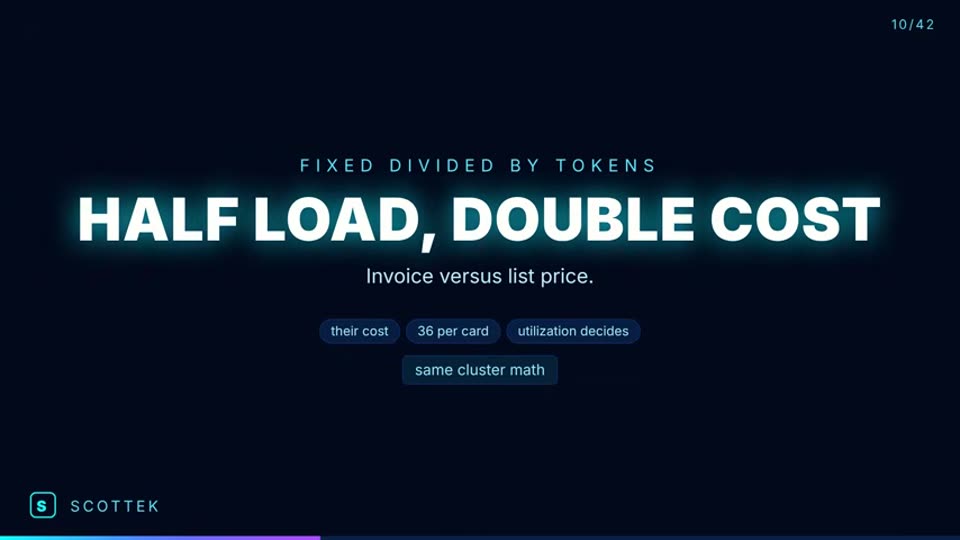
Self-hosted cost per token is fixed cost divided by tokens served. Revolut keeps 56 cards busy with about 2,000 engineers all working day, roughly 36 engineers per card, so the same cluster at half load would cost about twice as much per token. The one-tenth figure also compares total invoice before and after across a period when usage grew, not list prices per token. High utilization makes self-hosting cheap and low utilization makes it expensive, so do not buy hardware expecting 30 cents on a quiet single-user box.
Why the flagship cannot fit your homelab
GLM-5.3 is a 753-billion-parameter mixture of experts with about 39 billion active per token and a one-million-token window. The weights are public on Hugging Face but ship under a custom GLM-5.3 license rather than an open-source license, and the size is brutal: about 245 GB at 2-bit, 377 GB at 4-bit, 755 GB at FP8, and 1.5 TB at full precision, all before the context cache. A 24 GB card misses by an order of magnitude, and there is no official Ollama tag. Do not plan a homelab around this model; the sizes above are video-reported from the cited model pages.
What fits one graphics card today
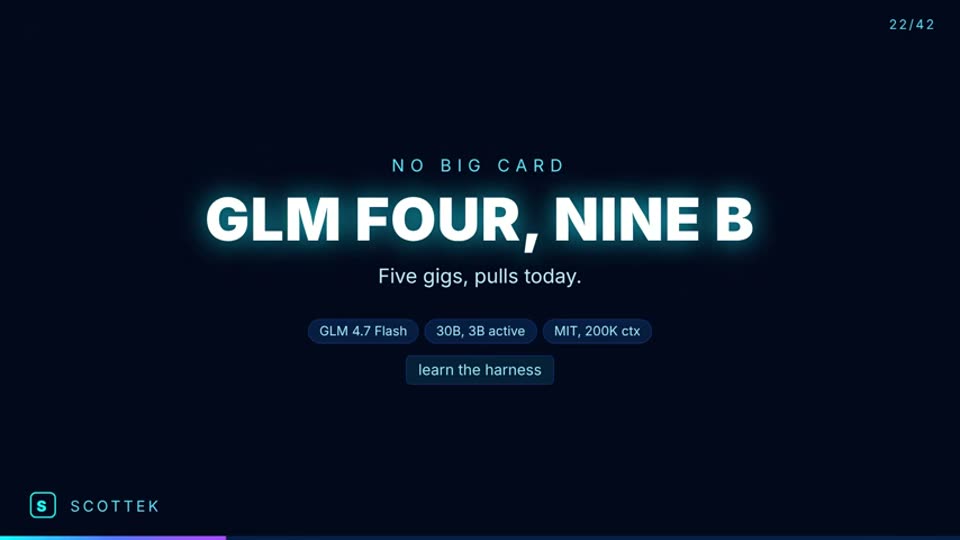
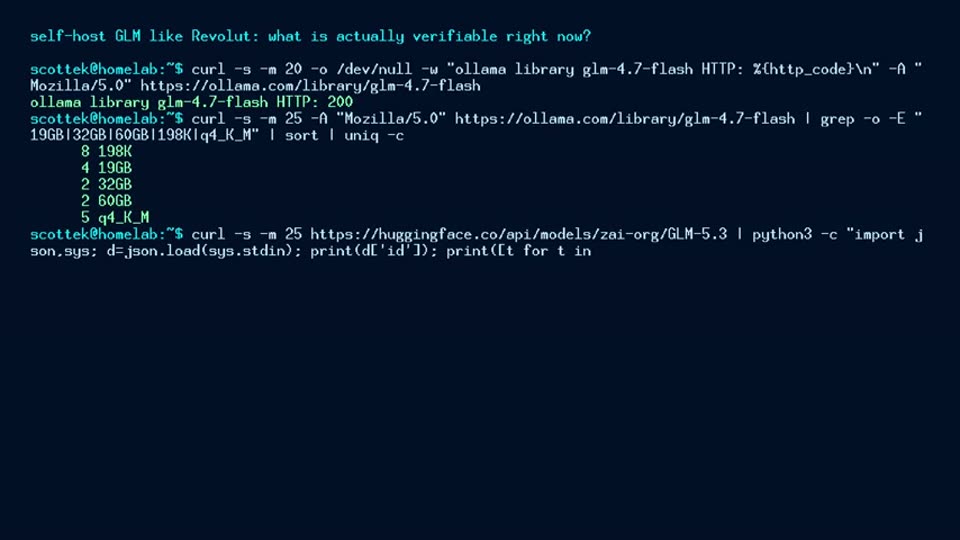
The smaller sibling GLM-4.7-Flash is 30 billion total with only 3 billion active per token, about 200K context, MIT licensed, with tools and thinking support. The Ollama library page lists an official tag at 19 GB for 4-bit, 32 GB for 8-bit, and 60 GB at full precision, and you need a recent Ollama for it.
- On a 24 GB card, pull the official tag with
ollama pull glm-4.7-flashand run the 4-bit build fully on GPU, a step that is untested here - On 16 GB, drop to 3-bit at about 14 GB or keep 4-bit and offload a few expert layers to system RAM, also untested here
- If you have no big card, start with the 9B
glm4model at about 5.5 GB viaollama run glm4, untested here - Use the Ollama official tag inside Ollama, and Unsloth or bartowski files inside llama.cpp or LM Studio; do not cross them or the chat template breaks
Verify the artifacts from your own machine
The video checks every claim from a sandbox rather than trusting screenshots, and you can repeat the read-only checks below from any machine with curl and Python. These checks only confirm the pages and metadata exist; they install nothing.
- Confirm the Ollama page exists with
curl -s -o /dev/null -w "%{http_code}" https://ollama.com/library/glm-4.7-flashand expect200 - Confirm the upstream repo metadata with
curl -s https://huggingface.co/api/models/zai-org/GLM-5.3and check the license field reads as the custom GLM-5.3 license, not MIT - Compare the hosted math yourself on Z.ai pricing: the Coding Plan is 18 dollars a month for Lite, 80 for Pro, 168 for Max, while API pay-as-you-go lists 1.40 per million in and 4.40 out for 5.3 and 15 cents in plus 50 cents out for Flash
The pattern to copy at homelab scale
Revolut runs a cheap fast default and escalates hard tasks to Codex and Claude, and the video argues the harness matters more than the model: a September benchmark across 64 coding tasks found accuracy within a few points across harnesses while cost split nearly two to one. Copy the pattern with a rule you can audit: default every agent to your cheap local or plan-backed GLM for small edits, boilerplate, tests, and docs, escalate only the gnarly debug or big refactor to the frontier rented model, and record latency, tokens, tool failures, and whether each edit was accepted. If the cheap model finishes eight of ten tasks, you cut your bill without cutting your standards. Nobody should buy hardware for the 753B flagship; wait for smaller distilled builds or use the hosted plan until they land.