sshhole: Patch Alpine SSH Now

What the video covers
The video walks through sshhole (CVE-2026-123158), a password-authentication bypass in OpenSSH on Alpine Linux that lets a stranger log in with a single connection and no password, and shows two clean fixes plus a log hunt for past break-ins. This companion guide gives you the same path in copyable form with expected results after each step. Watch it alongside the video at sshhole: Patch Alpine SSH Now.
The short version: OpenSSH issued emergency release 10.6p2 on November 5 2026, Alpine published its advisory the same day, and CISA added the flaw to its Known Exploited Vulnerabilities catalog on November 9. It is being exploited in the wild, so this one is patch-today, not patch-someday. The video's bench checks were verified on a live Alpine 3.24 box; the steps below follow the official advisory and the video but are marked untested where this guide's sandbox could not exercise them.
Am I exposed: the three conditions
All three must be true at once. If any one fails, the bypass does not apply to that box.
- Your SSH server runs on Alpine Linux with the musl-linked, non-PAM OpenSSH build
- Password authentication is enabled in the daemon config
- The box holds a key-only account whose shadow entry the flaw can abuse
The video's bench box came back clean on the third check: its root entry was locked and no password-hash accounts existed, so the check logic reported not armed. A default container that does not even run sshd is not affected until someone adds an SSH server plus a password next to it.
Three checks for your own box
Run these on each Alpine machine that runs sshd. Untested: the commands below follow the video and the advisory but were not exercised in this guide's sandbox, which lacked root access.
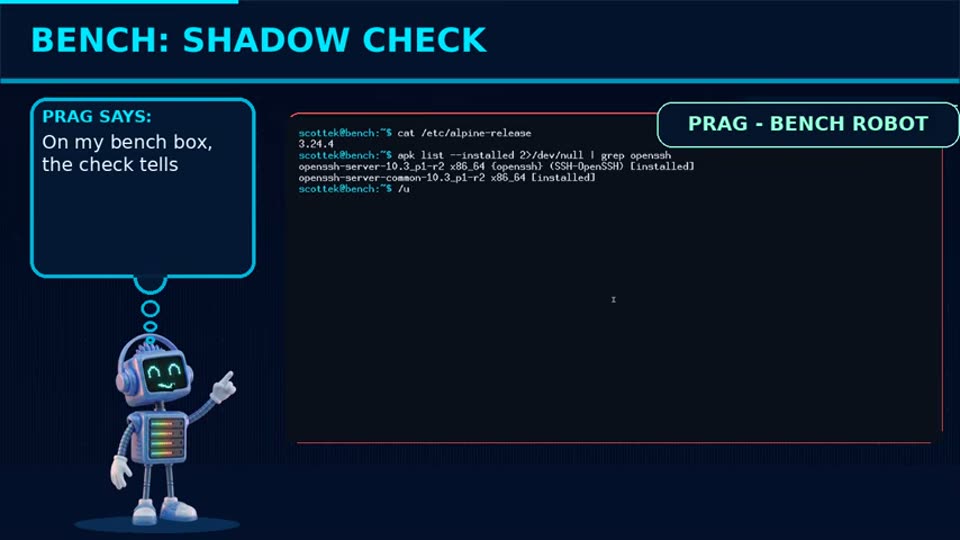
- Confirm the release with
cat /etc/alpine-release— the video's bench reads3.24.1 - Confirm the installed server build with
apk list --installed 2>/dev/null | grep openssh
- Confirm the effective config with
sshd -T | grep -Ei 'passwordauth|permitroot|allowtcp', and inspect account entries withawk -F: '{print $1, $2}' /etc/shadow— the video expectsPasswordAuthentication yesby default,PermitRootLogin prohibit-password, andAllowTcpForwarding no
Fixed builds per branch
Match your installed package revision against the advisory's fixed builds, not the version banner — the banner lies, and the video calls this out explicitly. Fixed revisions shown in the video:
- Edge:
10.6_p2-r0 - 3.24:
10.3_p1-r2 - 3.23:
10.2_p1-r1 - 3.22:
10.0_p1-r11 - 3.21:
9.9_p2-r1 - 3.20:
9.7_p1-r6 - 3.19:
9.6_p1-r3 - 3.18:
9.3_p2-r4 - 3.17:
9.1_p1-r7 - 3.16:
9.0_p1-r6
These revision numbers are video-attributed, taken from the video's per-branch table which mirrors the Alpine advisory. If your installed revision is older than the fixed one for your branch, you are patchable and should treat the box as exposed until fixed.
Fix 1: update, then restart the daemon
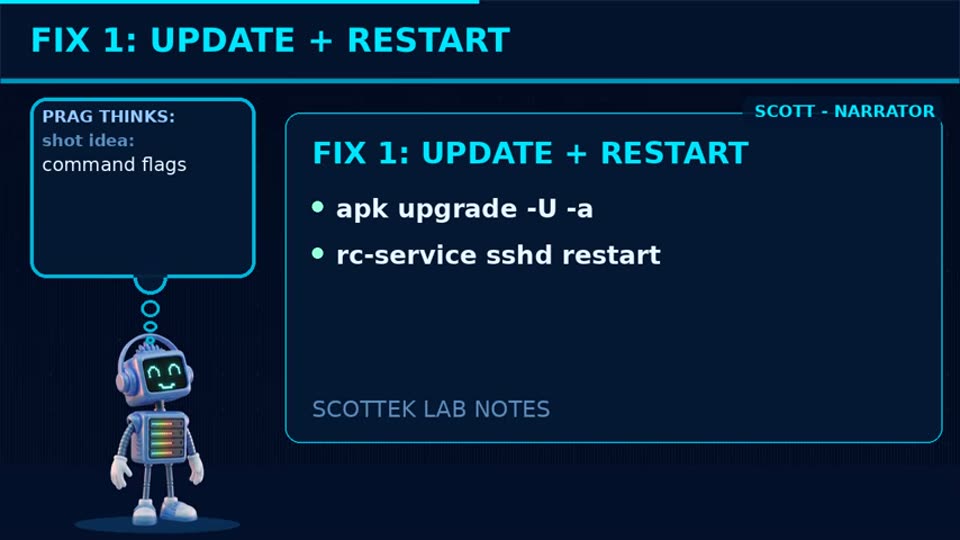
This is the primary fix. Both halves matter — the video stresses that the update alone does nothing until the running daemon is restarted.
- Refresh and upgrade with
apk upgrade -U -a - Restart the daemon with
rc-service sshd restart - Re-run the package check and confirm the revision now matches the fixed build for your branch
Untested: the upgrade and restart were shown on the video's bench, not in this guide's sandbox.
Fix 2: keys only, passwords off
If you cannot upgrade right now, disable password authentication entirely so only key logins work.
- Set
PasswordAuthentication noinsshd_config - Restart the daemon with
rc-service sshd restart - Confirm with
sshd -T | grep -i passwordauthand expectpasswordauthentication no
The video notes the tunnel trick is blocked too: with AllowTcpForwarding no, the forwarding path stays shut. And root is shielded by the locked * entry plus PermitRootLogin prohibit-password — it is the non-root accounts that need your attention.
Verify from outside your network
Do not declare victory from inside the box. From an external host, confirm the port answers only to keys: attempt a key login you control and confirm it works, and confirm a password-only login no longer does. The video demonstrates this outside-in verification as the closing proof of each fix.
Hunt for past break-ins
Because exploitation started on disclosure day, patching is only half the job. Check every exposed box for signs someone already walked in.
- Search auth logs for logins you do not recognize, especially around November 5 onward
- List user accounts and look for ones you did not create
- Inspect
authorized_keysfiles for keys you did not add - If anything looks wrong, treat the box as compromised: rebuild from known-good media and rotate every credential and key that touched it
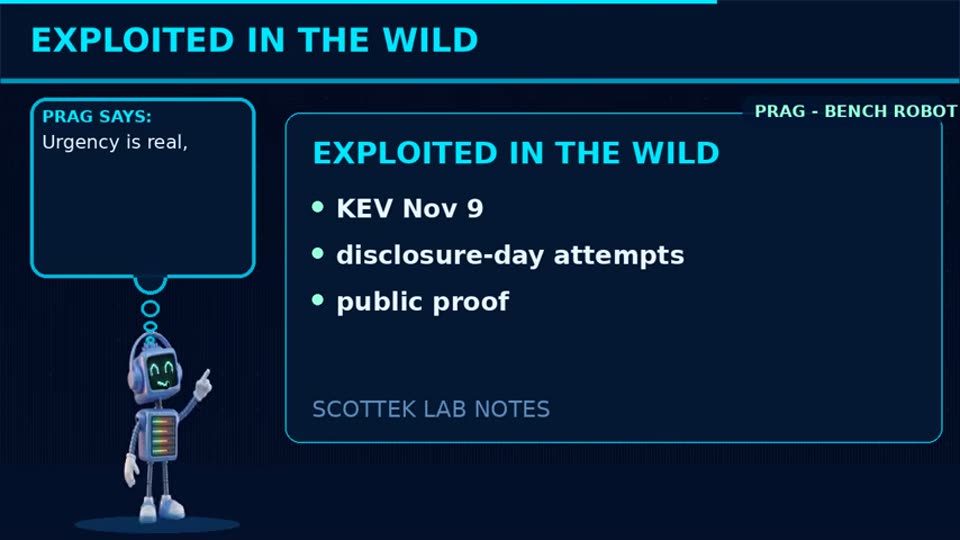
The video's urgency case rests on three facts: the November 9 KEV listing, attack attempts seen on disclosure day, and a public proof-of-concept. With all three confirmed, waiting is not a strategy.
Cloud images and containers, explained
Small cloud images and containers that ship no SSH server are safe by default — there is nothing to bypass. They become exposed the moment you install openssh-server alongside password-capable accounts, so apply the same three checks to any image you customize.
Sources and credit
The hole, the three conditions, the fixed builds, and both fixes are the video's, verified on its Alpine 3.24 bench. Primary sources: the sshhole overview, the Alpine Linux advisory of November 5 2026, the OpenSSH 10.6p2 release notes, and the NVD record for CVE-2026-123158. CISA KEV and disclosure-day exploitation claims are video-attributed. No exploit steps are included here by design — check, patch, verify, hunt.