Install Heretic on Ubuntu (Mod Local AI Models)

Companion guide and video starting point
This article is a companion to the video, not a replacement for it, and the video is the starting point for everything below.
In the video: the presenter installs Heretic 2.0 on Ubuntu, a tool that modifies a local AI model without retraining by steering behavior with math instead of expensive training, then verifies the install, tours the config files, and runs an optimization pass on a 4B example model.
Added from the sources: every consequential claim below is checked against the official Heretic repository, the v2.0.0 release notes, and the heretic-llm 2.0.0 package page, all checked November 2026. Anything not independently verified is marked untested rather than stated as fact.
What Heretic 2.0 is and where it officially lives
In the video: the official source is the GitHub user PEW and the repository heretic, and the Python package is Heretic LLM, with release 2.0 landing November 1st.
Added from the sources: the auto captions garble the owner name, so it was verified directly. The official repository is p-e-w/heretic, which confirms the PEW spelling from the video as the GitHub user p-e-w. The v2.0.0 release is dated November 1, 2026, and the PyPI page publishes heretic-llm 2.0.0 with files uploaded November 1, 2026. The project describes itself as training-free language model modification that steers behavior with contrasting example prompts and matching scorers instead of expensive training.
What you need before installing
In the video: you need Ubuntu, Python 3.10 or newer, and PyTorch 2.6 or newer, with Ubuntu 24.04 shipping Python 3.12 and the install pulling PyTorch for you, plus a graphics card strongly recommended for real model runs.
Added from the sources: the package page instructs users to prepare a Python 3.10 or newer environment with PyTorch 2.6 or newer installed as appropriate for their hardware, which matches the video requirements exactly. The Ubuntu 24.04 Python version and the graphics card recommendation are video claims carried through as stated, against the backdrop of the Ubuntu 24.04 Noble release the video builds on.
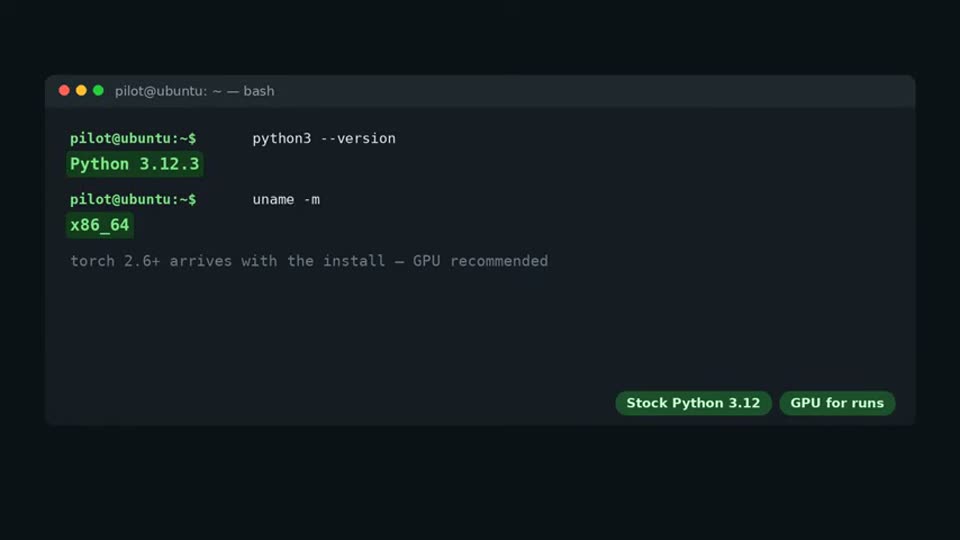
- Stock Ubuntu 24.04 satisfies the Python floor with room to spare, so no special Python setup is shown in the video.
- PyTorch arrives as a dependency of the package install, and the download is large, so budget disk space and time accordingly. The exact size is untested here.
- A graphics card is strongly recommended for real model runs, and the video runtime figure below assumes one. GPU behavior is untested here.
Install and verify the tool
In the video: install with pip, which fetches Heretic plus its dependencies including PyTorch, then verify with pip show printing version 2.0.0 and heretic --help listing every setting from model to scores to modifiers.
Added from the sources: the package page gives the install as pip install -U heretic-llm, which matches the video install step.
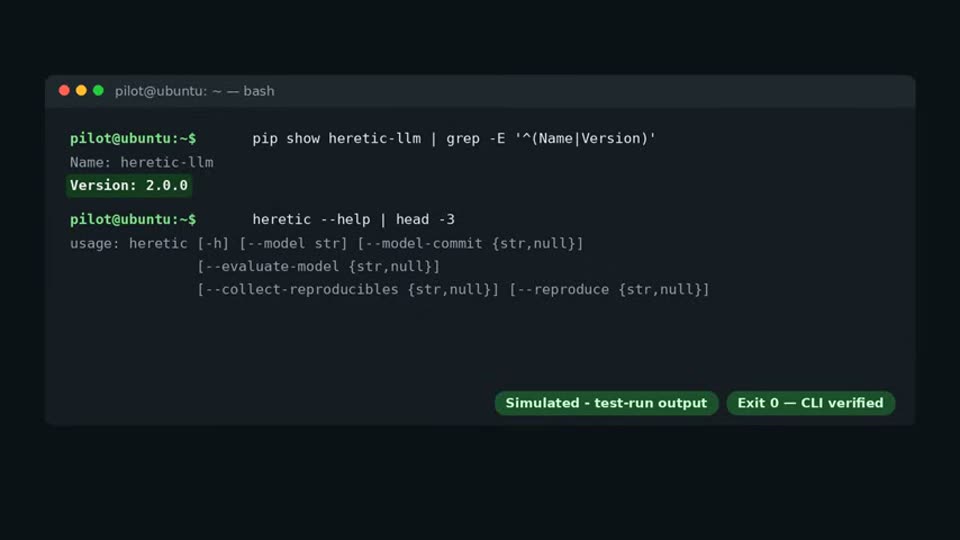
- Install with
pip install -U heretic-llmand expect a large download because PyTorch comes along. - Verify with
pip show heretic-llmand look for version 2.0.0. - Verify with
heretic --helpand look for the model, scoring, and modifier options. - The install and both verification commands are untested here, since this guide was grounded in the video plus official docs with no local run.
Pick what it does with a config file
In the video: download the default config and inspect it, noting the scorer section controls what gets optimized, with sibling files covering no slop, no sycophancy, and emotions, and old 1.x configs will not load.
Added from the sources: the v2.0.0 release notes confirm the breaking change directly, stating configuration files made for Heretic 1.x are not compatible with Heretic 2.0 and pointing to the migration guide. The package page lists the default censorship-removal action plus the config.noslop.toml, config.nohumor.toml, config.nosyco.toml, and config.emotions.toml variants, and the raw default config is available to download and read before running anything.
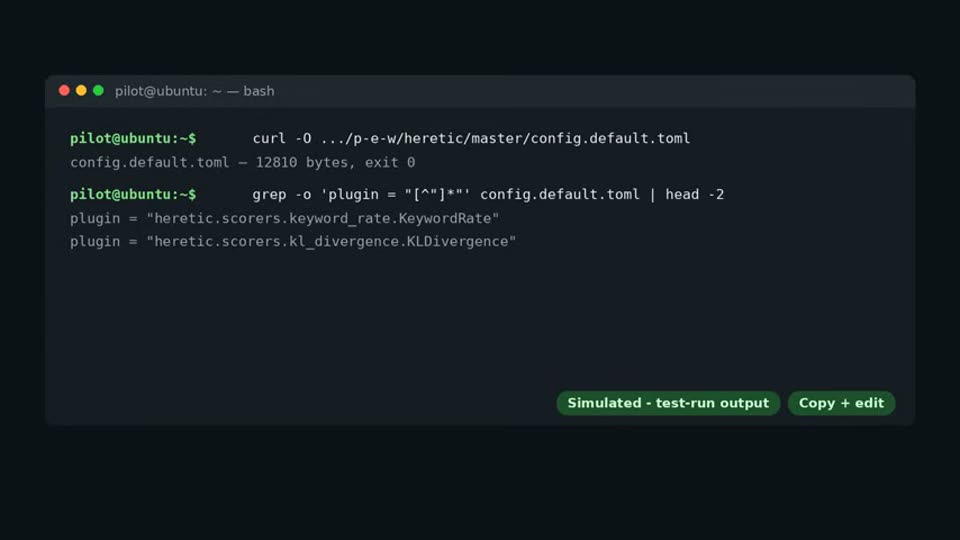
- Fetch the default config file and read the scorer section before changing anything.
- By default Heretic scores refusal rate with
KeywordRateand divergence from the original model withKLDivergence, and any number of scorers can be co-optimized. - Sibling configs switch the goal to less slop, less sycophancy, altered emotions, and more, so pick the file that matches the behavior change you actually want.
- Never reuse a 1.x config on 2.0, and check the migration guide if you have old files to convert. Config behavior is untested here.
Process a model and what to expect
In the video: process a model by passing its name, as in the 4B example, after which Heretic benchmarks the system first and then runs the optimization, with 30 to 40 minutes expected for that size on a 3090.
Added from the sources: the documented first run is heretic Qwen/Qwen3-4B-Instruct-2507, with the model name swapped for whatever you want to process, per the package page. That same page states Heretic benchmarks the system at the start of a run to set the optimal batch size and gives about 30 to 40 minutes on an RTX 3090 with the default configuration for Qwen3-4B-Instruct-2507, matching the video timing exactly. After processing, the page says you can save the model, upload it to Hugging Face, chat with it to test the result, run standard benchmarks, or combine those actions.
- Start small, as the video advises, with a 4B-class model before attempting anything larger.
- Check the output before uploading anything anywhere.
- The 30 to 40 minute figure assumes an RTX 3090 and the default configuration, so other cards and configs will differ. The full model run is untested here.
Practical notes and what stayed untested
- This guide was built from the video transcript plus the official docs linked above, with no Prag research folder and no local install run, so every hands-on step above carries an untested mark.
- The one fact the transcript left uncertain, the PEW owner name from the auto captions, was resolved by direct check. The real repository is p-e-w/heretic.
- Refusal removal is the default action of the tool, so use it only on models you have the right to modify and keep your publishing within the relevant rules.
- Get PyTorch right for your hardware first using the PyTorch install guide, since that is the heaviest dependency in the chain.
- If anything here disagrees with a newer release, the repository and the release notes win over this page.