Self-Host MAX + Mojo: the License-Honest Guide (26.7 Is Source-Available, Not Open Source)

Companion guide and video starting point
This article is a companion to the video, not a replacement for it, and the video is the starting point for everything below.
In the video: a 547-second walkthrough reads the actual MAX license before installing anything, because the landing page says open source while MAX 26.7, released October 22nd, 2026 with Mojo 1.2.0, is source-available under a proprietary MAX License modified October 21st, 2026, from Modular, now a Qualcomm company, while the Mojo language itself is genuinely open source under Apache 2.0 plus LLVM.
Added from the sources: the license framing was checked against the MAX License FAQ and the full MAX License, the release against the Modular 26.7 announcement and the max/v26.7.0 GitHub release, and the install path against the MAX quickstart and the PyPI max 26.7.0 page. A Prag research folder exists for this video, and its script and ledger grounded the outline, with every consequential claim below checked against these primary sources. The presenter's serve demo is explicitly labeled in the video as a dramatized illustration, not a benchmark run on local hardware, and install and serve steps here are marked untested here.
Read the license before you install
In the video: the plain version is that you can run and modify MAX locally and ship object-code apps you build with it for free, but you cannot publish modified MAX source except a fork that contributes back, you cannot feed MAX into an AI system to reimplement it, and commercial hosted inference needs Modular Accelerated branding approval, with telemetry on by default.
Added from the sources: the MAX License FAQ confirms the shape of the deal, a license that lets anyone use, modify, and build commercial products with MAX with no fees or royalties, while barring publication of modified MAX source elsewhere. The full license confirms the usage-data clause, collection of telemetry on interactions with MAX, governed by the privacy policy. The same FAQ confirms telemetry is on by default and gives the two opt-outs, MODULAR_TELEMETRY_ENABLED=0 for Mojo and low-level MAX telemetry and MAX_SERVE_DISABLE_TELEMETRY=1 for model-serving telemetry, so decide your telemetry posture before your first run. The 26.7 announcement states the license rationale directly, that it allows nearly everything Apache 2.0 does while keeping one common software foundation. If any of the red lines touch your pipeline, stop here and price the alternatives, since the engineering below does not change the terms.
What 26.7 actually opened
In the video: 26.7 opens the three pieces that were still closed, the graph compiler, the runtime, and the device hooks, while kernels, models, and serving infrastructure were already out, making this the first release with the whole stack visible. On top of that come a real eager mode for custom ops sharing one code path with the graph compiler, support for Decider 2B decision models through new v1/decisions and v1/systemone endpoints, new checkpoints Muse Glimmer and MiMo-V2.6-Flash, video input for Qwen3.5 and Qwen3-VL, and a claimed 2.6x prefill speedup on Qwen and GLM families from ops that stay on GPU.
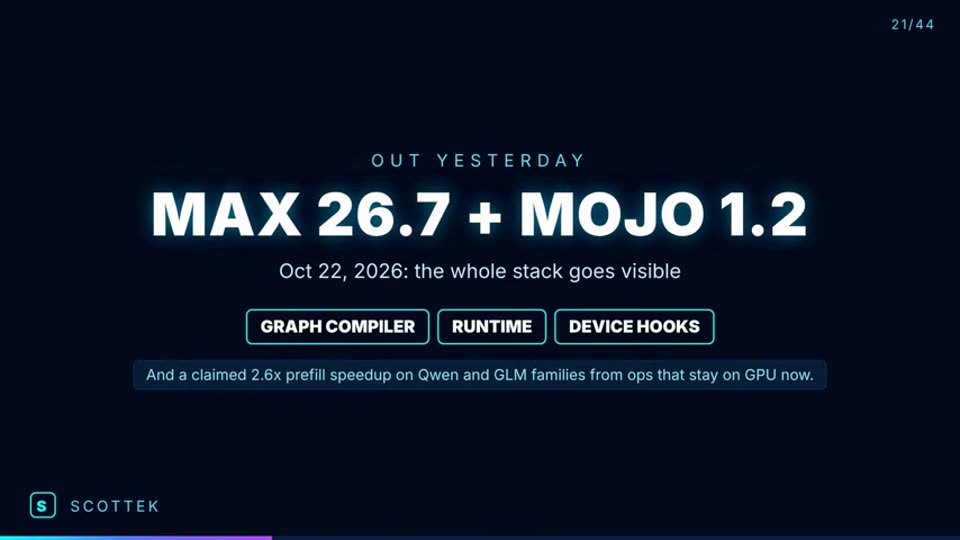
Added from the sources: the 26.7 announcement confirms the headline, that MAX is now fully source-available including hardware backends, the graph compiler, and the runtime, plus eager mode, decision-model support with Decider 2B, and the new model additions. The GitHub release confirms the max/v26.7.0 tag, the October 22nd date, the Decisions API, and the Mojo 1.2 pattern-matching and math-library work. Treat the 2.6x prefill figure as a vendor claim, per the video's own label, and validate it against your own workload before planning capacity around it.
Mojo 1.2 in ten lines
In the video: Mojo earned its place because the kernel story is real, shown as a teaching kernel of about ten lines, a closure over a vector addition dispatched with enqueue that compiles to CPU and GPU from one source file. Mojo 1.2.0 adds pattern matching with match and case, including compile-time match, plus faster large-package compiles and shared CPU-GPU math functions. The video is explicit that this is the shape of a kernel, not the size of one, since production fused-attention work runs to hundreds of lines.
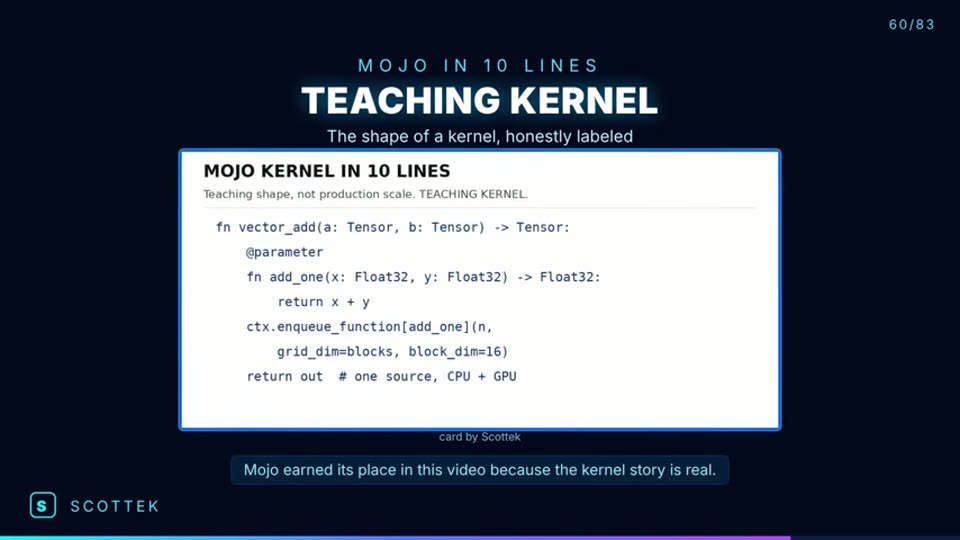
Added from the sources: the GitHub release confirms Mojo 1.2 pattern matching for literals, tuples, and structs across match, if, and while plus destructuring, more than 20 shared std.math functions across CPU and GPU, faster large-package compiles with jemalloc cutting big GPU kernel builds roughly 10 to 13 percent on Linux, and StringSpan going immutable. Start from the teaching shape, then grow into the changelog's real list before writing production kernels.
Install it the right way
In the video: one correction before copying anything, because the landing page still shows a stale pip install modular line. Do not use it. The documented path is pixi add max-all, or uv and pip with max[all]. Serve one model with max serve --model plus the Hugging Face ID, export your HF_TOKEN first for gated checkpoints, then point any OpenAI-compatible client at localhost:8000/v1. You need Linux with glibc 2.34 or newer, or macOS Sequoia on Apple Silicon M1 through M5, with Windows covered by WSL only. Modular recommends datacenter GPUs, and consumer cards run with fewer supported models.
Added from the sources: the MAX quickstart confirms the install commands, pixi add max-all after pixi init, or uv add "max[all]" in a venv, plus export HF_TOKEN="hf_..." and max serve --model with a model ID, and it states the datacenter-GPU recommendation, naming B200, H200, H100, MI355X, MI325X, and MI300X while warning that consumer systems get fewer compatible models and slower performance. The PyPI page confirms pip install "max[all]", the October 22nd release date, and the glibc 2.34 floor on Linux x86-64. The stale landing-page line is the video's finding, carried here as stated. Every install and serve command here is untested here, and the video's own serve segment is a labeled dramatization, so copy the commands, not any timings.
Where it runs and what it runs
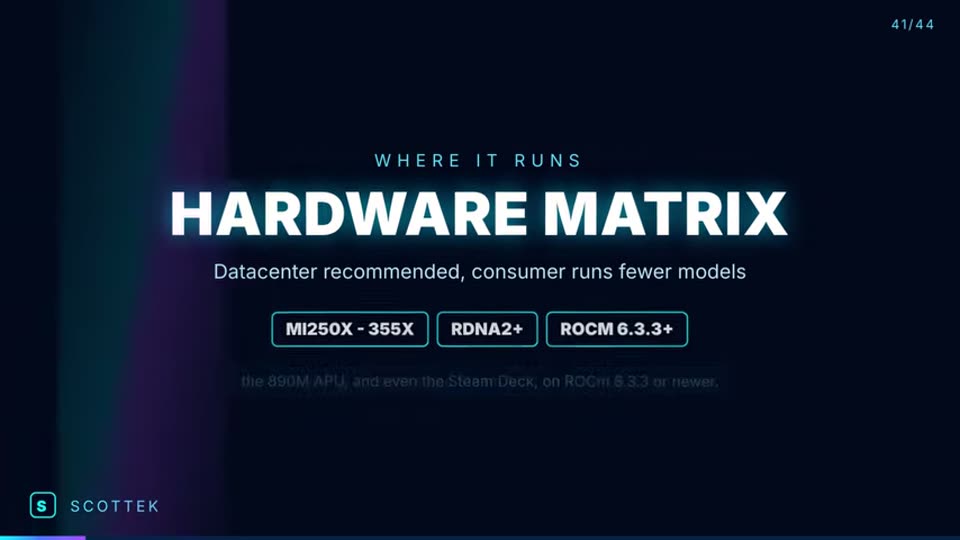
In the video: NVIDIA needs driver 580 or newer, from sm_75 up through Blackwell. AMD covers MI250X, MI300X, MI325X, and MI355X, plus RDNA2 and newer including the 7900 and 7800 cards, the 890M APU, and even the Steam Deck, on ROCm 6.3.3 or newer. Apple Silicon M1 through M5 serves at tier two, model by model with gaps, and FP4 needs an M5. CPUs need x86-64-v3 or Neoverse-N1. Qualcomm Dragonfly and Google TPU plugins are promised, not delivered, so treat them as roadmap. MAX runs an allowlist, not everything: Llama, Qwen, Gemma, GLM, Kimi, MiniMax, Nemotron, DeepSeek, Step, Hunyuan, and LFM families, with text plus image on Gemma 4 and Qwen-VL, FLUX.2 and Qwen-Image for image generation, Wan for video, and MiniMax-Music3 for audio.
Added from the sources: the 26.7 announcement confirms the plugin roadmap point, with Dragonfly and Google TPU sources arriving in the coming months rather than today. The driver, architecture, and model-family lists are the video's claims, carried here as stated, so check the model table and the GPU-compatibility list before planning a deployment around any checkpoint. On performance, the video cites one independent data point, an L40 run of Qwen3-8B finishing 500 prompts in 50.6 seconds against 54.2 for SGLang and 58.9 for vLLM, plus a Spheron result near 16 percent over vLLM at 50 concurrent requests on H100, with vendor claims reaching 2x marked as vendor on screen. Treat that as one documented data point, not a leaderboard, and note the video's own caveat that SGLang beats vLLM on several shapes. Install MAX if you serve open models across mixed hardware and accept source-available terms, if eager debugging on the ship path matters, or if decision models and video-input Qwen fit a real workload. Skip it if you must publish modified runtime source, if the AI-reimplementation ban touches your pipeline, or if unbranded commercial hosting is non-negotiable, and keep this next to the site's LiteLLM gateway guide when comparing single-API front ends.