8 MCP Server Flaws Patched: Update Before Your Agent Leaks

This guide is a companion to the video walkthrough and never replaces it. It retells what the video presents, adds release and advisory records checked for this guide, and stays defensive only with patch, update, and harden guidance. Every hands-on step described here is untested in this guide.
Watch the video first
Watch the video on YouTube before following along. The video runs about 553 seconds, was published on 2026-10-28, and is a homelab patch-now walkthrough for self-hosted MCP servers with a live client-config audit and a five-step lockdown.
What the eight advisories cover
- In the video: eight security advisories landed in one morning for the small programs that let an AI agent touch files and the web.
- Verified for this guide: the eight advisories live on the reference servers security advisories page, all published Oct 25, 2026 in the modelcontextprotocol servers repo.
- In the video: the affected pieces are the filesystem server, the fetch server, and the everything demo server, all listed in a client config that starts them when the client starts.
- Verified for this guide: Model Context Protocol documentation describes MCP as the open protocol for giving outside tools to AI apps, which matches the video level-set — untested in this guide.
Filesystem flaws and the fixed version
- In the video: four filesystem-server flaws let writes or listings escape the allowed folders, including a parent-folder race on new-file writes, a trailing quote and whitespace check mismatch, a case-variant symlink bypass on case-insensitive disks, and a directory listing that followed symlinks when reading sizes.
- Verified for this guide: the advisory list records the same four filesystem issues with scores 2.2, 4.2, 5.3, and 3.1, and the v2.1.0 release notes ship the filesystem fix in 2.0.1.
- In the video: date versions through 2026.8.31 carry the filesystem issues, and the case-trick issue is a regression from the August 31 date release.
- Verified for this guide: the version history write-up lists affected filesystem versions as 1.0.0 through 2.0.0 plus date versions through 2026.8.31, fixed in 2.0.1 — untested in this guide.
- In the video: on Windows the race fix is only partial, so harden Windows hosts regardless — untested in this guide.

Everything server flaw and the fixed version
- In the video: the highest score of the eight, a 6.5, sits in the everything server HTTP transports, which never checked the Origin header and always answered with an allow-anywhere header, so any open web page could call server tools including environment-variable output and read results back.
- Verified for this guide: the advisories page records the everything issue as Moderate 6.5 with cross-origin refusal and wildcard-header removal as the fix, applying only to HTTP runs rather than the usual stdio mode.
- In the video: the everything server is a demo box, but demo configs get copied into real setups, and every version from last September through 2.0.0 carried the issue.
- Verified for this guide: the version history write-up lists affected everything versions as 1.0.0 through 2.0.0 plus date versions 2025.9.24 through 2026.8.31, fixed in 2.0.1 — untested in this guide.
- In the video: if you ever exposed one over HTTP, rotate anything that lived in its environment — untested in this guide.
Fetch flaws and the fixed version
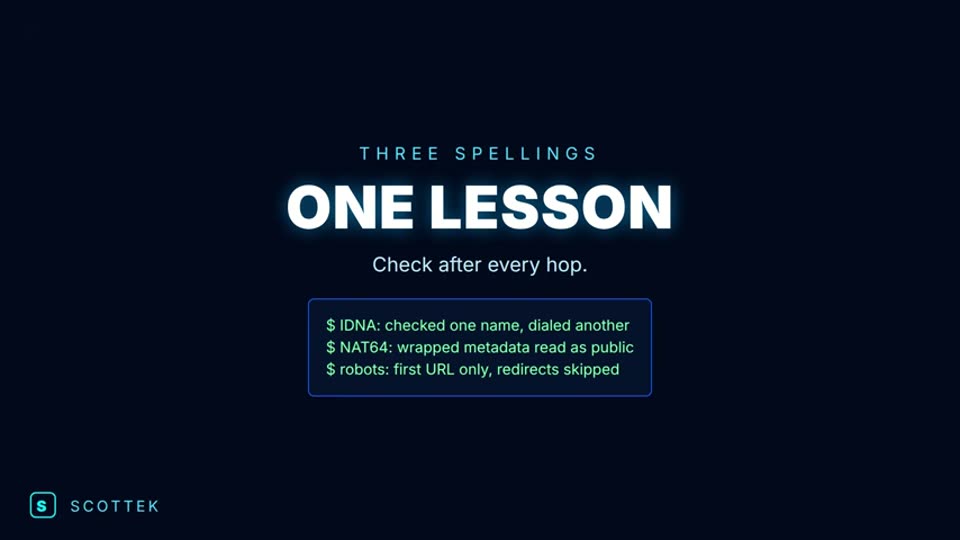
- In the video: the Python fetch server got three fixes about the line between public and internal addresses, covering internationalized hostnames, the NAT64 prefix, and robots rules checked only for the first URL before redirects.
- Verified for this guide: the advisories page records the same three fetch issues, with the NAT64 prefix 64 colon ff9b range judged by the carried IPv4 address after the fix and robots checks rerun after every redirect.
- In the video: the guard has to look at what is actually fetched, not what was first asked for.
- Verified for this guide: the PyPI fetch project page is the official Python package record, and the version history write-up lists affected fetch versions through 2026.10.19 with the fix in 2026.10.24 — untested in this guide.
Name the version yourself and restart the client
- In the video: the TypeScript servers moved from date versions to semantic versions at 1.0.0, so 2.0.1 ranks below every date version like 2026.8.31 in the package manager's eyes and the updater will not offer the fix.
- Verified for this guide: the version history write-up confirms the same upgrade trap and names the explicit fixed versions as filesystem 2.0.1, everything 2.0.1, and fetch 2026.10.24.
- In the video: pin the fixed versions in the client config args so the launcher cannot drift back to a date release, then restart the client because servers start once per client session — untested in this guide.
- In the video: the presenter audits a homelab-style client config on screen, finds drifted date pins, re-pins to the fixed versions, and checks what is actually running rather than what was thought to be installed — untested in this guide.
- In the video: check what you actually run tonight, not what you think you installed — untested in this guide.
Why this week and the five-step lockdown
- In the video: the wider month is framed as the agent trust-boundary month, with protocol-pivoting exfiltration, sandbox escapes, a quiet coding-agent sign-in fix, and a poisoned gateway release with a two-hour package window.
- Verified for this guide: independent agent-pivoting research is reported by Ars Technica, red-team sandbox escapes by The Hacker News, the Windows sign-in code-execution fix in OpenCode 1.18.33 with builds 1.0.137 through 1.18.32 at risk and no CVE by The Hacker News, and the LiteLLM exposed-key supply-chain postmortem by The Register.
- In the video: the five-step lockdown is pin every MCP server version and check advisories like any other dependency, prefer stdio transport and never publish a debug-style server over HTTP, keep allowed directories minimal and recheck after every config change, give fetch an egress story with no internal metadata in reach and hostile redirects assumed, and rotate provider keys, cloud tokens, and anything in an exposed environment.
- Verified for this guide: rotation rather than upgrade-only matches the postmortem lesson that stolen keys stay valid until rotated — untested in this guide.

Verdict for tonight
- In the video: the fixes are out and small, the trap is documented, and the job is pin 2.0.1 for the two Node servers and 2026.10.24 for fetch, restart clients, shrink allowlists, and keep demo servers out of real configs.
- Verified for this guide: the release and advisory records above name the same fixed versions, so treat the client config as the source of truth and recheck it after every change — untested in this guide.
This article contains no affiliate links.