llama.cpp 0.7: the One-Flag MoE Speedup, the New Port, and the Models Manager (2026 Guide)

This companion guide starts from the video llama.cpp 0.7: 2x Faster Local AI on One GPU and adds grounded detail from the upstream release notes and the llama.cpp router-mode documentation. Watch the video first for the full narrated breakdown, then use the sections below as the written reference. The episode runs as a narrated breakdown rather than a filmed live deployment, so every section keeps In the video claims apart from Added from the sources research, and nothing here was tested against a live build.
What 0.7.0 actually is
- In the video: llama.cpp shipped version 0.7.0, tagged 15 October 2026, as a named minor release at commit
620d222, which is unusual because the project normally ships anonymous build tags. - Added from the sources: the v0.7.0 release notes confirm the 15 October tag and the
620d222commit, and the Prag research notes record the version bump arriving via PR #30603, all checked October 2026. - In the video: the headliners are a host-memory expert cache for MoE models, two new speculative-decoding paths, a pile of new model architectures, a refactored server chat layer, a full models manager in the web UI, and ggml bumped to 0.27.0, drawn from well over a hundred merged pull requests.
- Added from the sources: the release overview lists the same headline set, LiliCorr speculative decoding plus MTP for GLM5-Next, the
--moe-cache-mibexpert cache, the new model batch, the refactored chat session API with part-based output, slot and prompt-cache restore work, decision-model support, the new default port, the Models Manager, and ggml v0.27.0, checked October 2026.
The expert cache that can double offloaded decode
- In the video: big mixture-of-experts models do not fit on one GPU, so most of their experts live in host RAM and cross PCIe on every token, and that shuttle is the bottleneck that makes offloaded MoE feel sluggish.
- In the video: the new
--moe-cache-mibflag keeps a least-recently-used cache of those host-memory experts on the GPU, so hot experts run locally and only cache misses get uploaded, covering batches of up to 32 tokens and shared automatically across multi-GPU rigs. - Added from the sources: the release highlights confirm
--moe-cache-mibas a GPU LRU cache for host-memory experts with up to 2.2x faster decode, the follow-up patch sharing the cache across multiple GPUs, and the newmoe_cache_sizecontext parameter ininclude/llama.h, checked October 2026.
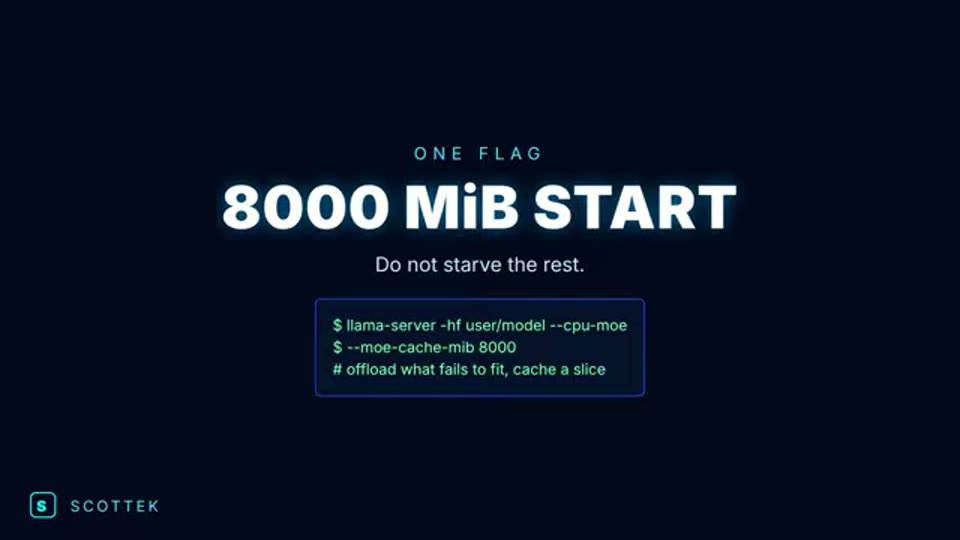
- In the video: upstream reports up to about 2.2 times faster decode when experts are offloaded, explicitly framed as their figure on their hardware as a best case, while a separately labeled independent tester running a 78 GB quant with one 16 GB card measured generation rising from 14.95 to 19.26 tokens per second with an 8,000 MiB cache, roughly a 29 percent lift with prompt processing unchanged.
- Added from the sources: the 2.2x ceiling is the upstream figure from the v0.7.0 release notes, reported here only as a repo claim and never as a tested result, while the 14.95 to 19.26 tokens-per-second measurement is a third-party fork result described in the Prag research notes and was not independently verified here.
- In the video: the usage recipe is one flag, adding
--moe-cache-mibwith a size in MiB to thellama-serverorllama-clicommand paired with CPU-offloaded experts, with 8,000 as a sane starting point on a 16 GB card, and the honest caveat that a model which already fits on the GPU gains nothing because there is nothing to cache. - Added from the sources: treat every sizing step in this section as untested here, since no live build was run for this guide, and verify cache behavior against the llama.cpp server documentation during a real deploy.
Guessing ahead: speculative decoding and new architectures
- In the video: speculative decoding drafts a few tokens with a small fast model and lets the big model verify them in one pass, which changes how fast the model answers without changing what it says, and 0.7.0 brings that trick to model families that could not use it before.
- In the video: the two new paths are LiliCorr, which picks candidates with a small draft transformer on top of DFlash, and multi-token prediction for GLM5-Next with an optimized sparse-attention path, plus a new
--spec-draft-n-ubatchflag that sizes the draft batch separately to save VRAM. - Added from the sources: the v0.7.0 release notes confirm LiliCorr candidate selection with a small draft transformer on DFlash, MTP speculative decoding with an optimized sparse-attention path for GLM5-Next, and the
--spec-draft-n-ubatchflag for separately sizing the draft batch, checked October 2026. - In the video: the stacked model half of the release covers K2 Horizon in dense and MoVA flavors, Prism Bonsai 2 as a 27-billion-parameter ternary model, EmbeddingGemma-2 for text plus vision plus audio embeddings, MiniCPM-V 4.7 for multimodal work, and the maion-coder architecture.
- Added from the sources: the new-models section confirms K2 Horizon dense and MoVA variants, Prism Bonsai 2 27B ternary support, EmbeddingGemma-2 text plus vision plus audio embeddings, MiniCPM-V 4.7, the maion-coder architecture, day-one Nemotron Super 3.5 VL plus Nemotron Bolt 74B A9B support, and the Mellum fix that reads MoE gating parameters from the GGUF file, checked October 2026.
- In the video: the decision-model category gets its own minute, with tiny non-chat models that judge, route, and pick tools for agents, namely Liquid AI D1-3B and D1-Omni, vLLM decision 2 and D3, and the PPLX decider, all wired into the server
/v1/systemoneendpoint so an existing agent harness points at it with a URL change rather than a rewrite. - Added from the sources: the release notes confirm the LiquidAI d1-3B and d1-omni-600M, vLLM decision 2 and d3, and pplx-decider additions with
/v1/systemoneextended to the new decision models, checked October 2026.
The two server changes that break setups
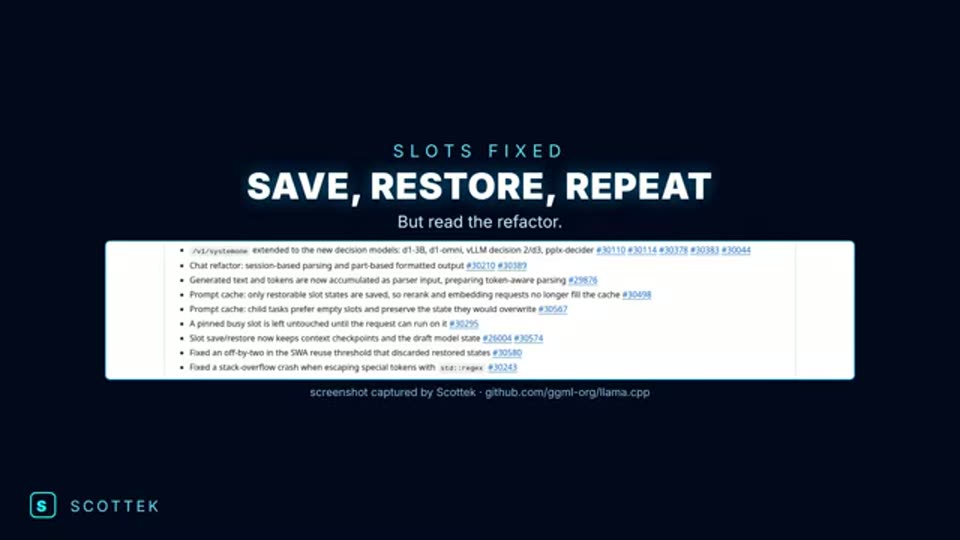
- In the video: slot save and restore got serious attention, with context checkpoints surviving, draft-model state saved with the slot, child tasks preferring empty slots instead of stomping the active one, the prompt cache storing only restorable states so rerank and embedding requests stop polluting it, and a
LLAMA_ARG_SLOT_SAVE_PATHenvironment variable for the slot path. - Added from the sources: the v0.7.0 release notes confirm slot save and restore keeping context checkpoints plus draft-model state, the prompt cache saving only restorable slot states, child tasks preferring empty slots, and the
LLAMA_ARG_SLOT_SAVE_PATHvariable for--slot-save-path, checked October 2026. - In the video: underneath sits the refactor to bite on, where the chat layer is now session-based and formatted chat output returns an array of parts instead of a single string, so any script parsing chat completions as plain text breaks and owners should pin the build or patch the parser before upgrading anything automated.
- Added from the sources: the API-changes section confirms the chat layer refactor around
common_chat_sessionwithfeed()andfinish()and formatted chat output as an array of parts instead of a single string, checked October 2026.
- In the video: the headline breaking change is that
llama-servernow listens on port 9931 by default instead of 8080, Docker images keep 8080 inside the container so compose setups are untouched, but every bare-metal command, web UI connection, curl one-liner, and firewall rule aimed at 8080 needs a look, with the recommended order of updating bookmarks and client configs first, flipping the server second, and verifying each integration one by one. - Added from the sources: the release notes confirm the default listening port moving to 9931 with Docker images keeping 8080 inside the container, and readers should note that older write-ups such as the router-mode blog show
curlexamples against port 8080 that predate this change, all checked October 2026.
Models Manager, router mode, and cheaper embeddings
- In the video: the most visible change is the web UI growing a real models manager, with one table of every served model, expandable quants, search, filters, sorting, favorites, row actions to load and unload models, deletion from disk, hiding untouched models, resumable downloads with progress, and a config side drawer with model info and the chat template.
- Added from the sources: the release notes confirm the new Models Manager with one table of served models, expandable quants, search, filters, sorting, favorites, load and unload row actions, delete-from-disk, hide and unhide, resumable downloads with progress, and the model-configuration side drawer, checked October 2026.
- In the video: paired with router mode, starting
llama-serverwith no model auto-discovers the cache or a--models-dirfolder, loading on demand and evicting least-recently-used past--models-max, which reads as Ollama-style management without leaving llama.cpp and fits a homelab serving three or four models to a household. - Added from the sources: the model-management blog confirms starting the server with no model enters router mode, auto-discovery from the
LLAMA_CACHEcache or a--models-dirfolder, on-demand loading, least-recently-used eviction past--models-maxwith a default of 4, and per-model presets, checked October 2026. - In the video: embedding models now skip the language-model head entirely when pooling is on, worth up to 10 times less VRAM for embeddings, which turns retrieval and semantic search from a second-GPU job into a background task and pairs with the new EmbeddingGemma-2 support, while underneath ggml brings faster kernels across CUDA, Vulkan, Metal, and CPU plus tensor-parallel RPC servers.
- Added from the sources: the release notes confirm embeddings skipping the logits buffer and LM head when pooling is enabled for up to 10x less VRAM, the ggml update to v0.27.0, and RPC tensor-parallel support on RPC protocol v8, checked October 2026.
The tonight upgrade path and its traps
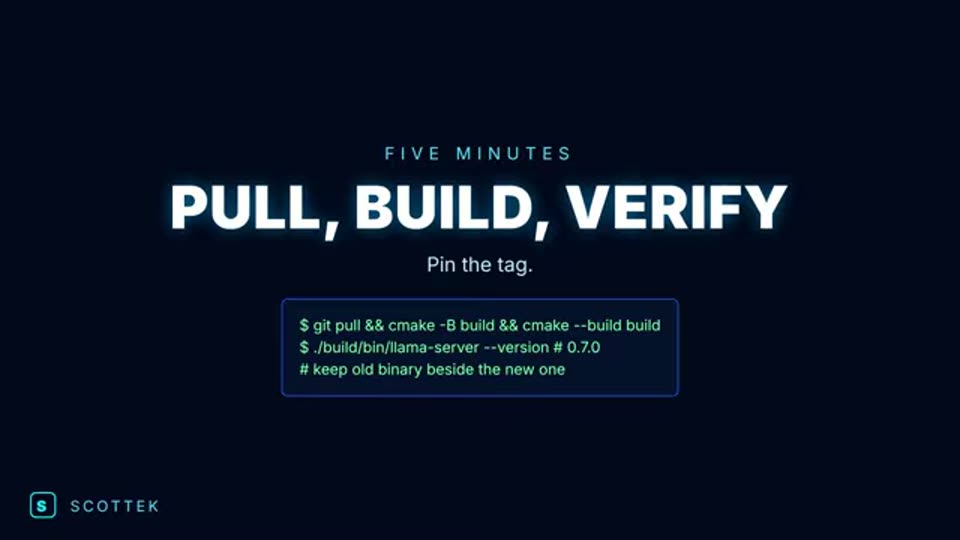
- In the video: for a source build, pull latest, rebuild, confirm the version string reads 0.7.0, and keep the old binary next to the new one until every client is happy, while Docker users should pin the 0.7.0 tag explicitly rather than floating latest so the port change lands on schedule.
- In the video: start the server once with no flags and confirm the log line showing 9931, a single line that proves the upgrade took, then pull the Nemotron Bolt 74B quant with the server
-hfflag straight from Hugging Face, adding--moe-cache-mibfor the expert cache and setting--portexplicitly, or skip the flags, start bare in router mode, and load the model from the web UI table with resumable progress. - Added from the sources: every command and step in this section is untested here, since no live build or model pull was run for this guide, so treat the recipe above as video-reported starting points and verify each flag against the v0.7.0 release notes and the llama.cpp server documentation during a real deploy.
- In the video: three traps close the episode, starting with the parts-array output silently breaking scripts that assume plain strings, then the 8080-to-9931 port move on bare metal with Docker exempt, then cache sizing as spent VRAM where every megabyte in the cache is a megabyte not holding layers or context, starting at 8,000 MiB on a 16 GB card and tuning from measured tokens per second, plus the bonus fourth that small fully resident models gain no speed from this release.
- In the video: the verdict is that half-offloaded MoE runners get their biggest free upgrade of the year and should set the cache flag tonight, small-model runners should upgrade for the Models Manager, router mode, and new architectures while budgeting ten minutes for the port migration, and anyone scripting against the server patches the parser first.