Beam 1.0 501B: Self-Host the Open Weights

This companion guide starts from the video Beam 1.0 501B: Self-Host the Open Weights and adds grounded detail from the Reflection availability post, the Hugging Face Beam walkthrough, the Beam model card, the Ollama beam library page, and the Unsloth GGUF repo. Watch the video first for the full narrated deployment tour, then use the sections below as the written reference. The video is a narrated explainer with on-screen recipes rather than a filmed live install, so every section keeps In the video claims apart from Added from the sources research, and anything not run here is marked untested.
What Beam 1.0 actually is
- In the video: Reflection's first open-weight model, released October 16, 2026. A sparse mixture of experts with 501 billion total parameters and about 23 billion active per token, 52 layers, 256 experts per MoE block with eight routed per token. It stores like a 501B model but computes roughly like a 23B one, with 1M token context, text in and text out, English first, and a June 30 knowledge cutoff.
- In the video: the license term that matters. The weights are Apache 2.0 with commercial use allowed, but the training data is not open. Say it right: open weights, not fully open source.
- Added from the sources: the Hugging Face walkthrough confirms the 501B total with 23B active, the 52-layer shape with 256 experts and eight routed per token, the 1M context, and the three checkpoints described below, checked October 2026.
- Added from the sources: the model card lists the same shape at 501.3B total and 23.4B active with a June 30, 2026 cutoff, and its benchmark table is vendor-reported, so treat every score as Reflection's own numbers, checked October 2026.
- Added from the sources: this video is the host-it sequel to the channel's earlier use-it guide on Beam as a coding agent through Ollama, which is also in the site grid at Beam 501B on Ollama. Watch that one for the agent side, this one for the deployment side.
Three checkpoints, three GPU doors
- In the video: Reflection ships three checkpoints and picking one is really picking your GPUs. BF16 is the full-fidelity original at about a terabyte on disk. FP8 halves that to around 503GB and suits Hopper, Ampere, and older cards. NVFP4 is the lean one at roughly 294GB, most weights in four bits with a few kept in BF16 for accuracy, and it wants Blackwell cards to run natively. A DFlash2 speculative drafter ships alongside for faster decoding.
- Added from the sources: the Hugging Face walkthrough confirms the same three footprints, BF16 near 1TB of safetensors, FP8 for Hopper/Ampere and older, NVFP4 near 280 to 294GB needing Blackwell, plus the DFlash2 drafter and fused kernels, checked October 2026.
- Added from the sources: the weights live under the reflection org on Hugging Face under Apache 2.0, with the model card and a safety technical report alongside, per the availability post, checked October 2026.
The VRAM math, read twice
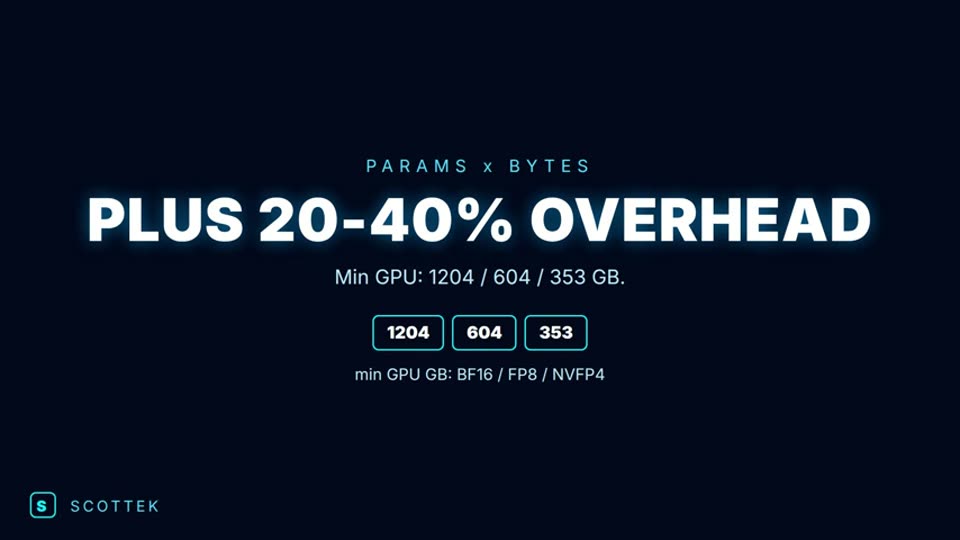
- In the video: memory is parameters times bytes each plus overhead. 501 billion times two bytes is about a terabyte for BF16, one byte each is about 500GB for FP8, half a byte is about 250GB at four bits, then add 20 to 40 percent for KV cache, activations, and fragmentation, worse at long context. The published minimums land at roughly 1204GB of GPU memory for BF16, 604GB for FP8, and 353GB for NVFP4. One gaming GPU is not playing here.
- Added from the sources: independent deploy math points the same way, with weights equal to parameters times bytes plus 20 to 40 percent for KV, activations, and fragmentation as the standard floor formula, checked October 2026.
Production route one: vLLM with day-zero support
- In the video: the documented vLLM recipe serves the NVFP4 checkpoint with tensor parallel across four GPUs, FP8 KV cache, and Beam's own tool-call and reasoning parsers. Hardware-wise that means four B200 or B300 cards, one GB200 or GB300 tray, or eight H100s. FP8 steps up to eight H200s and BF16 wants eight B200 or B300 class cards. Datacenter, not desk-side, and that is the honest headline.
- Added from the sources: the Hugging Face walkthrough gives the same recipe shape, serving the NVFP4 checkpoint with tensor parallel 16 in the BF16 layout example and the NVFP4 model path variant, with SGLang alternatives beside it, checked October 2026.
- Untested here, so confirm the exact flags against the walkthrough before committing a cluster to them.
Production route two: SGLang at scale
- In the video: SGLang is the second production path, also day-zero. Blackwell boxes launch the NVFP4 checkpoint with tensor parallel four, Hopper gear switches to the FP8 checkpoint with tensor parallel eight, the FA3 attention backend, page size 64, and the full million-token context length. Reflection's own production dashboard runs SGLang on Blackwell at scale, so this is the stack they monitor, not a sample config. Same memory floors as vLLM, so pick whichever engine your team already operates.
- Added from the sources: the Hugging Face walkthrough confirms the SGLang recipes, NVFP4 at tensor parallel four and FP8 at tensor parallel eight with the FA3 backend, page size 64, and million-token context, checked October 2026.
- Untested here, so verify the launch flags against the walkthrough for your GPU generation before serving.
The workstation squeeze: GGUF on big RAM
- In the video: Unsloth published GGUF quants that trade quality for footprint, from a roughly 103GB one-bit build through 187, 197, and 242GB steps up to a recommended four-bit build near 306GB. The rule is simple: RAM plus VRAM must clear the file size with headroom left for context. The one-bit file runs on 128GB of RAM with a 24GB card but loses the most quality, while the four-bit sweet spot wants a 512GB Mac Studio or a workstation with 384GB or more.
- In the video: one version gate before downloading anything. Beam's architecture merged into llama.cpp on October 16 and needs build b11701 or newer, still pre-release when checked, since older builds will not even recognize the model. The serve shape is familiar: llama-server with the Unsloth repo and the chosen quant, jinja templates on, temperature 0.7, top-p 0.99, and MoE offload flags for big-RAM boxes, giving a local OpenAI-compatible endpoint on port 8080 with a web UI. Community quants can lag release day, so check the model page tonight rather than trusting a cached link.
- Added from the sources: the Unsloth GGUF repo lists the same quant ladder including the UD-IQ1_S and UD-Q4_K_XL builds, with llama.cpp architecture support merged October 16 needing a current build, checked October 2026.
- Untested here, so verify the build version and the exact serve flags against the repo before downloading hundreds of gigabytes.
The fallback for everyone else: beam:cloud
- In the video: one Ollama tag exists, beam:cloud, free for a limited time after signing in. The commands are short:
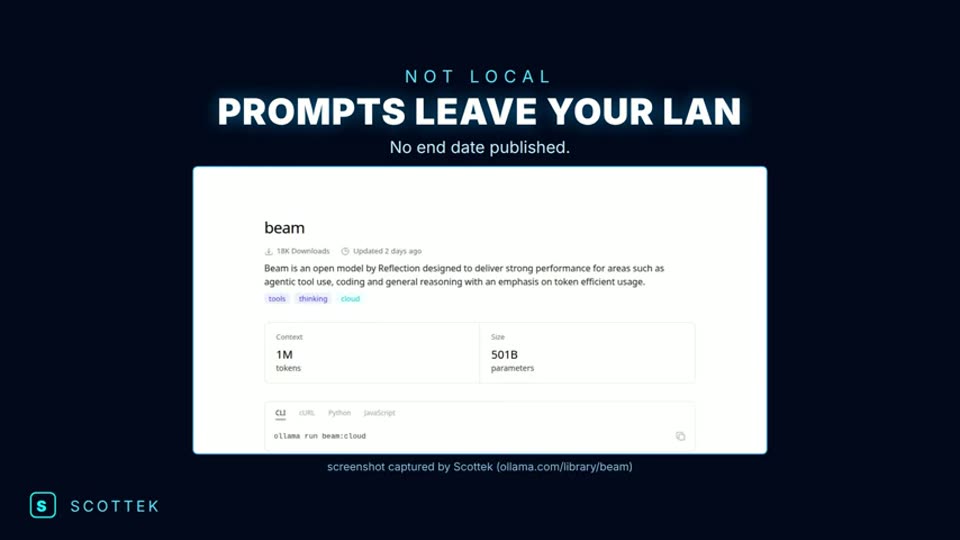
ollama run beam:cloudfor chat, or pointing Claude, Codex, OpenCode, or Hermes at beam:cloud for agents. It is US-hosted with full zero data retention, the right call for private code, but be clear about what it is. Your prompts leave your LAN, there is no local Beam tag in Ollama yet, it is borrowed compute rather than self-hosting, and Ollama has published no end date for free. Use it tonight, do not plan around free forever. - Added from the sources: the Ollama beam library page confirms beam:cloud is a cloud model requiring the Ollama app and sign-in, free for a limited time with US hosting and full zero data retention, and no local Beam tag was listed as of October 19, checked October 2026.
Something to drive it: Mirror CLI, then the verdict
- In the video: Reflection's answer is Mirror CLI, the open harness trained alongside Beam, a Python frontend over a minimal Rust agent core with resumable sessions, parallel agents in separate worktrees, project instructions, skills, MCP connections, and Python extensions. Beam was also tested with Pi, OpenCode, and Hermes for repo reading, file edits, and shell commands. Around it sit 40-plus launch partners across clouds and inference shops plus Dell and HPE for on-prem installs: an open stack from laptop to datacenter with the model as the kernel.
- Added from the sources: the availability post confirms Mirror CLI as the open-source harness alongside day-zero Transformers, vLLM, SGLang, Unsloth, Axolotl, TokenSpeed, and Dynamo support, with Dell and HPE among the on-prem partners, checked October 2026.
- In the video: the verdict in three lanes. If you run a GPU cluster, pull NVFP4 and follow the vLLM or SGLang recipe with the memory floors from the video. If you own a 384GB-plus workstation or a loaded Mac Studio, grab the four-bit GGUF and serve it with current llama.cpp. If you have one gaming GPU, skip the download and run beam:cloud free while it lasts. Vendor benchmarks are Reflection's own numbers and free tiers can change, so check the model card and the library page before committing.
Apache 2.0 weights at this scale with day-zero tooling is a real gift to self-hosters. In the video: the closing credit is explicit, and so is the homework: the vendor benchmarks are Reflection's own, the free tiers can change, and the links below are the starting point. Added from the sources: the model card, the Hugging Face walkthrough, the Ollama library page, and the Unsloth GGUF repo are all linked above. Pick your lane, check the page tonight, and report back which path you took.