WorldTUI: 360M AI That Fakes Your Linux Terminal

Companion guide and video starting point
In the video: a 481-second walkthrough of WorldTUI, a 360-million-parameter AI that fakes a Linux terminal entirely inside a browser tab, with no shell, filesystem, or kernel running commands. The presenter traces the primary writeup end to end, shows receipts from the live pages on screen, and closes on an honest verdict about what the experiment proves and where it falls apart.
Added from the sources: every technical claim below is checked against Simon Edwardsson's WorldTUI writeup of October 21, 2026, the live demo page, the Hacker News thread, and the Qwen2.5-Coder-0.5B base model card, all extracted and reachable at packaging time. The video's narration follows the project scripts almost verbatim, and the auto-subtitles were fetched and collapsed as the transcript-equivalent. Anything this guide did not independently re-run is marked untested here.
The trick: a terminal with nobody home
In the video: there is no shell behind the prompt. A 360-million-parameter model watches every keypress and predicts what the screen should do next, faking files, vim, tmux, and even Snake in the tab.
Added from the sources: the writeup frames the terminal as a grid of characters. For each keypress the model predicts which rows change and where the cursor lands, instead of reprinting thousands of tokens. Pressing Enter at the bottom issues copy operations that shift old rows up, then overwrites what differs, at about 3 tokens per row versus about 96 for a full rewrite. Time itself is a token: WAIT tokens let things like Snake keep moving while idle. The whole vocabulary is 333 tokens, meaning 256 byte values plus 64 row ids plus a handful of control ops, and every prediction is grammar-constrained so the output is always a legal screen update.
- Think grid diffs, not command execution: keypress in, row rewrites and cursor out.
- The
COPYop is what makes scrolling, clearing, andvimline operations cheap. - Monochrome only, and
tmuxbox-drawing characters are mapped to plain ASCII.
Where the idea comes from
In the video: the project started from Google's Genie 3 world model work, with one substitution: what if the world to predict is just a terminal, a character grid instead of pixels, with unlimited perfectly-labeled training data from real shells.
Added from the sources: the writeup names Genie 3 from DeepMind as the inspiration, alongside earlier stabs at the idea such as 2022 ChatGPT-as-terminal prompting, GameNGen for Doom-style diffusion, and NeuralOS for GUIs. The video notes the post passed 650 points with near 200 comments on Hacker News, with the author answering questions himself, and the research capture behind this guide recorded 651 points and 194 comments on the thread. The question was never whether it looks like a terminal. It is whether a model can hold a consistent world together without implementing any of the rules underneath.
- The author verdict quoted in the video is blunt: asked whether this is useful, the answer is not really, and this guide treats it as an experiment in consistency without rules, not a tool.
- Next step stated in the writeup: train on thousands of randomly generated apps and test zero-shot prediction of software never seen in training.
Training data nobody had, so it was built
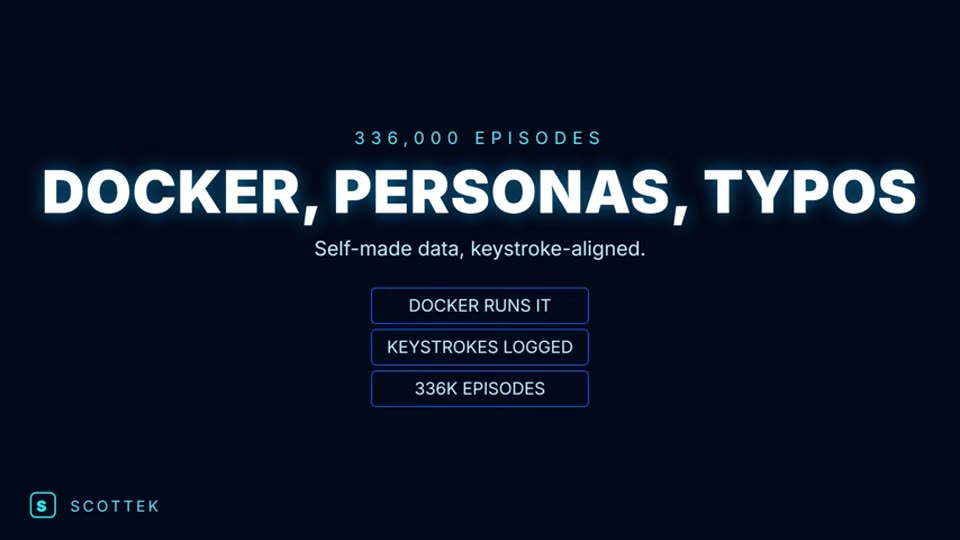
In the video: no dataset aligned keystrokes to screens, so one was manufactured: real programs run inside Docker containers, with every keypress and screen recorded across randomized users, hosts, prompts, and terminal sizes.
Added from the sources: per the writeup, directories and files were generated around fictional personas such as developers and sysadmins, with 6 to 24 weighted activities per session covering file editing, vim, Python, and tmux. Typing is human-style, one key at a time with tab completion and a 1.2 percent typo rate, and 35 percent of sessions start mid-application so the model learns to continue from any state. The final tally is 336,000 episodes at about 2 billion tokens, against roughly 18 trillion seen by the base model in pretraining. Terminal sizes are mostly 32 by 96, with some 24 by 80 and 40 by 120 mixed in.
- The base is Qwen2.5-Coder-0.5B, the half-billion-parameter coding model that already knows what commands like
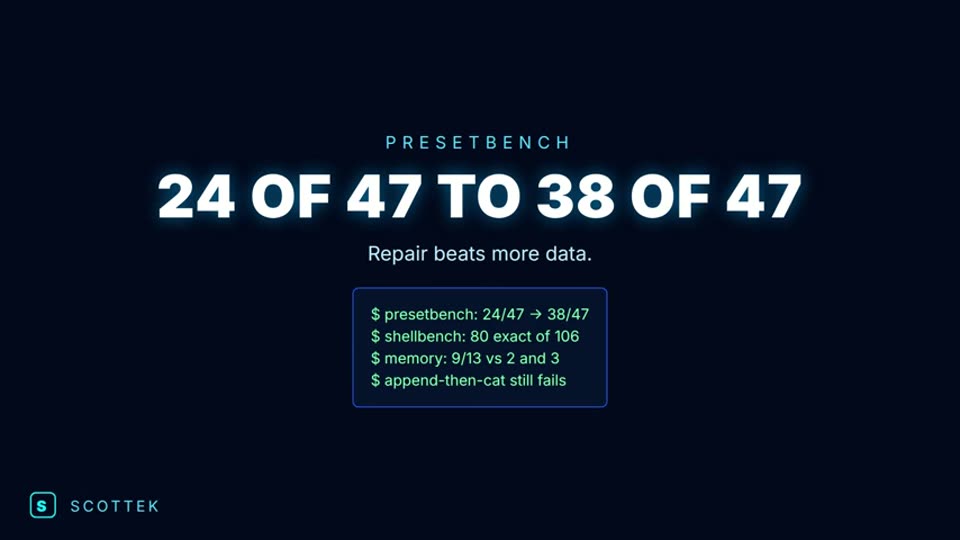
lsandcatshould print, and small enough to dream of realtime. - Plain fine-tuning learned typing fast but compounded mistakes, so training borrowed from DAgger: roll forward a few events, compare against the real recording, and where the gap is small, teach the repair move. Three rounds of that, with about one third of sessions yielding correction examples.
- The targeted drill is PresetBench, 47 scripted cases built from real demo failures: 24 of 47 before correction training, 38 of 47 at final
int4precision.
Measured honestly, caveats aired
In the video: the scoring is exact-output matching on sessions held out of training, and the prompted baselines got 3 worked examples each while predicting whole outputs, which the video flags as not quite the same task.
Added from the sources: ShellBench is 106 commands across 24 handwritten bash sessions, none of it in training, per the writeup. Prompted Qwen2.5-Coder-0.5B scores 52 of 106, prompted Qwen3-0.6B scores 60 of 106, and WorldTUI scores 80 of 106. The memory test spans 32 worlds: two random values written to two files, then read back later, with both required to match exactly. On 13 file readbacks the baselines manage 2 and 3 while WorldTUI gets 9, including an 18-command persistence case. One honest wrinkle the video airs: combine commands in new ways and it breaks, such as appending a line to a file and finding it missing on readback.
- A distillation probe found memory living in specific layers: dropping one layer moved next-token accuracy only from 99.3 to 98.9 percent but collapsed exact readbacks from 64 of 64 to 0 of 64, while a 16-layer student keeping layers 1, 7, 15, and 22 held 64 of 64. Distillation was abandoned.
- Total training cost is stated as about 75 GPU-hours on a single RTX 4090, and the self-generated 2 billion tokens are dwarfed by the base model's roughly 18 trillion.
Speed and the squeeze into a browser tab
In the video: typing felt fine at about 38 milliseconds per key, but full repaints like opening vim, a man page, or clear took up to 12 seconds on an RTX 4090, fixed by generating rows in parallel and verifying with the same model.
Added from the sources: per the writeup, most rows do not depend on each other, so each is generated off the same history and the cursor is resolved last. Cost drops from the sum of all rows to the longest single row, about 100 steps instead of about 3000, and large-frame latency fell from a p95 of 6.7 seconds to 0.87 seconds on the 4090. Parallel rows cannot coordinate, so vim opened on row three while Snake grew three foods at once, which is why drafts are verified sequentially with regeneration from the first disagreement. Then came the squeeze: Qwen's 151,936-token vocabulary carries a 136-million-parameter embedding table the terminal never needs, so keeping the 333 used tokens padded to 384 drops the model from about 494 million parameters to about 360, and int4 quantization makes a 208 MB download. The demo is a hand-written JavaScript Qwen decoder with WGSL compute shaders over WebGPU, weights unpacked from 4-bit at inference with FP32 activations plus KV cache, all local in the tab. Reported figures: an M4 Mac browser takes about 60 milliseconds per keystroke and about 0.9 seconds for a man page, while Firefox runs the same code about 20 times slower for unknown reasons.
- All speed figures above are author-reported from the writeup and untested here.
- The demo needs a desktop browser with WebGPU plus a real keyboard, per the demo page, and model weights were promised but not posted at packaging time, so no weights URL is quoted here.
What it can and cannot do, and how to poke it
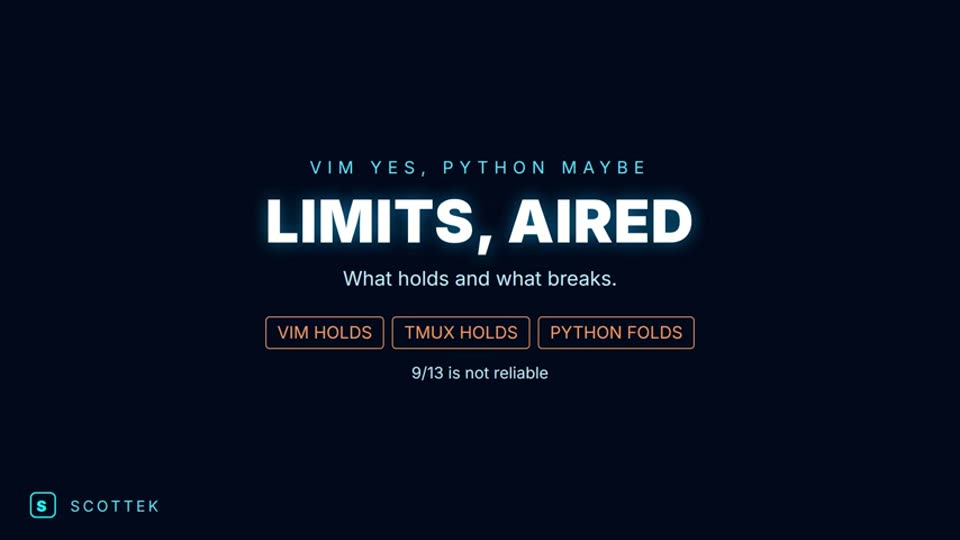
In the video: bash basics, vim modes with save and quit, tmux panes, man pages, Snake, and environment variables all work, while Python beyond the trivial hallucinates, nested directories lose the path, and appended lines vanish on readback.
Added from the sources: the writeup and demo page confirm support for the Python REPL, custom starting screens with rows, columns, and prompt of your choice, plus environment variable expansion. The signature quirk the video demonstrates: type pythoon with two Os and Python launches, while ython launches nothing, which is exactly how you know nobody is home. Containers used for training had no internet, so anything network-shaped is boring by construction.
- Try it yourself on the demo page: open it in Chrome or Edge with WebGPU, then type
pythoonand watch Python launch. This try-it recipe is video-documented and untested here. - What fails, aired in the video:
echo green >> colorsfollowed bycat colorsoften drops the appended line, list comprehensions come back list-shaped with wrong contents, and hard Python reads like early-2020s hallucinations. - For homelab purposes this is a proof, not a product: nothing here deploys, and the value is that a tiny model with no rules engine holds a somewhat consistent world across
vim,tmux, andcat.