UEFI PXE Flaw 9.5: Protect Your Homelab Now

This companion guide builds on the video Watch UEFI PXE Flaw 9.5: Protect Your Homelab Now, which walks through a defensive checklist for CVE-2026-97631 with live inventory commands and no exploit traffic.
The video is the starting point and this article adds sourced detail you can act on. Nothing here shows or links to exploit code, and steps I did not re-run in this lab are marked untested.
What broke in the PXE driver
TianoCore rates CVE-2026-97631 Critical with a CVSS 4.0 score of 9.5 in GHSA-99cj-7hg9-mp4m. The flaw is a buffer overflow in the EDK II PXE Base Code driver at NetworkPkg/UefiPxeBcDxe.
During a PXE network boot the driver keeps listening for ICMP error messages and copies each one into a fixed 504-byte field called Mode.IcmpError. Both handlers get the bounds check wrong, meaning PxeBcIcmpErrorDpcHandle for IPv4 and PxeBcIcmp6ErrorDpcHandle for IPv6. A longer message is still copied and the destination pointer advances by the wrong length, so attacker bytes land past the field. TianoCore states that nothing earlier on the receive path limits the message length.
The advisory lists two outcomes. An oversized message corrupts driver memory and the next ICMP error raises a CPU exception in DXE, so the boot hangs and provisioning or recovery stops. An attacker who knows the exact firmware build can plant a counterfeit event that CoreSignalEvent dispatches in the DXE phase, in ring 0, before Secure Boot or measured boot has checked anything. That second path is the pre-boot remote code execution case described in the CVE record.
Context from Ars Technica helps explain why firmware bugs get attention. EDK II is the reference UEFI implementation used by vendors including AMI, Insyde, and Phoenix, plus the Project Mu fork, and the vulnerable code is about 16 years old. The same write-up notes the payload itself does not persist, but one execution can open the door to a persistent early-boot payload.
Who is exposed and who is not
You are exposed only while a machine is actively PXE booting over IPv4 or IPv6. The advisory says the attacker must deliver a unicast ICMP error to the client IP from any network distance, and the window is the duration of the PXE boot.
That splits a homelab into four groups, following the fleet triage in the RFF exposure guide:
- Machines that network boot every time are exposed on every restart
- Machines with a one-shot
BootNextentry armed for PXE are exposed on the next restart - Machines with network boot enabled behind the disk are exposed only if the disk fails or PXE is picked manually
- Machines with no network boot entries are not reachable this way
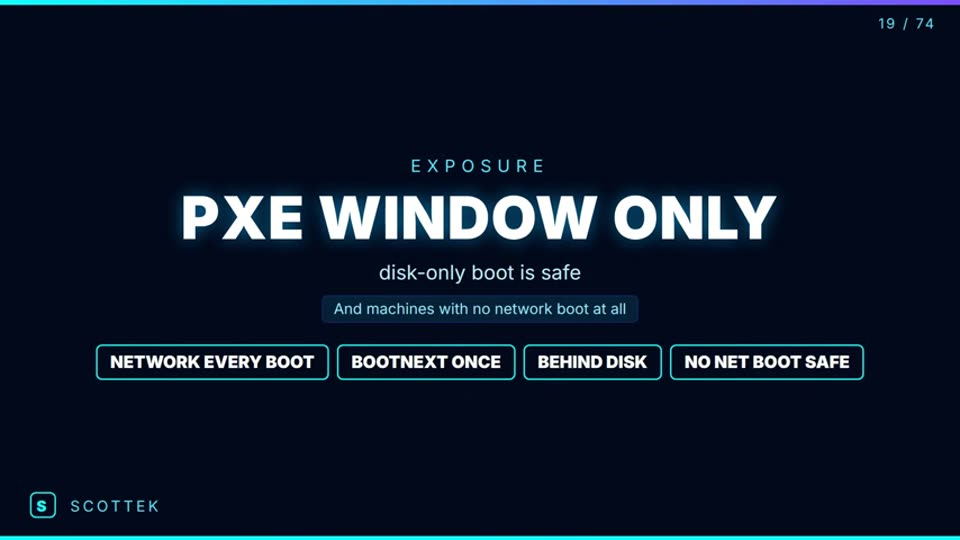
Disk-only boot is outside this bug. Legacy BIOS network cards use their own option ROM, not this driver. Entries showing Uri mean HTTP boot, which uses a different driver. Intel states that no commercial products under security support are known to be affected, while adding that OEM board vendors may integrate the vulnerable code, so check with your system maker rather than assuming either outcome. The linked Intel reference discussion carries that statement in full.
Check your boot entries before changing anything
The video demonstrates inventory only, meaning listing BootCurrent, BootNext, and BootOrder, confirming the advisory publish date, checking the Hetzner notice, and listing local OVMF packages. I did not re-run those exact screens here, so treat the commands below as sourced and untested in this lab until you confirm output on your own host.
On Linux, the check from the video and the RFF guide is sudo efibootmgr -v. BootCurrent is where this boot came from, BootNext is a one-shot override when present, and BootOrder is the try order. A network entry carries MAC plus IPv4 or IPv6 in its device path. If it carries Uri, that is HTTP boot and a different driver.
On Windows, run an elevated prompt with bcdedit /enum fwbootmgr plus bcdedit /enum firmware. The first command gives displayorder as the boot order and a bootsequence line means a BootNext one-shot is armed. The catch is that Windows shows friendly names only, so verify against your firmware setup screen.
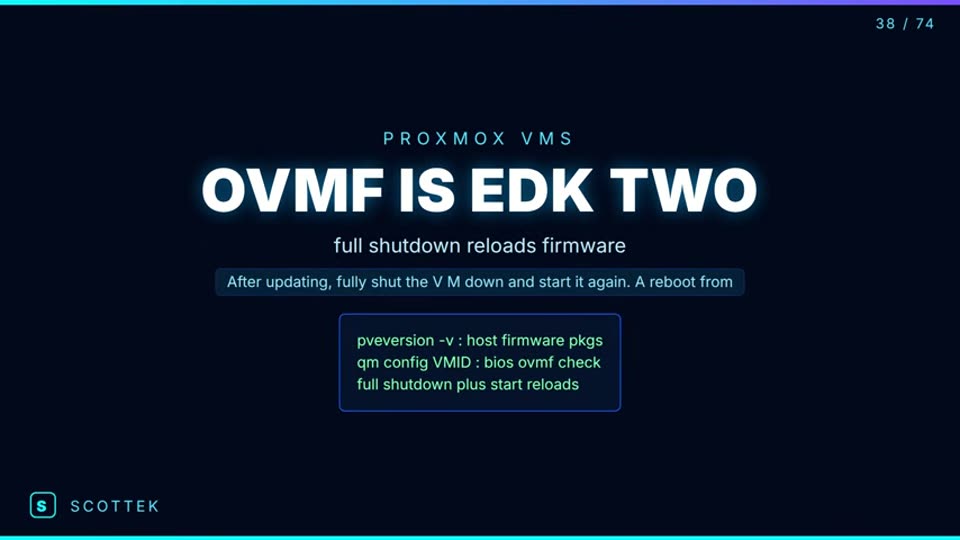
On Proxmox-style hosts, the video checks pveversion -v, then lists firmware packages matching pve-edk2-firmware, ovmf, and edk2, then runs qm config VMID. If bios says ovmf, that VM uses EDK II firmware because OVMF is the EDK II build for virtual machines. SeaBIOS guests use a different implementation. After a fixed firmware package lands, do a full shutdown plus start because a guest reboot may keep the old firmware instance alive. Untested here.
On Hetzner-style dedicated or cloud hosts, first confirm UEFI with [ -d /sys/firmware/efi ] && echo UEFI || echo BIOS per the Hetzner status incident. Hetzner scopes current risk to dedicated-server reboots and cloud Rescue System boots, not to already-running systems.
Lock it down until firmware ships
TianoCore lists no workaround, so the steps below are defensive guidance derived from the advisory, not vendor-stated workarounds. The Rescana analysis labels them explicitly as its own guidance.
- Turn PXE off where nothing needs it in firmware setup, meaning the network stack or PXE option itself for both IPv4 and IPv6 where they are separate. Disabling IPv6 alone does not cover you because both handlers are vulnerable. Moving network boot down the order changes when it runs, not whether it can run.
- Clear
BootNextsurprises. An imaging tool can arm a one-shot PXE boot without changing your normal order, and that box is exposed on its next restart. - Isolate provisioning traffic. Where PXE must stay on, keep it on its own VLAN that only the deploy server can reach. The packet must reach the booting host during those seconds, so a filtered install segment stops it.
- Filter unexpected ICMP errors aimed at booting hosts at the edge of that segment where your firewall allows it. Untested here because every firewall differs.
- Follow the hosting guidance if it applies. Hetzner currently recommends avoiding PXE-related reboots until a fix exists and temporarily blocking incoming ICMP during reboots with the Hetzner Firewall, with Allow Hetzner Services kept on for dedicated servers.
Do not copy foreign firmware images between hosts, do not run proof-of-concept code against machines you do not own, and keep Secure Boot and measured boot on. They do not stop this pre-boot path, but they still protect against other threats.
Patch watch and what is still unknown
The code fix was merged to EDK II master on October 15 in PR 13302, after an earlier public PR 13200 named the CVE in September. The advisory still lists patched versions as Not patched currently through edk2-stable202608.
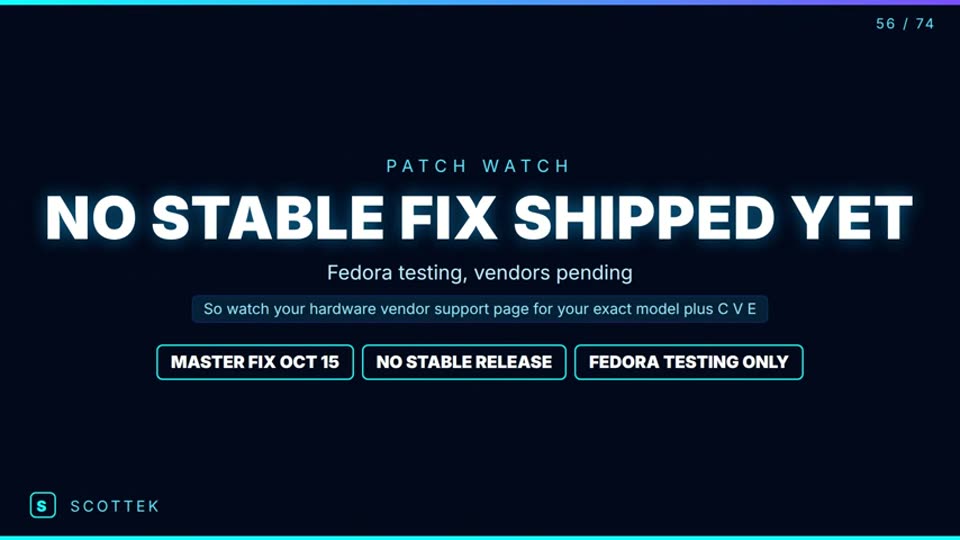
Distribution status was still moving at check time per Rescana. Fedora built fixed packages on October 26 for versions 43, 44, and 45 but they were in testing, not stable. Red Hat, SUSE, and Debian listed their EDK II packages as affected with no fix yet. No server or board vendor firmware update was found at check time, the flaw was not in the CISA Known Exploited Vulnerabilities catalog, and no official report of exploitation or public exploit was reported.
Reliable code execution needs three things at once, meaning the target is PXE booting right then, the packet reaches it in that window, and the attacker knows the exact firmware build. Treat this as escalation fuel for someone already near your provisioning network, not as drive-by internet magic. Watch your hardware vendor support page for your exact model plus CVE-2026-97631 and watch your distro for an updated edk2 or ovmf package, because that update is the real fix.