Self-Host Auth0 + Salesforce Replacements

Watch the video and what this guide is
In the video: a 440-second decision guide, not an install walkthrough. The presenter benches the ZeroAuthy release candidate live on a Proxmox sandbox with real logins and tokens, labels the SalesCompel stretch as documented surface rather than bench results, and gives a verdict on when each project earns a switch.
Added from the sources: this is a sequel to the grid install companion Install ZeroAuthy on Ubuntu: Self-Host Auth0 Yourself. That page is the how-to with exact build, certificate, and console commands. This page is the should-you-switch guide with the movement framing, the release-candidate bench numbers, the SalesCompel status, the clean-room method, and the switching criteria. Start here for the decision, go there for the commands.
The movement: a protest written in code
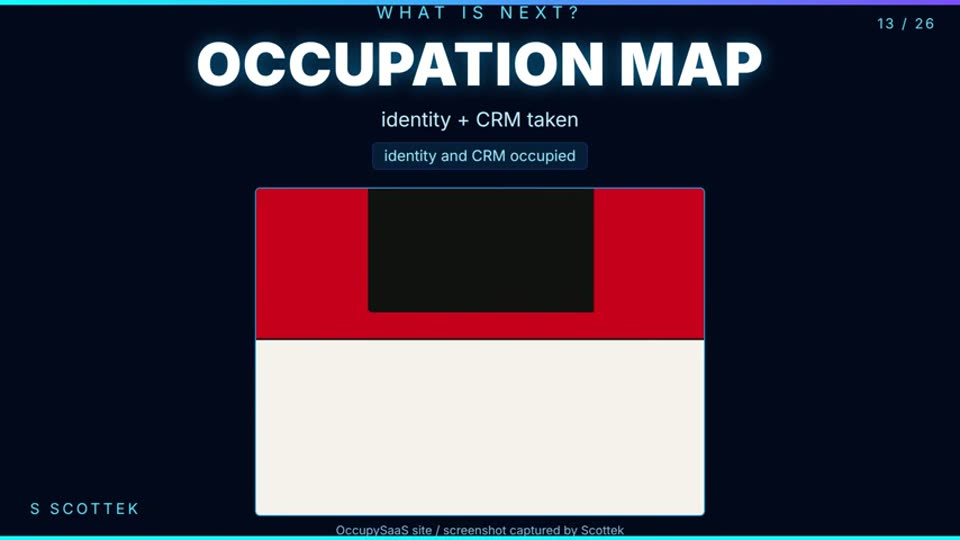
In the video: a group of laid-off engineers rebuilding the two subscriptions almost every company pays for, logging in and tracking customers, in the open with AI and giving the result away for free. The project hit the front page of Hacker News on November 2nd with 532 points and 320 comments, and the first two projects are an Auth0 replacement called ZeroAuthy and a Salesforce replacement called SalesCompel, both Apache 2.0, both self-hosted, both early.
Added from the sources: the movement is OccupySaaS at occupysaas.com, estimated October 2026, and its FAQ states it is independent and unaffiliated with Auth0, Okta, or Salesforce, with product names describing compatibility only. The occupation map lists Identity plus Auth and CRM as occupied, while Docs, Issue Tracking, Feature Flags, Observability, and Support are proposed, not commitments. The timeline runs ZeroAuthy public on October 14th, SalesCompel on October 15th, and the ZeroAuthy release candidate on November 4th. The Hacker News thread is preserved at news.ycombinator.com/item?id=50331402, where cheers mix with open skepticism.
Why it matters: the per-seat grievance
In the video: follow the money. Auth0's free tier covers 25,000 monthly active users, which is generous until you grow, then Essentials starts around 150 dollars a month for 500 users and Professional starts around 240. Salesforce's Starter suite is 25 dollars per user per month and the free suite covers exactly two users, so every hire is another line item.
Added from the sources: the vendor pricing pages confirm the anchors at auth0.com/pricing, where the Free plan covers 25,000 monthly active users, Essentials starts from 150 dollars a month at 500 monthly active users, and Professional starts from 240 dollars a month for business-to-consumer or 800 for business-to-business, with paid plans priced by monthly active users, and at salesforce.com/starter, where the Starter Suite is 25 dollars per user per month with a free suite for up to two users. That per-seat math is the grievance the movement is built on.
ZeroAuthy rc.1 benched live in one container
In the video: ZeroAuthy just shipped its first release candidate, version 1.0.0-rc.1, on November 4th. It is a self-hostable identity server that speaks the Auth0 APIs, with the Authentication API, hosted Universal Login, multi-factor logins, passwordless, a Management API, and an admin console, plus storage choices of SQLite, Postgres 14 and up, MySQL, in-memory, or gRPC storage plugins. It is OpenID Certified for Basic plus Config plus Form Post, approved October 30th, and the team tests it black-box against the real Auth0 SDKs including node-auth0, the Auth0 CLI, the Deploy CLI, React, and Next.js.
Added from the sources: the release notes at v1.0.0-rc.1 confirm the coverage above plus PKCE, client credentials, refresh rotation, password and password-realm grants, logout, consent, PAR, device flow, TOTP plus email plus SMS plus voice multi-factor with recovery codes and policies, and the admin console, all in the ZeroAuthy repository under Apache 2.0. Certification details are listed at openid.net/certification/certified-openid-providers-profiles, and SDK compatibility is tracked in the compatibility matrix.
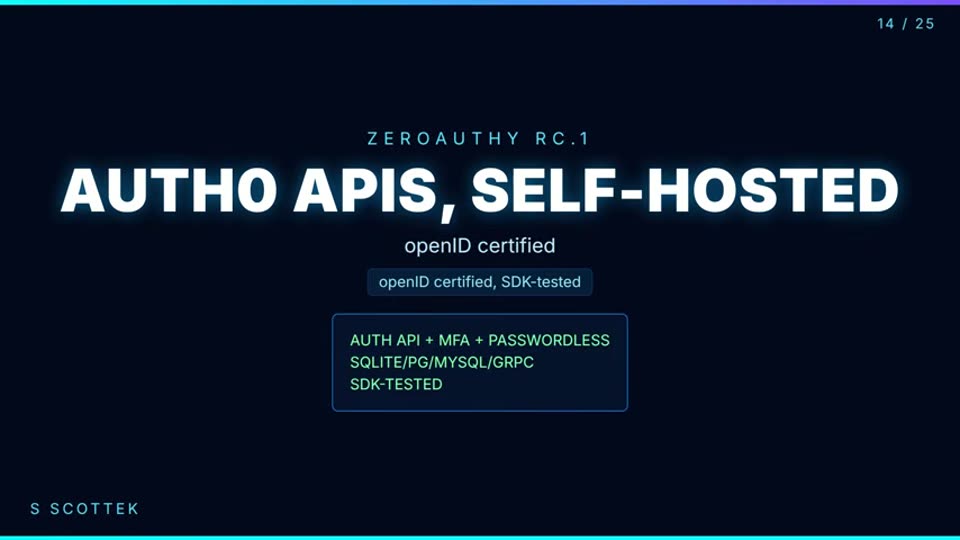
In the video: claims are cheap, so the presenter benched it with one Docker command from the quickstart. The health check answers ok, the OpenID discovery document lists the full Auth0-shaped surface of authorize, token, userinfo, and keys, then a real password grant for the seeded test user Alice returns a Bearer token valid 24 hours with an ID token carrying the right issuer and her email. Userinfo returns Alice Tester, verified, and the Management API hit with machine-to-machine credentials lists both seeded users with their verification flags. Total idle footprint is under 40 megabytes of RAM, which is a real login server in one container.
Added from the sources: the sandbox numbers behind those claims are a health check returning ok, a discovery document with issuer https://localhost:8443/ plus authorize, token, userinfo, and JWKS endpoints, a password grant returning token type Bearer with expires_in 86400 and scope openid profile email, userinfo showing Alice Tester with email verified true, a machine-to-machine client-credentials call listing exactly 2 users with Alice verified and Bob unverified, and an idle footprint of 39.15 megabytes of RAM. Requests to the root path without a tenant host return an honest not_found unknown-tenant error, which is correct routing behavior, not a failure.
The honest gaps before you trust it
In the video: this is a release candidate, not a victory lap. No WebAuthn, no passkeys, no SAML, no enterprise directories, and no token exchange yet, with the roadmap listing all of it as planned. The master key that seals secrets cannot be rotated, so back it up or the database backup is scrap. Self-signed TLS is testing only, and email goes to the server log until a provider is wired. Try it for a homelab and continuous-integration pipelines, and do not move company logins onto it this week.
Added from the sources: the release notes confirm the exclusions above plus WS-Federation, CIBA, and JAR, and add that the master key is a 32-byte base64 value that cannot be rotated, so a backup without it is useless. Migrating production company logins onto this release candidate is untested here and explicitly discouraged by the project, which states it is not production-ready.
SalesCompel: documented surface only, not benched
In the video: this stretch is labeled exactly as it is, documented surface rather than bench results, because the bench box has no Go toolchain and the project is still pre-release. It is a Go plus Postgres core with tenant isolation plus a Vue record editor. What the team says works today is persistent Account and Contact records, describe calls, limited queries, external-ID upsert, bearer auth, and an OpenAPI 3.2 contract with an offline test lab. The vendor's own README words are quoted directly: not production-ready and not certified, with Apex, Flow, and custom UI excluded from the first release. The goal is a 0.x early preview for new teams and simple orgs, with a dry-run import that reports what will not carry over before committing. Reviewers point at mature self-hosted CRM options while this one grows up.
Added from the sources: the SalesCompel repository is Apache 2.0 with a Go plus Postgres tenant-isolated core and Vue editor, and its compat lab entry runs over the node path. Every capability claim in this section is untested here because no build or run was performed on the bench VM, which had no Go toolchain. Treat this section as vendor-documented status, not verified behavior.
Clean-room: how reimplementation stays legal
In the video: spec writers read public docs and open standards, builders stay behind a firewall, AI writes the code from the spec, humans review every merge, and the vendors own SDKs decide what counts as done. Every repo carries its clean-room policy. The project states plainly it is independent, not affiliated with, endorsed by, or sponsored by any vendor named, and product names describe compatibility only. The Hacker News thread said the skeptical part out loud too, with some of it reading like performance art and AI writing much of it, which open source settles with commits.
Added from the sources: the method is documented in each repo's clean-room policy with allowed and denied lists, the Go single-static-binary rationale is stated in the project FAQ, and the commit history shows AI-authored commits with human review. Trademark use follows the same rule on this page: Auth0, Salesforce, and Okta appear only to describe compatibility, with no claim of affiliation or endorsement.
When to switch and what is next
In the video: the verdict is split. Run the ZeroAuthy release candidate today wherever Auth0 dev tenants get burned, meaning homelab apps and continuous-integration end-to-end tests with seeded logins. Watch SalesCompel until the 0.x preview lands. Nobody switches CRM yet, because the clone covers records and a REST contract while Slack, Tableau, and the agent layer stay out of scope. Star it, run the compat lab, and file the issue where a workflow breaks, since that is how a 0.x becomes a 1.0.
Added from the sources: Auth0's free tier is genuinely generous at 25,000 monthly active users at zero cost, and a managed service means no 3am pages, so self-hosting identity earns its place when data must stay in the building, when continuous integration needs deterministic logins, or when the paid tiers stop fitting the user curve. The recommended first use is the project's testing kit: a seed file defines the tenant, apps, and users, memory storage throws it all away after the run, and the smoke test signs Alice in, checks her token signature and claims, then hits the Management API. Point an app's Auth0 SDK at a local domain in continuous integration for real login flows with no network dependency, no shared-tenant rate limits, and no leftover users between runs, after checking the compatibility matrix before treating a passing test as proof of production behavior. Do not switch to save 40 megabytes of RAM.