Firecracker VM Escape: Patch Your Homelab Now

This guide is the written companion to the video Firecracker VM Escape: Patch Your Homelab Now (342s, uploaded 2026-11-16), and it treats the video as the starting point. Claims shown in the recording are labeled In the video, and everything confirmed against the primary sources is labeled Added from the sources. Anything not independently confirmed is marked untested. The caption-track fetch for this video failed with HTTP 429, so the video record used here is the owner-written video description plus the published narration script, disclosed as such, and the figures below are stills of the video's explainer cards.
In the video: a guest virtual machine broke out and ran code as root on its host, with Firecracker, the lightweight hypervisor behind serverless platforms, as the target. The chapters run 0:00 guest-to-host root and what happened, 0:16 who published it and when, 0:33 the kernel bug in plain terms, 0:50 the escape chain step by step, 1:10 the fine print, 1:28 why the call ran as root, 1:48 the CVE and the upstream fix, 2:11 the Debian fixed versions, 2:36 the Firecracker version nuance, 2:54 live bench proof on a real Proxmox box, 3:17 checking your own host, 3:35 the Proxmox upgrade path, 3:53 containment with the jailer, 4:12 containment with the system-call filter and no root, 4:31 three things not to do, 4:49 the honesty ledger, and 5:08 the verdict of patch plus contain. The narration voice is synthetic. The chapter list and pacing are video claims, repeated here as given.
The bug in plain terms
In the video: the root cause lives in the host kernel's internet protocol stack, not in Firecracker. A packet with corrupt checksum metadata can make a helper corrupt the network header, and that corruption is the foothold from a bad packet to reading and rewriting host memory. From there the chain is surgical: map the guest page to its host address, recover the host page tables, locate the Firecracker binary under its randomized layout, and find the saved registers of the thread sitting in the kernel runner. Rewrite that return path and the hypervisor issues a write call with its own privileges, while the virtual machine never goes down.
Added from the sources: the PwnEscape Part 2 writeup by Paulos Yibelo is the primary record. Part one built a host-memory primitive out of the Linux networking bug, and part two aims it at Firecracker to take over a live vCPU thread from inside the guest. The tested target is Firecracker v1.16.1 on x86-64 with host kernel 7.0.0-1011-aws and guest kernel 6.18.44 plus, launched directly as root under systemd-run, pinned with taskset, and with no jailer. The controlled call executed on the host was a write marker on Firecracker's own stderr, and the virtual machine stayed up with guest SSH still working. The authors state plainly that production containment such as privilege dropping and namespaces needs a separate assessment, and they claim no root in any vendor's live environment.
Added from the sources: the independent explainer Firecracker Escape: From Guest to Host Root by Dagny Taggart, dated November 6 2026, names the underlying flaw as CVE-2026-99999, a Linux kernel IPv4 checksum bug, with a CVSS score of 9.3. That 9.3 figure comes from this explainer alone, never from the original authors, so treat it as one outlet's rating rather than consensus. The explainer describes the upstream fix, commit 6785011f8b16, as guarding checksum completion against writing into an already-parsed IPv4 header, and the upstream commit page was verified reachable. An unrelated Chrome-spoofing link that appears in the writeup's related-articles rail is not part of this bug and is not cited here.
Read the fine print before you panic
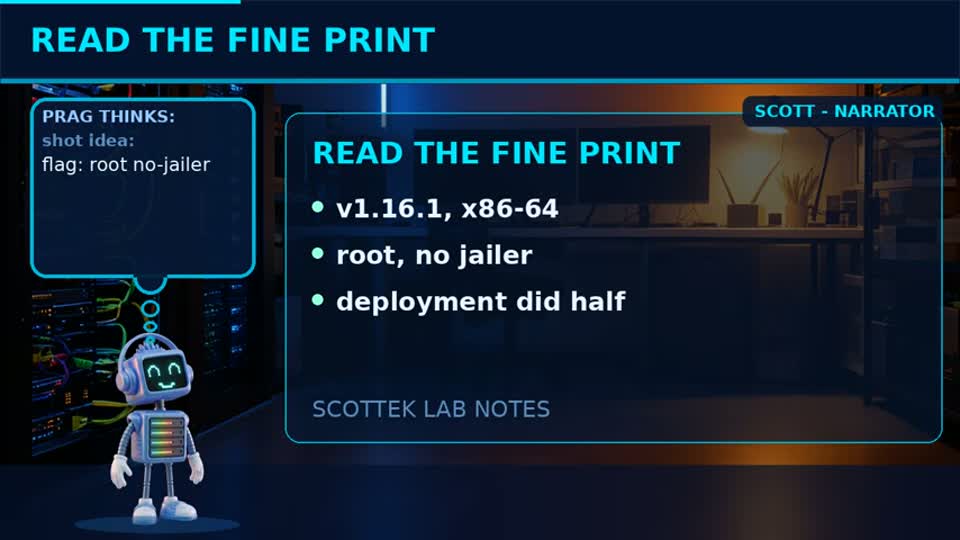
In the video: the still above is the fine-print card, read as v1.16.1 on x86-64, run as root with no jailer, where that deployment choice is doing half the damage. The demo configuration is the blast-radius story as much as the kernel bug is.
Added from the sources: both writeups carry the same target table of Firecracker v1.16.1, cloud host kernel, 6.18 guest, root user, and no jailer, so the fine print is corroborated, not just narration. The community discussion circled exactly this point, with the most echoed question asking what the jailer plus privilege dropping does to the blast radius, alongside real-world exposure notes from people running Firecracker-backed demo services. Comment scores move daily and are not quoted here.
Check your own host in thirty seconds
In the video: print the running kernel with uname -r, open your distribution's security tracker page for this CVE, and compare build numbers. Anything older than the fixed builds needs the upgrade, and the tracker page, not a forum post, is the source of truth. On Proxmox the path is the usual one: confirm the running kernel and the installed kernel package, refresh your sources, install the fixed kernel when it lands, then reboot the host, because a kernel patch is not live until the host restarts. Guests and containers cannot fix this for you.
Added from the sources: the Debian security tracker page for CVE-2026-99999 was verified reachable and lists the fix in bookworm build 6.1.190-1 under DLA-4841-1 and in trixie build 6.12.113-1 under DSA-6568-1, with its upstream note linking the same 6785011f8b16 fix. If your Debian host reports a kernel older than those builds, you are behind.
- Run
uname -rto print your running kernel and compare it against the tracker page for CVE-2026-99999 - Treat the tracker page as the source of truth rather than any forum post or video, including this one
- On Proxmox, confirm the running and installed kernel with
pveversion -vand check for an upgradable kernel withapt list --upgradable, then reboot after any kernel install since the patch is not live until the host restarts - The video's own Proxmox bench illustrates the honest outcome: running kernel 7.0.2-6-pve on Proxmox VE 9.2.0 with a May 2026 changelog carrying no entry for this fix, so the host counts as unpatched until the vendor ships one, and the install-when-it-lands step is untested here because no fixed Proxmox kernel package was available at check time
Do not misread the version number
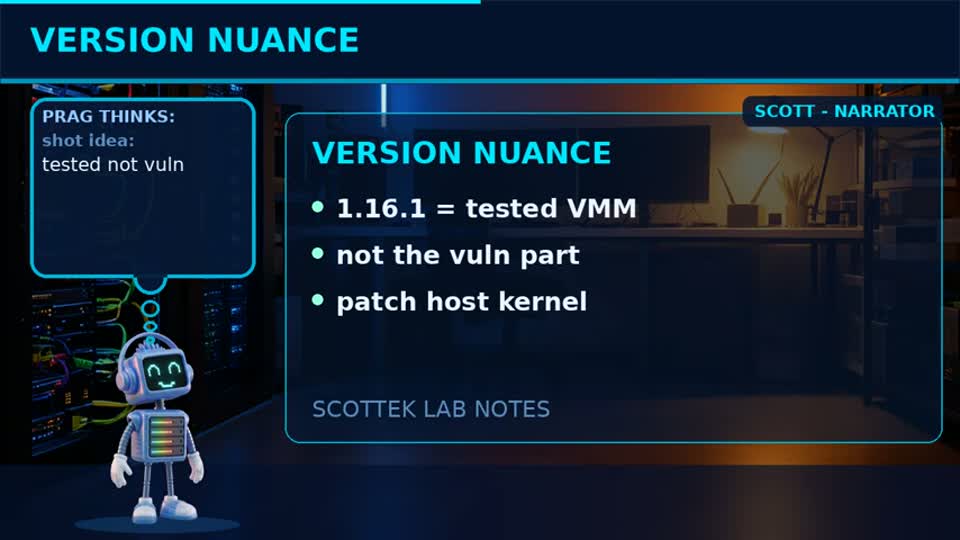
In the video: the still above is the version-nuance card. Firecracker 1.16.1 came out in July and it is the tested hypervisor, not the vulnerable part, so upgrading Firecracker alone fixes nothing. The patch that matters is the host kernel underneath it, plus containment around it.
Added from the sources: the Firecracker v1.16.1 release page was verified reachable and confirms that tag as a July 2026 maintenance release, while the vulnerability is the host kernel's IPv4 stack. Framing a Firecracker upgrade as the fix is the exact misreading the video warns against. The video's bench also confirmed both release binaries reporting version 1.16.1 for the hypervisor and the jailer, which only establishes what was tested, not what is patched.
Contain it today: the jailer and the filter
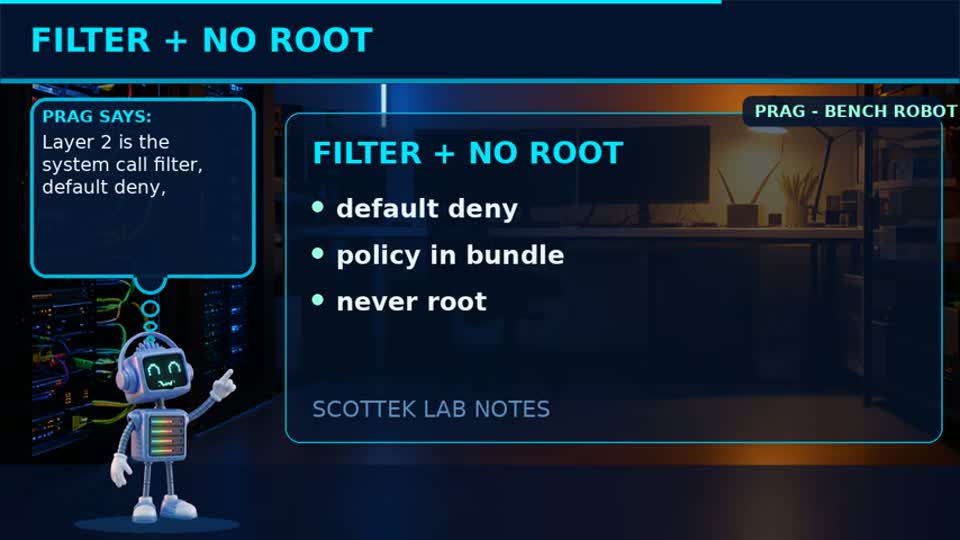
In the video: the still above is the containment card. Patching is half the job and containment is the other half. The Firecracker jailer sets up namespaces, drops to an unprivileged user, and cages the process before any guest code runs, so an escape against a jailed hypervisor lands in a cage rather than a root shell. Layer two is the system-call filter with default deny and an allow list only, whose policy ships inside the release bundle with a trap-by-default action. Layer three is the simplest: never launch the hypervisor as root in production, since the demo ran as root for science and your homelab has no excuse. Run every micro virtual machine jailed, with no exceptions.
Added from the sources: the containment advice is docs-voiced from the Firecracker project's own design, jailer, and system-call-filter documentation, which ship under the Apache 2.0 project, combined with the writeup's own no-jailer caveat. No micro virtual machine was launched to test this path, so jailer setup steps beyond the video are untested here, and any production deployment still needs the separate assessment the researchers call for.
- Run every Firecracker instance behind the jailer with namespaces and a dropped unprivileged user
- Keep the bundled default-deny system-call filter on rather than opening it up for convenience
- Never launch the hypervisor as root outside a throwaway lab
Three things not to do
In the video: do not test this exploit against shared or rented hosts, do not patch only the guest and call it done, and do not read the hype as a production breach, since the authors claim no root in any vendor's live environment. This was an owned lab target with the guards down, and no exploit was reproduced in the making of the video by design.
Sources and next steps
- The companion video is the starting point for this guide and all In the video claims above
- The PwnEscape Part 2 writeup by Paulos Yibelo owns the escape chain, the target table, the root-with-no-jailer setup, and the no-production-breach caveat
- The Sesame Disk explainer by Dagny Taggart owns the CVSS 9.3 rating and the plain-terms fix description, and only that rating
- The Debian security tracker page for CVE-2026-99999 owns the fixed builds 6.1.190-1 and 6.12.113-1 with advisories DLA-4841-1 and DSA-6568-1
- The Firecracker v1.16.1 release page owns the tested-version confirmation and the bundled jailer and filter binaries
- The upstream fix commit owns the checksum-completion guard that stops the corruption
- The community discussion owns the blast-radius questions this guide answers for homelab hosts