Headscale + Headplane: Self-Host Your Mesh VPN (2026 Guide)

This companion guide starts from the video Own Your Mesh VPN: Headscale + Headplane Setup and adds grounded detail from the Headscale docs, the Headplane docs, and both projects release notes. Watch the video first for the full narrated walkthrough, then use the sections below as the written reference. The episode runs as a narrated walkthrough rather than a filmed live deployment, so every section keeps In the video claims apart from Added from the sources research. Readers deciding between hosted and self-hosted remote access should also see the earlier Tailscale vs Cloudflare Tunnel remote-access comparison, which rented the control plane this guide buys.
What Headscale actually is
- In the video: Headscale is an open-source, self-hosted implementation of the Tailscale control server, written in Go under the BSD 3-Clause license, with a deliberately narrow goal of a single tailnet sized for personal use or a small outfit.
- In the video: devices keep running the official Tailscale clients on every platform and just point at your server instead of Tailscale cloud, and the 0.29 line needs Tailscale clients at version 1.80.0 or newer, so old clients get updated before anything else.
- Added from the sources: the Headscale docs home states the same design goal almost verbatim, a single tailnet for self-hosters and hobbyists, and names Kristoffer Dalby and Juan Font as maintainers, checked October 2026.
What the October releases changed
- In the video: Headscale v0.29.5 shipped 13 October 2026 as a patch release with about twenty fixes concentrated in policy evaluation and map delivery, including exit-node steering through via grants surviving unrelated ACL rules, deleted SSH rules no longer leaking access, removed nodes reaching the Android app as their own delta, policy changes no longer blasting DNS config at every node, and a privacy fix where clients uploaded logs upstream with logging disabled.
- Added from the sources: the v0.29.5 release notes confirm the fix list and the upgrade pointer, and the Headscale FAQ confirms the two upgrade rules quoted in the video, one minor version at a time and always the latest patch, checked October 2026.
- In the video: the sleeper feature of the 0.29 line is SSH check-mode, where a policy rule with the check action holds an incoming SSH session until the user authenticates through OIDC login or an explicit CLI approval, with the OIDC path requiring the user to own the source machine and tagged role-nodes excluded from check-mode entirely.
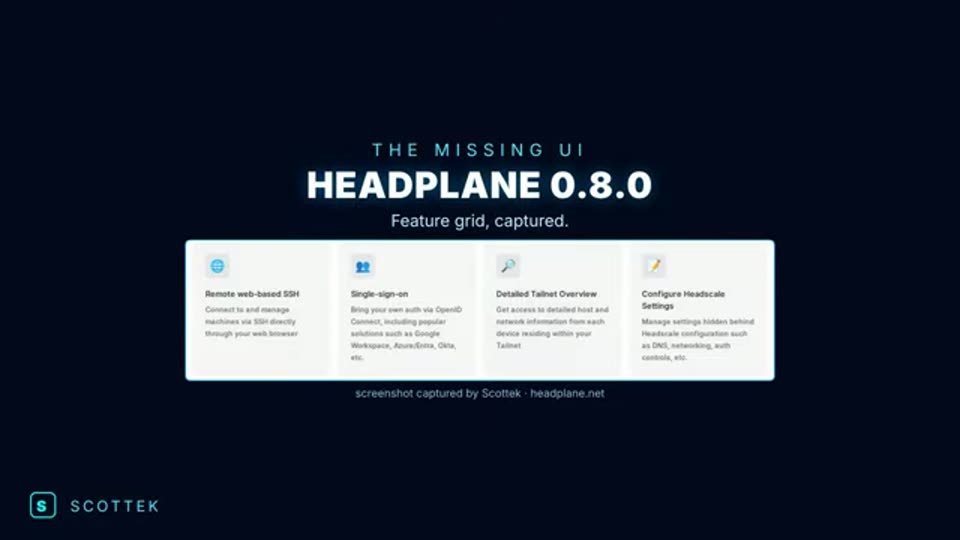
- In the video: Headplane 0.8.0 also shipped 13 October 2026 with a structured Access Control editor across Rules and Tags-and-Groups tabs that suggests real tailnet sources, stages edits until Save, and warns when an edit would drop policy comments, plus tailnet overview, user and machine management, DNS and networking settings, bring-your-own OIDC single sign-on, browser SSH, and floating minor Docker tags so pinning 0.8 still receives patches.
- Added from the sources: Headscale never shipped an official web UI and its docs list only community interfaces, which matches the video framing, while the Headplane home page confirms the feature grid of browser SSH, single sign-on, tailnet overview, and Headscale settings management, checked October 2026.
- Added from the sources: Headplane v0.8.1 shipped 16 October 2026, the same day as the video, fixing actions that failed with Bad Request behind TLS-terminating reverse proxies plus single sign-on and logging fixes, per the Headplane releases page, so readers deploying today should start on 0.8.1 rather than the 0.8.0 covered on camera.
- Added from the sources: the rename-operation path-traversal bug CVE-2026-46484 died back in the 0.6 line, which supports the video advice to stay current, and the selfh.st spotlight of 9 October 2026 is referenced via the ETTAYEB self-hosted roundup, all checked October 2026.
Honest limits and prerequisites
- In the video: four limits come before any terminal, starting with no official web UI, so Headplane is excellent but separate and owners carry two update paths.
- In the video: Tailscale Funnel is closed as not planned, so public sharing stays on the reverse proxy, and identity-provider groups cannot be used inside ACLs, which caps fancy group models.
- In the video: breaking changes happen since 0.29.0 shipped seven, so upgrades go one minor at a time with the changelog open, with SQLite as the homelab default and Postgres documented for later.
- In the video: the architecture splits into two planes, where auth, access rules, and key coordination move onto your server while files, streams, and sessions flow directly between devices over WireGuard whenever NAT traversal succeeds, with the relay fine print that unreachable peers hop a DERP relay defaulting to Tailscale servers unless custom DERP servers are configured.
- In the video: prerequisites are Docker, a reverse proxy with real TLS, and an identity provider, positioned for channel regulars as the video that rented the control plane versus this one that buys it, with the Authentik guide becoming the login provider and Beszel monitoring watching the boxes, and the decision-level comparison lives in the Tailscale vs Cloudflare Tunnel remote-access comparison.
- Added from the sources: the Headscale FAQ confirms the stepwise upgrade rule and the homelab-scale focus, and the Headplane install page confirms Docker, Native, and Limited deployment modes, checked October 2026.
Deploy Headscale and join nodes
- In the video: the build is one compose file with two services behind your own domain, running the official image pinned at 0.29.5 with config plus data mounted in, port 8080 published, and UDP 3478 reserved for a future self-hosted DERP.
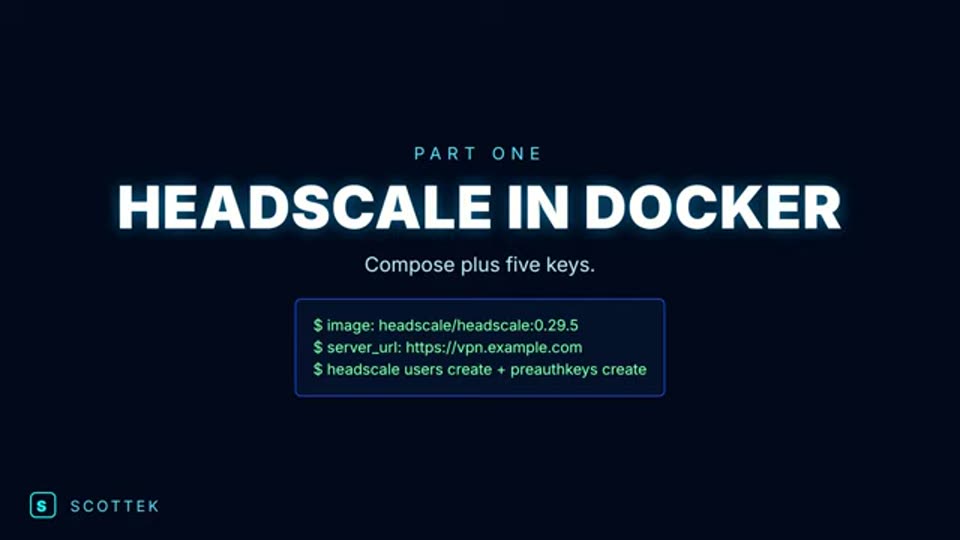
- In the video: the config needs five things, namely the server URL set to the real address, a listen address, a generated Noise private key, the classic
100.64.0.0/10prefix plus a ULA range, and deliberately set DNS plus logtail, followed by bringing it up, creating the first user, minting the Headplane API key, and fronting it with the reverse proxy over real TLS. - Added from the sources: the recipe commands
docker compose up -d,headscale users create,headscale preauthkeys create, andheadscale nodes registerare docs-standard and quoted from the Prag research notes, and every step in this section is untested here since no live deployment was run for this episode. - In the video: each device joins with the official Tailscale client using
tailscale up --login-server ... --authkey ...against your domain, keys are minted per purpose such as a day-long laptop key versus ephemeral tagged container keys, servers advertise tags, routes, and exit-node duty with each route approved before going live, andtailscale statuslisting every peer proves the control plane works. - In the video: road-warrior mode means advertising an exit node on the always-on box, approving it, and pointing the laptop at it, summarized as two commands per device plus one approval per route.
- Added from the sources: the client floor of 1.80.0 and the tail-closed policy-typo behavior below are release-notes-backed, but the join and exit-node commands above remain untested here and should be verified against the Headscale docs home during a real deploy.
Add Headplane and run access control
- In the video: Headplane rides alongside as a sidecar in the same compose file on the floating 0.8 tag, with three values that matter, the Headscale URL, the API key, and a cookie secret generated with
openssl rand -base64 24, exactly as the install docs hand it over. - Added from the sources: the Headplane install page confirms that exact
openssl rand -base64 24command, theheadscale.url,server.cookie_secret, andserver.data_pathfields, and that Docker is recommended because network management and browser SSH need it, checked October 2026. - In the video: mounting the Docker socket unlocks network management and browser SSH, while without it Headplane runs in Limited Mode, fine for a look but not production, and the wiring notes are Docker API 1.24-plus with cookie secrets random per install, never pasted from a tutorial.
- In the video: first login takes the API key, then OIDC takes over and key login gets disabled, and 0.8.0 adds a manual JWKS endpoint for exotic providers, with all of this untested here.
- In the video: the Access Control page suggests real sources and destinations from the groups, tags, hosts, and users already in the tailnet, nothing applies until Save, the raw editor stays one click away, structured edits warn before dropping comments they cannot round-trip, the tag dialog flags tags missing from tag owners, users show policy groups with in-row editing, auditors mint their own pre-auth keys, and 0.29 evaluates policy test blocks beside ACLs.
- In the video: single sign-on links OIDC users to Headscale counterparts by subject and email automatically with a claim screen for the unmatched, roles arrive via default role plus the provider role claim, the same provider backs node auth and SSH check approvals, and API-key login is disabled once OIDC works.
Day-two ops, gotchas, and verdict
- In the video: day-two rules are upgrades one minor at a time with the changelog open, backups of the data directory, config, and database file on the existing NAS schedule, and under the hood 0.29.5 stops rebuilding the peer map on routine requests with fresh mapper metrics, plus Headplane trimming whitespace on UI-added DNS records and closed tagged-node and ephemeral expiry edge cases.
- In the video: three gotchas close the build, starting with the client floor biting silently below 1.80 with logins never completing, so every device including phones gets inventoried first.
- In the video: phones get updated too since the Android stale-peer crash was fixed server-side in 0.29.4 but ancient clients still misbehave, and policy typos fail closed because an unknown user in grants resolves to an empty set, so misspelled names match nothing and read as denied traffic until policy tests and a spellcheck run.
- Added from the sources: readers on 0.8.0 behind a reverse proxy should upgrade to the Headplane 0.8.1 release and can remove any Origin-header rewrite workaround, per the 0.8.1 notes checked October 2026, and backup, upgrade, and OIDC steps here remain untested.
- In the video: the verdict is to run this when Tailscale cloud is a trust line worth taking back, Docker plus a reverse proxy plus an identity provider are already operated, and a community UI with stepwise upgrades is acceptable, while skipping it for Funnel needs, provider-group access models, or zero-maintenance networking.
- Added from the sources: nothing in this guide was tested against a live tailnet here, so treat commands and version pins as docs-verified starting points from the sources linked above and verify each step during a real deploy.