Linux 9.8 TCP Flaw: AI Wrote a Working Root Exploit (2026)

Watch the starting point
This is a companion to Watch the video and the video is the starting point for everything below. Video claims and added research are labeled throughout so you can tell them apart.
In the video: the presenter triages an Anthropic security-research disclosure in which an unreleased internal research model, starting from human prompting, wrote a working zero-click remote root exploit against the Linux kernel TCP stack, aimed at homelabs with a TCP port open to any network they do not fully trust.
Added from the sources: the underlying flaw is CVE-2026-98432, published to the NVD on Oct 15 2026 and last modified Oct 30 2026, with the kernel's own numbering authority rating it 9.8 Critical. The Anthropic research post, the Ubuntu tracker, and Red Hat bulletin RHSB-2026-016 corroborate the disclosure. Auto-subtitles for the video were unfetchable at production time (yt-dlp returned HTTP 429), so the narration files in the production package are treated as the transcript-equivalent and cited as video claims below.
The 9.8 bug in plain language
In the video: the bug lives in the generic IPv4 TCP handshake path, the code that turns a half-open request socket into a real connection. When the handshake finishes, the kernel hands saved IP options from the request socket to the new child socket without copying them, and a retransmitted handshake packet arriving on another CPU at the same moment can make the kernel build its reply from memory that was already freed. That is the use-after-free, and the fix makes the kernel wait for every reader before freeing those options.
Added from the sources: the NVD description confirms this mechanism in full technical detail, naming tcp_v4_syn_recv_sock() handing ireq->ireq_opt to the child without copying, a concurrent retransmitted SYN on another CPU building a SYNACK under RCU only, and the child being freed via plain kfree() in inet_sock_destruct() because TCP child sockets lack SOCK_RCU_FREE. The fix changes those frees to kfree_rcu(), including in tcp_v4_reqsk_destructor(), and a second trigger path exists through request-socket migration (net.ipv4.tcp_migrate_req=1 or a BPF reuseport migrate program). IPv6 is not affected by the first issue because the IPv6 path duplicates the options. The regression dates to commit 079096f103fa, so kernels back to the 4.4 era are in scope.
Why the score is not hype
In the video: the kernel's own authority scores this 9.8 Critical, and Ubuntu's tracker agrees on 9.8 while adding its own version-4 score of 8.3 High. Anyone who can reach the TCP port can try as often as they want, and success means total control.
Added from the sources: the NVD page shows the kernel CNA vector as CVSS:3.1/AV:N/AC:L/PR:N/UI:N/S:U/C:H/I:H/A:H, which is network attack vector, low complexity, no privileges, no user interaction, unchanged scope, full loss of confidentiality, integrity, and availability. Note the boundary: the NVD's own assessment is still listed as not yet provided, so every 9.8 figure here is the kernel CNA's rating echoed by vendors, not an independent NVD score. The Ubuntu tracker confirms the same 9.8 vector plus a CVSS v4.0 score of 8.3 High.
What the AI actually demonstrated, with boundaries
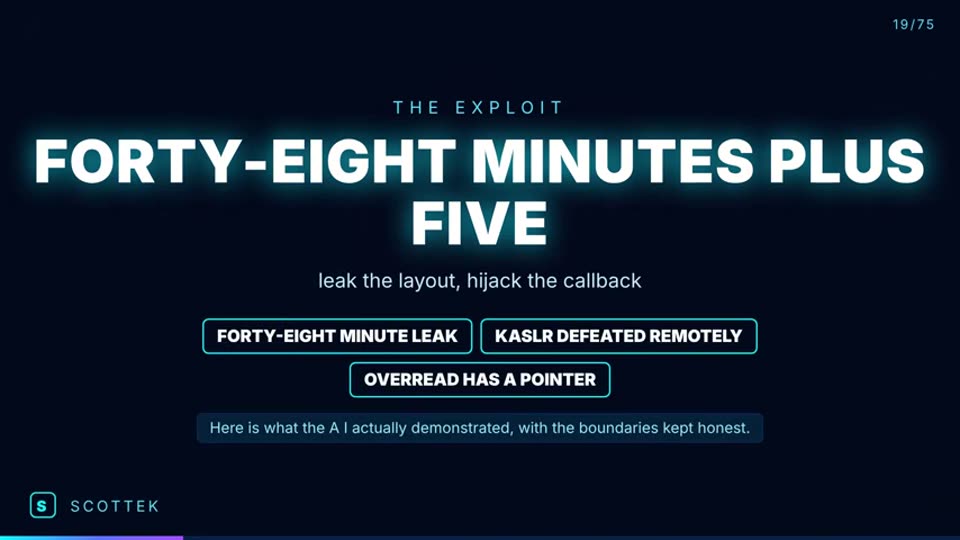
In the video: stage one defeats kernel address randomization remotely by tricking the kernel into copying back extra bytes, where one overread containing a kernel pointer leaks the memory layout, taking 48 minutes in the proof of concept. Stage two hijacks control flow through the same bug and chains kernel functions into an attacker-chosen shell command as root, taking five more minutes. A lost race only fails one handshake without crashing anything, so the attacker can retry indefinitely. What this is not: not autonomous, not a public tool, and those times are lab conditions, not your network.
Added from the sources: the Anthropic post states each of these points verbatim, including that the model acted after initial prompting, that it is an unreleased internal research model rather than a public product, that the payload is staged via an ordinary protocol feature before a callback pointer is overwritten, and that the vulnerability was patched upstream and backported to all maintained stable branches. The proven remote trigger in the disclosure is a multipath TCP listener, so the accurate framing is a generic handshake bug with a demonstrated MPTCP trigger. Do not attempt to reproduce or run any exploit: everything below is defensive checking only.
Check whether you are exposed
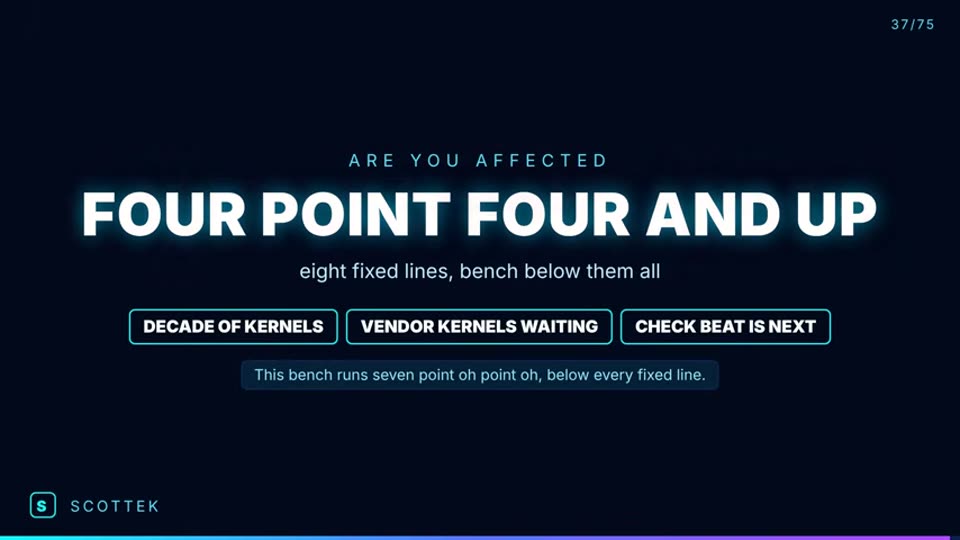
In the video: five read-only checks, all demoed live on the bench with outputs verbatim. One, uname -r returns 7.0.0-38-generic, below every fixed stable line. Two, distro and installed kernel packages identify which vendor line is being waited on. Three, multipath TCP status reads 1, compiled in and enabled. Four, the migration sysctl net.ipv4.tcp_migrate_req reads 0, so the secondary trigger path is off by default. Five, the listener survey shows Samba on ports 445 and 139 plus local services and no web ports, and every inbound TCP listener counts as surface.
Added from the sources: the bench values match the production research notes for this box, which is Ubuntu 24.04.5 on the HWE line with installed images 7.0.0-38 and 7.0.0-42, CONFIG_MPTCP=y in the kernel config, and nftables 1.0.9 present. Run these read-only checks on your own machines and re-run them after every kernel update until your vendor marks you patched.
- Check your kernel with
uname -rand compare it against the fixed stable releases5.10.272,5.15.223,6.1.190,6.6.159,6.12.113,6.18.56,7.2.10, and7.3 - Check your distro line with
cat /etc/os-releaseand list installed kernels withdpkg -l | grep linux-imageon Ubuntu and Debian orrpm -qa kernelon RHEL family systems - Check MPTCP state with
sysctl net.mptcp.enabledand build support withgrep -w CONFIG_MPTCP /boot/config-$(uname -r), noting that MPTCP ships enabled on modern kernels so do not assume a listener is vanilla TCP just because multipath was never configured - Check the secondary trigger path with
sysctl net.ipv4.tcp_migrate_req, where0means that path is off by default, which removes one trigger but not the main one - Map every inbound TCP listener with
ss -ltnandss -M -ltn, covering reverse proxies, game servers, media servers with remote access, and anything port-forwarded from the router, since firewall rules that only filter ports change nothing here - These checks are read-only and safe to run, while exploit reproduction is out of scope and must not be attempted
The Red Hat filter: exposure reducer, not a fix
In the video: no reboot-saving trick fixes a kernel use-after-free, but Red Hat published an exposure reducer worth knowing: a tiny nftables table dropping inbound IPv4 TCP packets carrying IP options, which ordinary traffic does not use since standard TCP options ride in the TCP header and keep working.
Added from the sources: RHSB-2026-016 publishes the exact table and is blunt about its limits: filtering reduces exposure but cannot fully prevent exploitation, may disrupt necessary workloads, and patching is the only complete solution. Test it in a non-production environment before deploying it, review it against your own traffic and operational requirements, and remove it after the kernel is updated to a fixed version. The rule drops inbound IPv4 TCP with ip hdrlength > 5, validates with nft --check, applies with nft --file, and removes with nft delete table inet cve_2026_98432. See the bulletin for the exact file text rather than copying fragments from anywhere else.
- Reduces exposure only and cannot fully prevent exploitation, so treat it as a stopgap while waiting on vendor kernels
- Test off-production first because it may disrupt workloads that legitimately use IP options
- Ordinary application traffic is generally expected to keep working since TCP options live in the TCP header
- Remove the table once a fixed kernel is installed, using the bulletin's removal command
Patch status: fixed upstream, waiting on distros
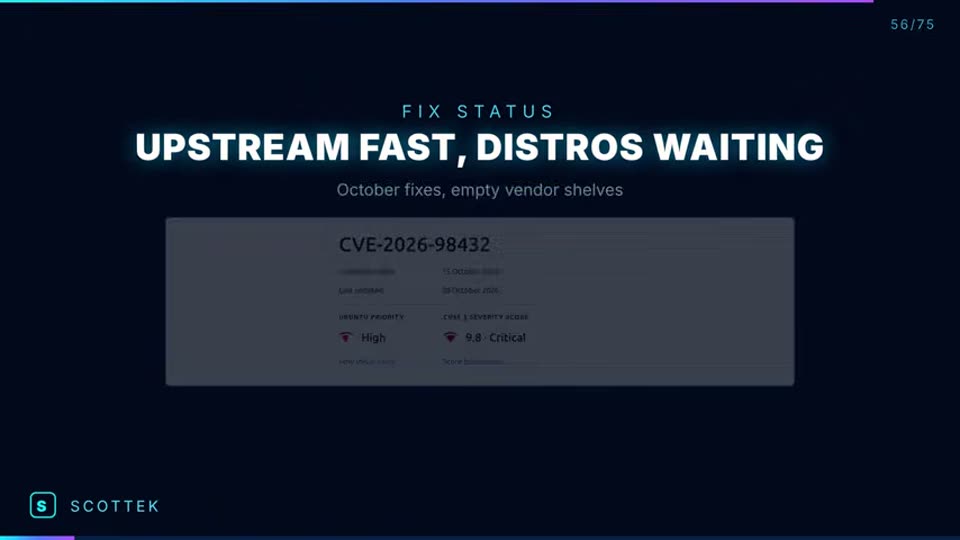
In the video: upstream moved fast, with the fix landing in stable trees around Oct 11 and Oct 15, while as of Oct 31 Ubuntu lists every release as vulnerable with fixes still in progress and Red Hat lists versions 8, 9, and 10 plus OpenShift as affected with fixes expedited but unshipped. RHEL 7 is the exception because its kernel predates the vulnerable code. The video also states Debian and current enterprise vendor kernels already carry the fix, which is a video claim without independent corroboration in this package.
Added from the sources: the NVD page lists the fixed releases as 5.10.272, 5.15.223, 6.1.190, 6.6.159, 6.12.113, 6.18.56, 7.2.10, and 7.3, with the mainline fix commit e3f33b0a1d89 landing in 7.3-rc7. The Ubuntu tracker shows releases 26.10, 26.04, 24.04, and 22.04 as vulnerable with work in progress toward target versions 7.3.0-10.10, 7.0.0-43.43, 6.8.0-149.149, and 5.15.0-203.213, while 20.04, 18.04, and 16.04 are listed vulnerable and 14.04 is not affected. Those target versions are work targets, not shipped fixes, and no Ubuntu security notice had been released as of Oct 31. Red Hat confirms RHEL 8, 9, and 10 plus the OpenShift and RHCOS family affected, RHEL 7 not affected, and no fixed RHEL kernel released as of Oct 31. The fix is credited to Eric Dumazet with Anthropic's Xinyang Ge as reporter.
Your list this week
In the video: watch the distro tracker, not the CVE databases, and re-run the five checks after every kernel update until uname shows a fixed line and the vendor marks the release patched. That is the whole program: check, reduce, patch, reboot.
Added from the sources: the NVD assessment field still reads not yet provided, so vendor trackers carry the real shipping status. Anthropic's disclosure clock is 90 days to patch plus 45 days before further detail beyond advisories, so expect deeper technical write-ups to land inside that window. The Ubuntu tracker and Red Hat bulletin are the two pages to watch, and patching plus rebooting remains the only complete fix.
- Track the Ubuntu CVE page and the Red Hat bulletin instead of relying on aggregator scores
- Re-run the exposure checks after each kernel update until the kernel is at or above a fixed release and the vendor marks the release patched
- Apply the nftables filter only where traffic allows, test it first, and remove it after updating
- Install the vendor kernel update and reboot the day it ships, since a running kernel only changes on reboot
- Expect further technical detail inside Anthropic's 90-plus-45-day disclosure window