AI Rewrote Qwen Weights With No Training: Run Both Locally

This guide is the written companion to the video AI Rewrote Qwen Weights With No Training: Run Both Locally (401s, uploaded 2026-11-10), and it treats the video as the starting point. Claims shown in the recording are labeled In the video, and everything confirmed against the authors' post and the model repositories is labeled Added from the sources. Steps not independently run here are marked untested. The draft is grounded in the Prag research folder for this video, including the owner-written video description checked against the fetched auto-sub captions, the LEDGER.md bench record, and research/SOURCES.md fetched 2026-11-10.
In the video: MIT CSAIL researchers gave GPT-6 Astra the raw weights of Qwen3.5-0.8B and told it to improve the math, with no training runs, no gradients, and no fine-tuning. Added from the sources: the authors' post Sparks of Weight-Space Programming describes Astra working in a Python session over the weights with a budget of 50 forward passes on practice problems from the training sets, never shown the evaluation sets. That framing matters for the whole guide: this is an AI doing machine-learning engineering with code and tools, not telepathy.
What was actually edited
In the video: the edit touches exactly two tensors and nothing else in the model is changed. Added from the sources: the authors state 131,072 weights changed, about 0.016% of the model, confined to the down-projection weights of the MLP blocks in layers 15 and 19, with 64 output columns in each. The community manifest pulled in the video's sandbox verification lists each tensor as shape 1024 by 3584 in bfloat16, with 65,260 changed entries in layer 15 and 64,928 in layer 19, and everything else byte-identical to the base checkpoint.
In the video: the sandbox check confirmed the base checkpoint matches the official Qwen revision 2fc06364 and the two edited tensor hashes match the authors' published hashes. Added from the sources: the official edited repository RikiyaT/Qwen3.5-0.8B-weight-space-programming is Apache-2.0 licensed and names Qwen/Qwen3.5-0.8B as its base, and the live base record for Qwen/Qwen3.5-0.8B confirms the same revision hash and an Apache-2.0 license. The video's verification was file-level plus score-file comparison, labeled as such, not a full 500-problem rerun.
The headline numbers and the catch
In the video: the authors' headline numbers are MATH-500 from 7.9 percent to 48.1, with thinking mode on and up to 32,768 tokens at temperature 0.6. Added from the sources: the authors also report GSM8K from 13.8 to 67.1, instruction following from 21.0 to 62.3, and the share of answers ramming into the token limit collapsing from 93 percent to about 33. The independent community rerun lands within about two points of the authors, at MATH-500 base 0.0735 to edited 0.5015 and GSM8K base 0.1296 to edited 0.6763, under the same thinking-on sampling of temperature 0.6, top_p 0.95, top_k 20, and presence penalty 1.5.
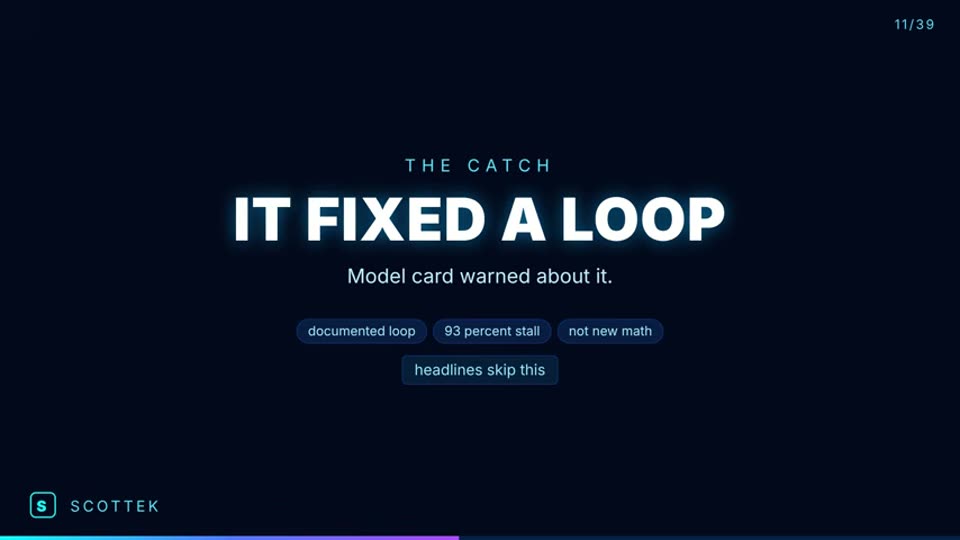
Now the catch the headlines skip. In the video: Qwen3.5-0.8B had a documented looping problem, with 93 percent of hard-math answers never finishing and just reasoning in circles until the token wall, and Astra traced the loop to one direction written by those two MLP blocks and subtracted it out. The gain comes almost entirely from answers that now finish instead of looping forever. It removed an obstacle. It did not install new math knowledge.
How to run both locally
In the video: both versions are small enough for a laptop, and thinking mode must be on or the edit does nothing for you. The three repositories you need are all Apache-2.0 and ungated:
- Base model Qwen/Qwen3.5-0.8B at revision
2fc06364— the before half of the comparison - Edited checkpoint RikiyaT/Qwen3.5-0.8B-weight-space-programming — the authors' official after half
- Community port JonathanColetti/Qwen3.5-0.8B-Astra-WeightEdit — the runnable after half with
GGUFforllama.cpp, LM Studio, and Ollama plusONNXfor browsers and ONNX Runtime
Added from the sources: the community repository's live tags confirm gguf, onnx, llama.cpp, and transformers.js support, which is what makes the laptop and browser routes possible. Downloading both checkpoints and comparing the same prompts before and after is the cheapest striking demo of interpretability turning into a fix this year, and the exact load-and-generate commands are untested here, so follow each repository's own usage card for your runner.
Settings that matter
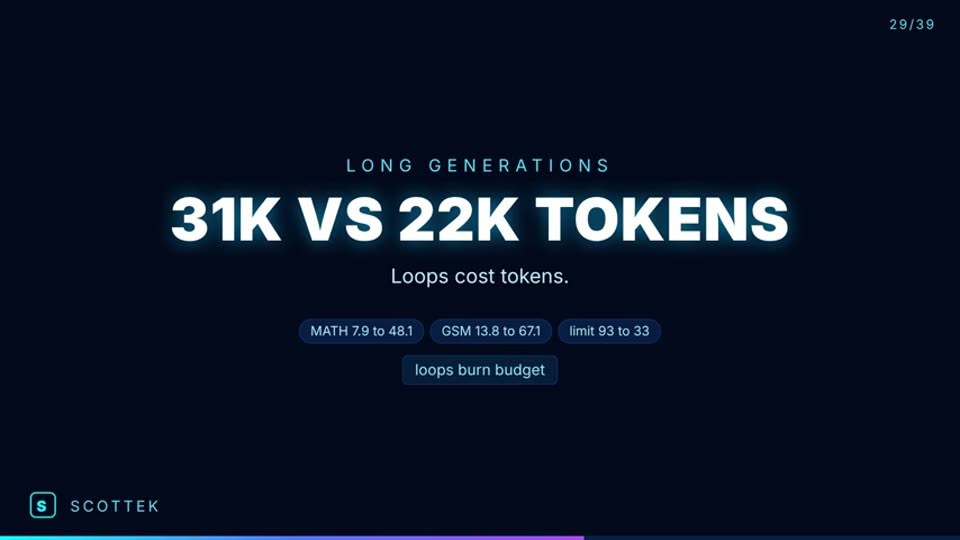
In the video: copy the authors' sampling or your numbers will not compare. The settings are thinking on with enable_thinking true, temperature 0.6, top_p 0.95, top_k 20, presence penalty 1.5, up to 32,768 tokens, and seed 0 for the paper's table. The chat template turns thinking off unless asked, so request it explicitly. Expect long generations either way: the base model averages around 31,000 tokens per MATH problem because it loops, against around 22,000 for the edited one.
Limits that cap the claim
In the video: the authors are upfront about the limits, and the critique gets airtime alongside the post. The same trick on Gemma 3 270M barely moved, from 6.8 percent to around 7, because that model rarely loops. Astra also failed to spot a sycophantic model from weights alone. With thinking turned off, the edit costs about one to two points. And the team calls these very early results in a blog post, not a peer-reviewed paper.
Added from the sources: critic Matthew Honnibal's point stands as presented in the video — the Qwen edit used a Python kernel plus up to 50 batches of practice problems in a human-style engineering loop, and direct raw-weight reading only happened on tiny toy networks. Read the critique alongside the post before repeating the strongest version of this claim.
Verdict: should you download it
If you run small models at home, take the edited weights for any thinking-mode math pipeline using Qwen3.5-0.8B, since the looping fix is real and independently reproduced within about two points. If you wanted proof that models can natively read hundred-million-weight brains at a glance, this is not it. And if you like local-AI experiments, the before-and-after comparison is worth an evening: same prompts, same settings, two tensors changed, and a sixfold math jump that survives independent reruns. Promising, narrow, and honest is the right shape for this claim.