Unsloth Studio's Big Week: Browser AI, New Local Models, and Faster Everything
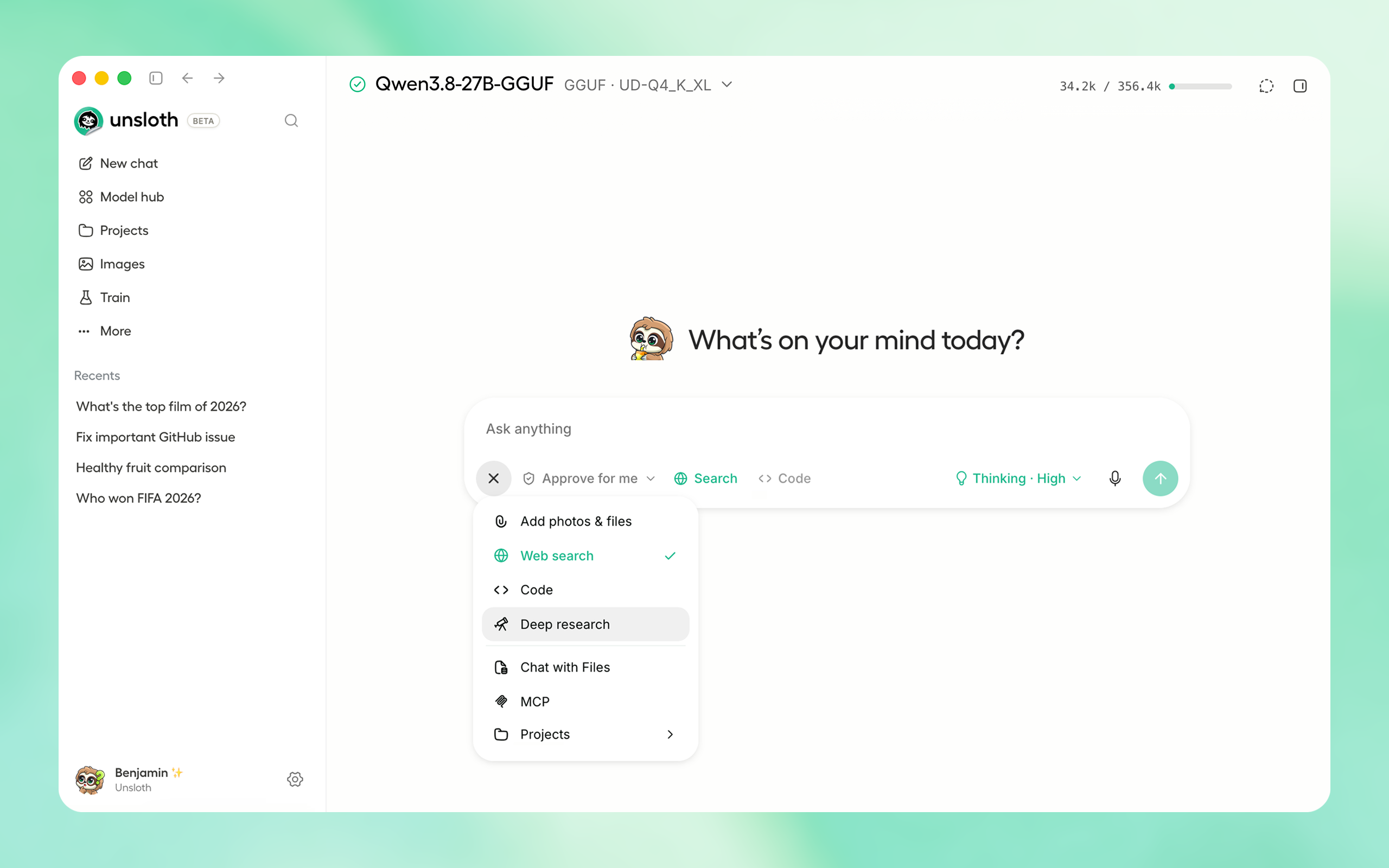
Unsloth has shipped five releases in nine days, turning its open-source Studio app into a local agent workstation. The stretch from October 7 to October 15 added agentic browser control, day-one support for NVIDIA's Nemotron 3.5 family and Meta's giant Muse Spark Open, train-your-own decision models, OS-level sandboxing, and speed improvements across inference, training, and the UI itself. All of it runs on your own hardware, and the pace is worth a roundup.
Models that click, type, and scroll
The signature feature of the week is Browser Use, which arrived October 12 and matured within days. Turn it on and a local model drives a real browser beside the chat: opening pages, reading them, clicking, typing, and scrolling while you watch, each chat keeping its own tabs. The follow-up hardened it with an always-allow option, a visible cursor, per-site rules, and scripted actions. For a local-AI homelab, this is the moment the model stops being a chatbot and starts being an operator — with your tabs, not someone else's cloud, as its workspace.
Day-one giants: Nemotron 3.5 and Muse Spark Open
The October 15 release brought same-week support for the two biggest open model drops around. NVIDIA's Nemotron 3.5 Bolt (74B, 9B active) fits a 24GB card, while the 120B Super VL targets machines with 64 to 128GB. Meta's 816B Muse Spark Open, with 42.7B active parameters and a million-token context, is documented around 256GB. Same-day support for flagship releases used to be a cloud privilege; Unsloth shipping GGUF builds and guides within hours keeps local labs in the race.
Better, faster, safer training
Two releases pushed training somewhere new. The October 8 drop lets anyone turn a text or vision model into a Jev-style decision model, with the team reporting accuracy climbing from 30% to 80% on decision tasks — classification and scoring without giant models. The same stretch added text-diffusion LLM training (LLaDA, Dream, and friends) with a live denoising canvas, plus DeepSpeed ZeRO support for bigger jobs. And sandboxing landed across all three desktop OSes, so model-run code executes contained rather than on your bare user account.
The speed Papercuts disappearing
A mid-week performance release claims up to 10x faster UI work across multiple chats, up to 5x faster inference at high cache-hit rates, up to 3x faster oversized MoE models, and nearly 3x faster Mac replies via speculative decoding. Vendor numbers, not independent benchmarks — but the direction across five releases is unmistakable, and video generation joined in with LTX-2.5 and Wan2.2 support plus faster image LoRA training.
A word for the team
Shout-out to Daniel, Mike, and the rest of the Unsloth team — shipping five substantial releases in nine days, with docs, guides, and same-day flagship model support, is a serious pace. Keep up the great work.
How this article was made
Disclosure: this article was researched and drafted with AI assistance. Every version number, date, feature claim, and performance figure above was checked against the linked primary sources before publishing, and vendor speed claims are labeled as vendor claims, not independent test results.
Sources
- Unsloth updates changelog
- v0.1.908 release notes: Nemotron 3.5 + Muse Spark Open
- v0.1.907 release notes: performance gains + browser use
- v0.1.905 release notes: sandboxing
- Unsloth blog: decision models
- KBlip signal feed on Unsloth + RTX Spark
Article image: Unsloth Desktop screenshot from unsloth.ai.
Comments (0)
Log in to comment.