Tailworm: One Hacked Device Means Root Everywhere

This guide is a companion to the video walkthrough and never replaces it. It retells what the video presents, plus same-day checks of the official sources linked below. Every patch and lockdown step described here is untested in this guide and was never reproduced on a live tailnet for this article.
Watch the video first
Watch the video on YouTube before following along. The video runs about 10 minutes (598 seconds), was published on 2026-10-28, and is an incident-response walkthrough of the Tailworm report with patch and lockdown steps for Tailscale SSH and self-hosted Headscale.
What Tailworm is
- In the video: the Tailworm report comes from Erica Windisch at Cyberdione Labs, published October 24 after lab testing from October 22 to 24 against unmodified releases, with 11 findings and 6 rated High, 4 of them in Tailscale SSH.
- Verified for this guide: the report site at tailworm.com carries the same testing window, versions, and finding counts, and notes fixes landing in the public repositories with v1.104.4 tagged 2026-10-27.
- Verified for this guide: Tailscale confirms the patched release in Tailscale SSH: Findings and fixes, with detail in the four bulletins on the security bulletins page and background in the earlier SSH investigation and remediation update.
- In the video: Tailscale received the report on the morning of October 24 and it was public about two hours later, and the patched release plus the full write-up followed within four days.
- Verified for this guide: the tested versions were Tailscale v1.104.2 and Headscale v0.29.5, while Headscale v0.29.6 predates the disclosure and carries unrelated fixes only.
What the flaws need, and what they are not
- Verified for this guide: exploiting the SSH flaws needs an existing foothold on an authorized device plus SSH access explicitly permitted in the tailnet policy, and the flaws do not let an unauthenticated attacker connect to arbitrary Tailscale SSH servers, per Tailscale SSH: Findings and fixes.
- Verified for this guide: Tailscale describes the effect as lateral movement limited to connections the policy file already allows, not self-replicating malware spreading across the internet, and notes the stable app connectors in use today are not affected while the experimental conn25 connectors are pre-production.
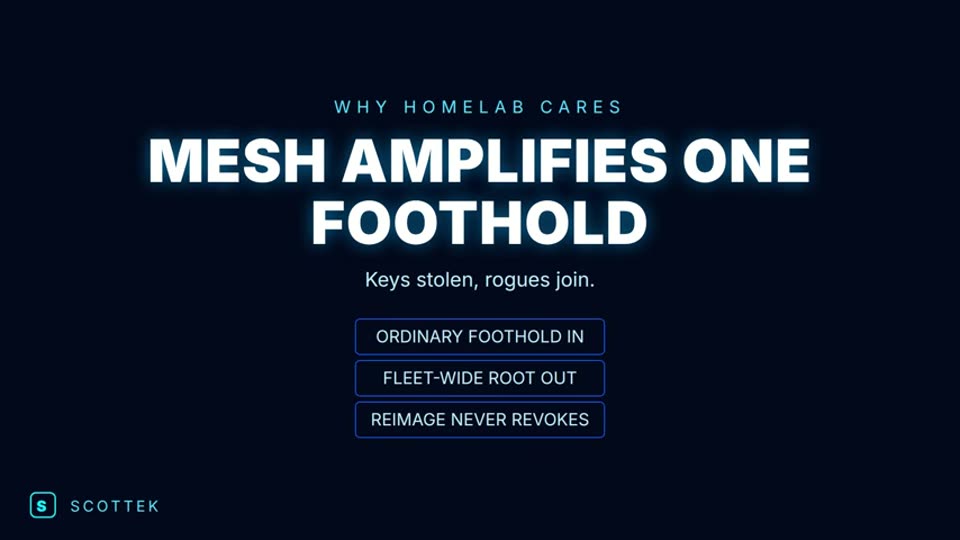
- In the video: the mesh amplifies one ordinary foothold into fleet-wide privileged access at machine speed, with lab spread measured under a second per hop, because every path between machines was pre-approved by the viewer own policy.
- In the video: limiting SSH to non-privileged accounts does not mitigate the findings, which operate from fully unprivileged accounts, and reimaging a owned box does not revoke its stolen keys, so only deleting the device at the control plane does.
Patch to v1.104.4 first
- In the video: check what you run with
tailscale version, and treat anything at or below v1.104.2 as needing the update, then pull v1.104.4 or newer from the official package repo and verify the version string again, untested in this guide. - In the video: containers and sidecars ship their own copies, so rebuild those images too and confirm the running image rather than only the pulled tag, untested in this guide.
- Verified for this guide: the security bulletins page states each confirmed flaw is fixed in Tailscale v1.104.4 or newer, and recommends upgrading SSH and Serve users accordingly.
- In the video: if you cannot upgrade today and you use Tailscale SSH, set
TS_SSH_DISABLE_FORWARDING=1in the tailscaled service environment and restart, which kills forwarding while ordinary sessions keep working, and hosted Tailscale users can also set the per-rule forwarding flags to false, untested in this guide. - Verified for this guide: the SSH investigation and remediation update gives the same interim switch and notes it mitigates several of the more serious findings without disabling all of Tailscale SSH.
- In the video: a live terminal segment checks the patched release and the projects it touches, so watch those outputs and run the same checks on your own machines.
Shrink the SSH policy
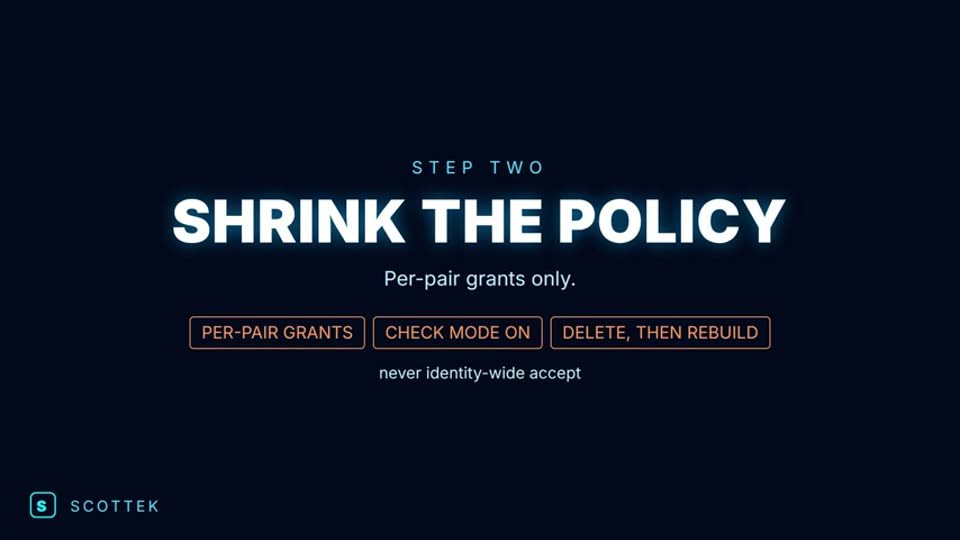
- In the video: rewrite SSH rules as per-pair grants covering one device, one server, and the one account it needs, never identity-wide or tag-wide accept rules, because per-pair grants were the single control that stopped the spread in the lab, untested in this guide.
- In the video: turn on check mode for sensitive systems so an allowed connection needs a second authentication tap, and review the Tailscale SSH docs plus the policy file syntax while tightening, untested in this guide.
- In the video: set key expiry on server fleets per the key expiry docs, look at Tailnet Lock, and watch authkey issuance so a node joining outside a change window reads as an alarm, untested in this guide.
- In the video: build one incident habit where a owned box means deleting the device at the control plane first and then rebuilding, since reimaging alone leaves stolen keys valid, untested in this guide.
If you self-host Headscale
- In the video: Headscale v0.29.6 does not fix Tailworm since it predates the disclosure, with changes limited to certificate handling and performance, so check the v0.29.6 release notes rather than assuming coverage.
- In the video: on Headscale v0.29.5, SSH forwarding cannot be switched off per rule and is granted unconditionally on every accepted session, so until a Headscale fix ships, treat every SSH grant as root-equivalent and only grant SSH where you would grant root, untested in this guide.
- In the video: harden the control plane itself with memory limits, restart supervision, and throttling on registrations, since unauthenticated attackers can crash-loop it from the internet, and keep watching Headscale releases the way you watch Tailscale, untested in this guide.
- Verified for this guide: this site has a separate Headscale deploy walkthrough at Headscale plus Headplane, which covers the self-hosted control plane this section hardens.
Disclosure note and what remains uncertain
- In the video: two hours notice is rough and uncoordinated disclosure splits opinion, with the researcher case being that fast awareness speeds remediation and the vendor case being that Tailscale was already investigating and still shipped in four days.
- Verified for this guide: as of 2026-10-28 no CVE identifiers are published for these findings, the demonstrations are lab-only, and no in-the-wild exploitation has been reported.
- What remains uncertain is when a Headscale-side fix for the unconditional forwarding grant will ship, whether CVEs will be assigned later, and which findings touch any single node, since each depends on whether that node runs the Tailscale SSH server or Serve with the affected features on.
This article contains no affiliate links, and the video closing sponsor plug is intentionally excluded.