Strix Halo 128GB: Best Local AI Box in 2026?

Watch the starting point
This guide is a companion to the video Strix Halo 128GB: Best Local AI Box in 2026?, a 9-minute decision guide built on the channel research package for this exact video. The video opens with the memory crisis, recaps the Serve the Home review, walks the Linux bring-up shape, does the buy math across the 128GB field, and ends with an honest skip list. Video claims and added research are kept visibly separate throughout, and anything not actually tested is marked untested.
Two honesty notes carry over from the video itself. First, the bring-up segment from 5:09 to 5:33 is a labeled dramatized illustration: the video has no Strix Halo bench silicon, so it replays the documented community command sequence keystroke for keystroke with illustrative outputs, disclosed in the narration, the on-screen tag, the description, and the research ledger. Second, benchmark figures are each measurer's own numbers and cross-source comparisons are approximate, while prices were checked late October 2026 and move with memory supply. The transcript was fetched and matches the narration script. There are no affiliate links in this package.
The one idea: one pool of memory
- In the video: the Ryzen AI Max Plus 395 packs 16 Zen 5 cores up to 5.1 GHz, Radeon 8060S graphics with 40 compute units, and up to 128GB of LPDDR5X shared between CPU, GPU, and NPU. One pool, and everything drinks from it, which is why a 120-billion-parameter model fits on a mini PC with no 24GB VRAM ceiling.
- Added from the sources: the ASRock Industrial AI BOX-A395 page confirms the soldered 128GB LPDDR5X-8000 configuration behind that claim. The catch is permanent: the memory is baked onto the board, so there is no later upgrade and the buying decision is final. Buy once, buy the big one, because solder means no second chances.
The review verdict that settles it
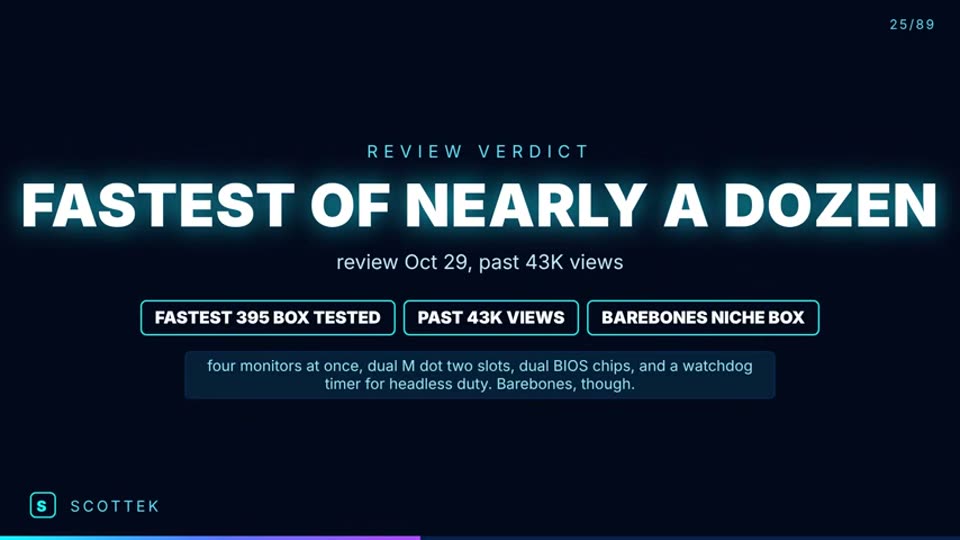
- In the video: Serve the Home tested the ASRock Industrial AI Box-A395, a standing mini-ITX tower with a carry handle and internal power supply, and called it the fastest 395 box they have reviewed across nearly a dozen systems, with their video passing 43K views in days. The spec wishlist reads like a homelab dream: 10GbE plus 2.5GbE, three USB-C ports with two at 40Gbps, two HDMI 2.1, four monitors at once, dual M.2 slots, dual BIOS chips, and a watchdog timer for headless duty. Barebones, though: no SSD and no OS included, and a niche industrial portable rather than a family desktop.
- Added from the sources: the Serve the Home review (Ryan Smith, October 29) confirms the verdict wording used here: the fastest Ryzen AI Max Plus 395 system reviewed, a remarkable entry, with explicit niche framing. The channel research package corrects an early draft phrasing here: the review says fastest-tested, not most well-rounded. Industrial extras confirmed in the review include the rarely seen dual BIOS chips, the self-reset watchdog, Wi-Fi 7, and the optional carry handle, against critiques of fast-USB-only-on-rear ergonomics and the cramped front M.2 slot that needs heatsink removal to reach.
What actually runs on it
- In the video: gpt-oss 120B runs at 31 to 34 tokens per second in light runs, dropping to the mid-teens with heavy inputs and high concurrency. Qwen 3.6 at 35B parameters does about 60-plus tokens per second, Qwen 3.8 27B dense is respectable on a tuned quant, the Flash Next variant at nearly 94GB on disk pushes the box limits, and Nvidia Nemotron 3 Nano 30B runs fine including a 64K-context test. The rule that saves you money is that sparse experts fly while dense giants crawl: a dense 70B model limps at about 5 tokens per second, so buy for mixture-of-experts, not for dense.
- Added from the sources: the numbers above are aired as video claims with the video's own approximate-comparison caveat. Independent community compilations point the same direction: the Presenc Halo benchmark compilation and the bex.co self-hosted inference study both land gpt-oss-120B in the low-30s per second with dense 70B near 5, which corroborates the video's sparse-flies-dense-crawls rule without making it a fixed score. Treat every tokens-per-second figure as engine- and quant-dependent, since results move with weekly engine updates.
The Linux path and the one BIOS setting
- In the video: Serve the Home tested on Ubuntu and Linux is the first-class path. Start with Vulkan on RADV, the open Mesa driver, which beats AMD's own ROCm stack for mixture-of-experts inference on this chip, with Ollama running on it out of the box. ROCm with an explicit GFX 1151 build is the second route. The setting that decides everything is the UMA frame-buffer carve in BIOS: measured guides say start small at 512MB or the vendor minimum and let the shared GTT pool do the work, or carve a full 96GB and tune kernel flags for the biggest models. Same silicon, wildly different ceilings, so set it before benchmarking anything.
- Added from the sources: the documented community paths behind this segment are the strix-halo-guide setup doc for the small-UMA-reserve route, xct/strix for the 96GB carve where Vulkan on RADV consistently beats ROCm for mixture-of-experts, and the halo-box strix-llama.cpp fork where ROCm needs an explicit
gfx1151build plusamdgpu.gttsizetuning. None of this was run on bench hardware here, so every flag below counts as untested until you reproduce it on your own box.

The buy math at crisis prices
- In the video: SK hynix told investors its DRAM and HBM supply is effectively spoken for through 2029, and the price tags show it. The Framework Desktop lists 128GB at $3,449 DIY without SSD and is out of stock, GMKtec EVO-X2 runs about $3,650, Minisforum MS-S1 Max near $3,900, Beelink GTR9 Pro up to $4,349 and actually in stock, AMD's own developer box at $3,999, HP's workstation take past $5,000, and the ASRock 64GB box near $2,950 with the 128GB config around $4,300 through industrial channels. Last summer this class started near $2,000, so the memory crisis roughly doubled it.
- Added from the sources: the crisis quote checks out against PCMag's earnings-call report: SK hynix says DRAM and HBM volume through 2029 is effectively sold out under long-term agreements covering over half of 2027 to 2028 capacity. The field prices match the ComputingForGeeks 395 mini-PC comparison, which the video links as its receipt source. Every dollar figure above is a late-October-2026 snapshot and is perishable: recheck before buying, and never treat a Newegg-style listing as confirmed, since the research package hit a Cloudflare wall there and substituted the comparison table.
Three honest reasons to skip
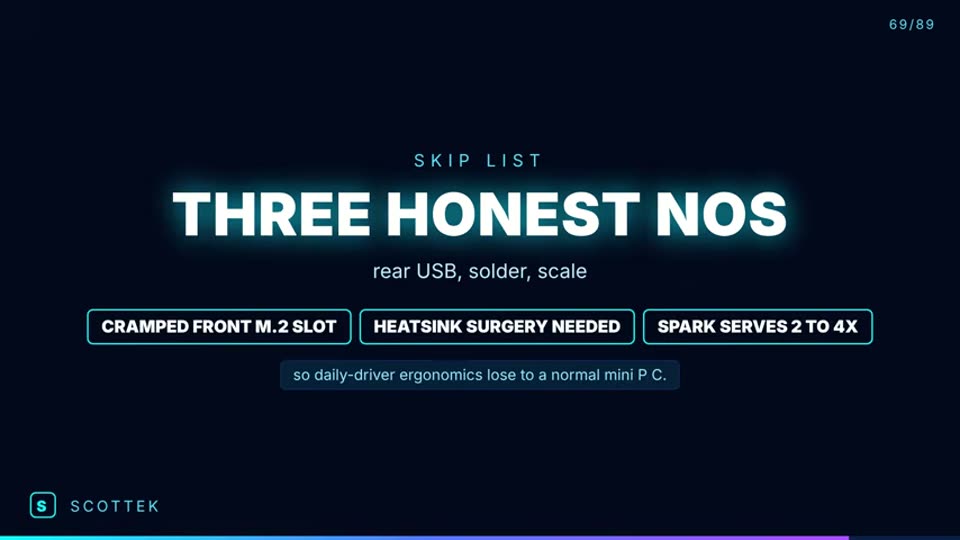
- In the video: one, desktop duty: the fast USB lives on the rear only, so daily-driver ergonomics lose to a normal mini PC. Two, upgraders: soldered memory plus that cramped front M.2 slot means heatsink surgery to reach storage. Three, throughput per dollar at scale: an Nvidia DGX Spark serves batched loads two to four times faster with about five times the prompt processing, and a used 24GB card still wins on a budget. This box has exactly one job: big sparse models, local, quiet, on your network, behind 10GbE. If that is not your job, keep your money.
- Added from the sources: the Spark gap is consistent with the bex.co study linked in the video description, which puts the batched-serving gap at two to four times depending on workload. The practical memory-bandwidth ceiling near 215 GB/s of 256 GB/s in the research notes explains why batching favors the Spark while single-stream desk-side runs stay Halo's home turf. No Spark hardware was tested here, so treat the gap as reported comparison, not a reproduced result.
Gorgon next and the verdict
- In the video: AMD's follow-up Gorgon Halo silicon, the Ryzen AI Max Plus Pro 495, raises the ceiling to 192GB with up to 160GB available to the GPU. Framework already lists a 192GB option, and Minisforum claims two linked 192GB boxes run a 235-billion-parameter model at 16 tokens per second. Vendor claim, treat it that way: independent numbers do not exist yet. If your target is a 120-billion-parameter model today, Strix Halo is proven. If your target is 200 billion plus next year, waiting is the rational trade.
- Added from the sources: the Minisforum 235B figure is aired strictly as a vendor claim in the research ledger, with no independent bench to corroborate it. The verdict stands as a video judgment call: buy the ASRock A395 or any proven 128GB Halo box if you want one quiet machine serving 120B-class sparse models over your LAN with real 10GbE and industrial reliability extras. Buy the 128, never the 64, install your own SSD on day one, set the UMA carve before anything else, start on Linux with Vulkan, and measure with your model, not anyone else's.
What is untested and what is next
- No Strix Halo hardware was on the bench for this package, so the bring-up sequence, every UMA flag, and every tokens-per-second figure above counts as untested here and comes from the video, the Serve the Home review, or the linked community guides.
- Prices are a late-October-2026 snapshot in a sold-out-through-2029 memory market: verify before spending, since solder makes the decision permanent.
- If your target is Gorgon-class 192GB or 200B-plus models, wait for independent numbers rather than buying on vendor claims. For the local-API side of serving whatever you buy, see the companion guide Install Self-Host 1.1.1 on Ubuntu: 93 Apps, One Command.