Old Phone Becomes a Local AI Watcher (v3.3.0)

This companion guide starts from the video Old Phone Becomes a Local AI Watcher (v3.3.0) (254 seconds, uploaded 2026-11-19) and adds grounded detail from the linked official pages plus bench research verified 2026-11-19, so you can tell what the video claims apart from what was actually checked on Linux.
Transcript note: auto-subtitles were unavailable for this video (HTTP 429), so the video description serves as the transcript-equivalent for this guide. Stills here are animated storyboard frames; the terminal captures inside them are the real bench output. Anything the description does not state is labeled as added research below, and anything not run on a bench is marked untested.
This guide is a genuine sequel to the earlier grid guide Install Observer on Ubuntu: Local AI That Watches, which covered Observer 3.2.4 as an Ubuntu install. This one follows version 3.3.0 with the drawer-phone watcher angle, including the phone-locking tools new since the 3.2.2 baseline.
What the watcher is
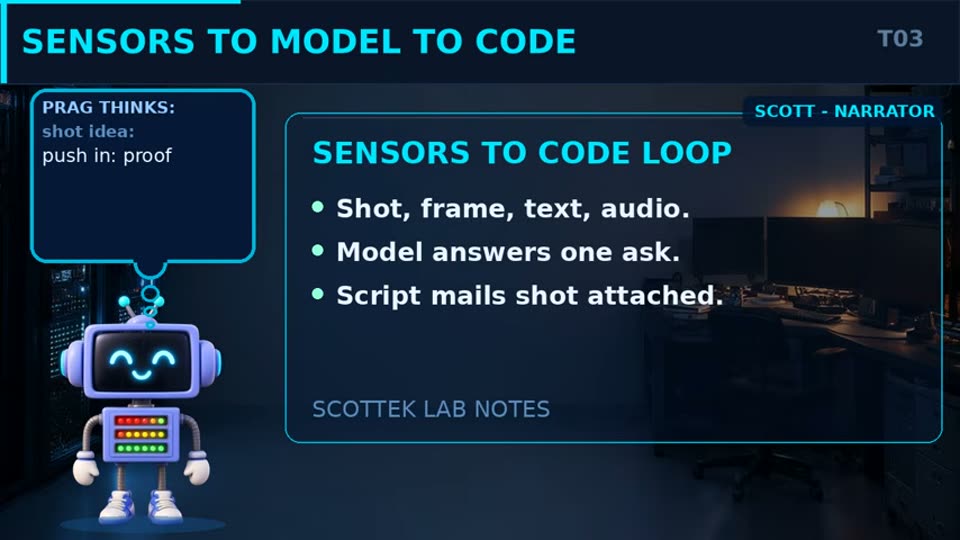
- In the video: a spare drawer phone becomes a local-first watcher that sees a screen, a camera, or hears a mic, then calls or messages you when something happens.
- In the video: the pattern is when X, then Y, with the phone acting as camera plus mic while Observer makes decisions without chatter.
- Added from the sources: the Observer repo describes local-first micro-agents that watch screen, camera, and audio and take action, with sensors including
$SCREEN,$CAMERA,$MEMORY,$IMEMORY,$CLIPBOARD,$MICROPHONE,$SCREEN_AUDIO, and$ALL_AUDIO. - Added from the sources: actions include
sendDiscord,sendTelegram,sendEmail,sendPushover,call,sendWhatsapp,sendSms, andnotify, pluslockPhoneandunlockPhoneacross video, desktop, and mobile, and theobservehelper wraps commands soobserve sleep 5calls you when the command exits. - Pointing a real phone camera and microphone at a room and receiving the resulting call or message is untested here, since the sandbox had no phone hardware.
v3.3.0 verified on Linux
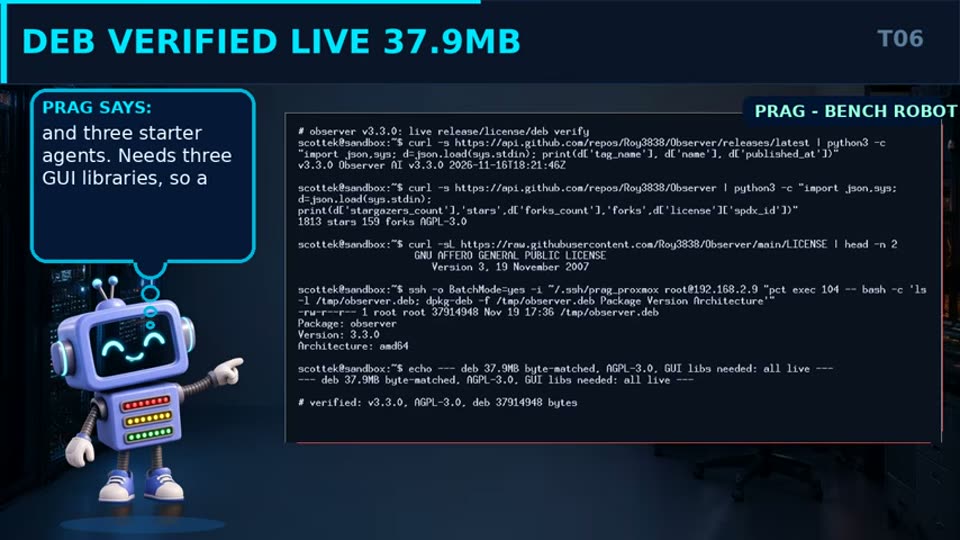
- In the video: version 3.3.0, released Nov 16, with the deb verified live at about 37.9MB.
- Added from the sources: the v3.3.0 release is the latest release, following v3.2.4 from Nov 10, while the v3.2.2 baseline from Nov 5 is stale, and the v3.2.2 to v3.3.0 range holds 38 commits including a phone-locking plugin.
- Added from the sources: research verified 2026-11-19 records 1813 stars, 159 forks, license AGPL-3.0, and a push on 2026-11-19.
- Added from the sources: a Debian 12 LXC bench verified the deb at
37914948bytes (about 37.9MB), the package record as PackageobserverVersion3.3.0Archamd64, dependencieslibappindicator3-1,libwebkit2gtk-4.1-0, andlibgtk-3-0, binaries/usr/bin/observeat6MBplus/usr/bin/appat53MB, and aLICENSEfile of type AGPLv3. - Added from the sources: the release also publishes an AppImage of
110737912bytes plusrpm,exe, anddmgbuilds. - Added from the sources: the desktop app ships
llama.cppand runs anyGGUFplusmmprojmodel, or you can bring your own server through the Custom Model Server URL to any OpenAI-compatible endpoint such as Ollama, llama.cpp, or vLLM, per the Observer repo. - The bench proves files, license, sizes, and dependencies only, since the sandbox could not launch the Tauri GUI and never ran a model, so every model behavior in this guide is untested.
Drawer-phone weekend plan
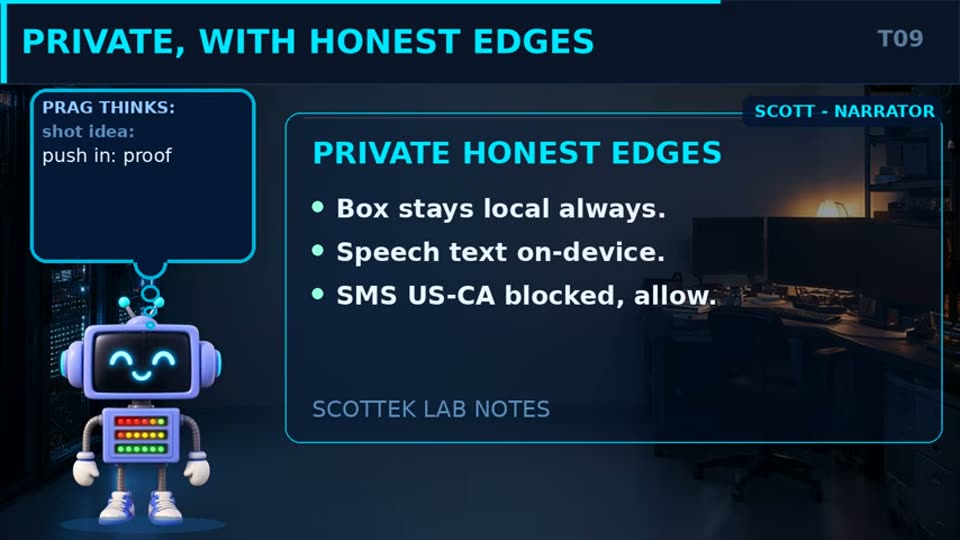
- In the video: the weekend project is a drawer phone as watcher, private by design, with honest edges stated rather than skipped.
- In the video: no model size is quoted on camera, so this guide states only small on-device vision models and gives no parameter count.
- Phone locking and unlocking through
lockPhoneandunlockPhoneis the 3.3.0-window addition to try first, and it is untested here for lack of phone hardware. - Call and message delivery from a live watcher is untested here, since no model was ever run on the bench.
Video chapters
0:00Old phone, new watcher0:17v3.3.0 out Nov 160:42Sensors to model to code1:04When X, then Y1:27Phone is camera plus mic1:47Deb verified live 37.9MB2:14Bring your own server2:35Decisions without chatter2:57Private, with honest edges3:20No size quoted on camera3:39Drawer phone weekend3:57Subscribe: 9-year fix next
Sources and credits
- Sources from the video description: Observer repo — open-source micro-agent orchestrator, AGPL-3.0 — accessed 2026-11-19 — supports the sensors, tools, and BYO-server claims; latest release — v3.3.0, Nov 16 2026 — accessed 2026-11-19 — supports the version and asset-size claims; observer-ai.com — local open-source micro-agents, privacy-first — accessed 2026-11-19 — supports the local-first framing; Observer App — web app entry — accessed 2026-11-19; and an Agent K LLM Daily archive page — Nov 8 2026 — accessed 2026-11-19 — supports the third-party traction note.
- Credits: License AGPL-3.0, by Roy Medina and the Observer AI community.