Linux 7.4: 23% Faster Local AI on AMD iGPU (PerfOpt Guide)

This companion guide starts from the video Linux 7.4: 23% Faster Local AI on AMD iGPU (PerfOpt Guide) and adds grounded detail from the Phoronix benchmark reports and the upstream kernel merge. Watch the video first for the full narrated walkthrough, then use the sections below as the written reference. One honesty note up front, stated on camera too: the bench here runs NVIDIA graphics with no AMD iGPU, so every before-and-after number below is Phoronix silicon, cited and credited, never measured on this bench. Readers weighing a Strix Halo purchase should also see the Strix Halo 128GB local AI box guide, which covers the hardware side this kernel feature lands on.
What PerfOpt actually is
- In the video: PerfOpt is short for an AMD IOMMU performance optimization drawn from AMD's own IOMMU specification, and in Linux 7.4 it lets an AMD integrated GPU that already sits in the IOMMU identity domain bypass IOMMU address translation when reaching directly into system memory.
- In the video: with the bypass armed, the IOMMU enforces only read and write permission bits with no address-translation step, which cuts per-access overhead and latency, and that shows up as more tokens per second.
- Added from the sources: the feature applies to integrated graphics only, never discrete cards, it is gated on the IOMMU PerfOptSup feature bit with the driver warning and continuing without it, and arming it switches off ATS, PRI, PASID, and Shared Virtual Addressing for the device, per the Prag research notes checked against the upstream patch text.
- Added from the sources: the enablement series comes from AMD engineer Mario Limonciello, the patches sat in the IOMMU subsystem tree through September, and the Linux 7.4 IOMMU merge news dates the pull to 30 October 2026, with the merge commit visible upstream at git.kernel.org.
The benchmark numbers, and whose they are
- In the video: every number in this section was measured by Michael Larabel at Phoronix, not on this channel's bench, using a test kernel built from the IOMMU tree with PerfOpt on versus forced off on the same machine, through the Lemonade local AI server with a llama.cpp backend on ROCm and Vulkan.
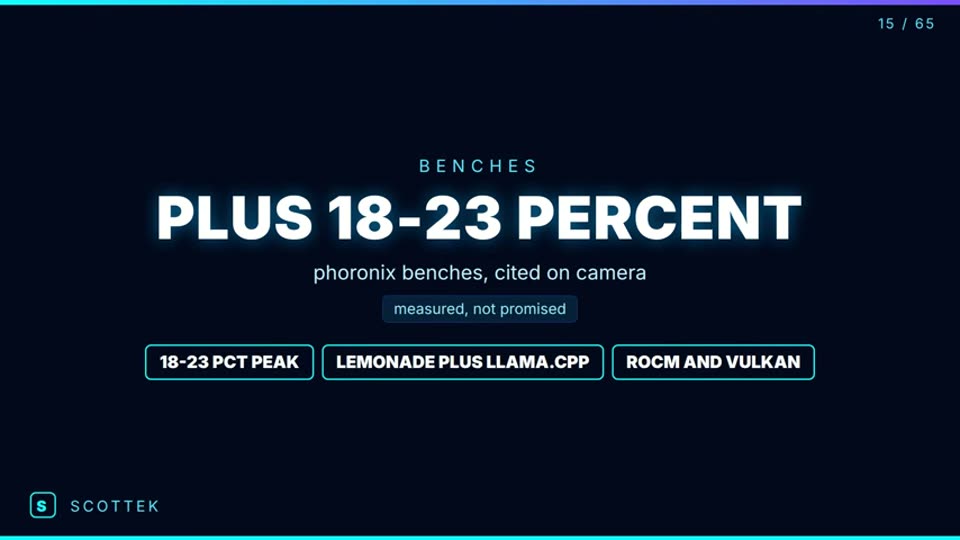
- In the video: across Strix Halo desktops plus Strix Point and Krackan laptops, local model speed rose as much as 18 to 23 percent, with the peak on a Ryzen AI 9 365 machine, while flagship Strix Halo parts with large reserved VRAM moved only 2 to 4 percent.
- Added from the sources: the round-one Phoronix review is the source of the 18 to 23 percent range, and the mechanism summary is that GTT shared-memory access ran 2 to 3 times slower than reserved VRAM before PerfOpt and lands within about 10 percent with it, so thin laptops with a small reserved slice gain most.
- In the video: older hardware is invited too, with a Ryzen 7 PRO 7840U plus Radeon 780M laptop gaining roughly 4 to 12 percent across Qwen3, MiniCPM4, DeepSeek-Qwen3, and gpt-oss-20b variants, where time to first token improved visibly and steady decode throughput rose only slightly.
- Added from the sources: those prior-gen numbers come from the Phoronix prior-gen review, and the prefill-improves-more-than-decode pattern matches the GTT-latency mechanism above.
Checking it and testing it yourself
- In the video: once booted on a 7.4 kernel on a supported APU, confirm with
dmesg | grep -i perfopt, and to run your own before-and-after, boot once more withamdgpu.iommu_perfopt=0on the kernel command line and rerun your usual prompt, measuring time to first token and tokens per second. - In the video: ride your distro kernel once 7.4 ships stable, expected around year's end, or test a release candidate on spare hardware first, never on the machine that pays the bills.
- Added from the sources: the Phoronix PerfOpt explainer confirms PerfOpt is enabled by default for the AMDGPU driver on integrated graphics, and the
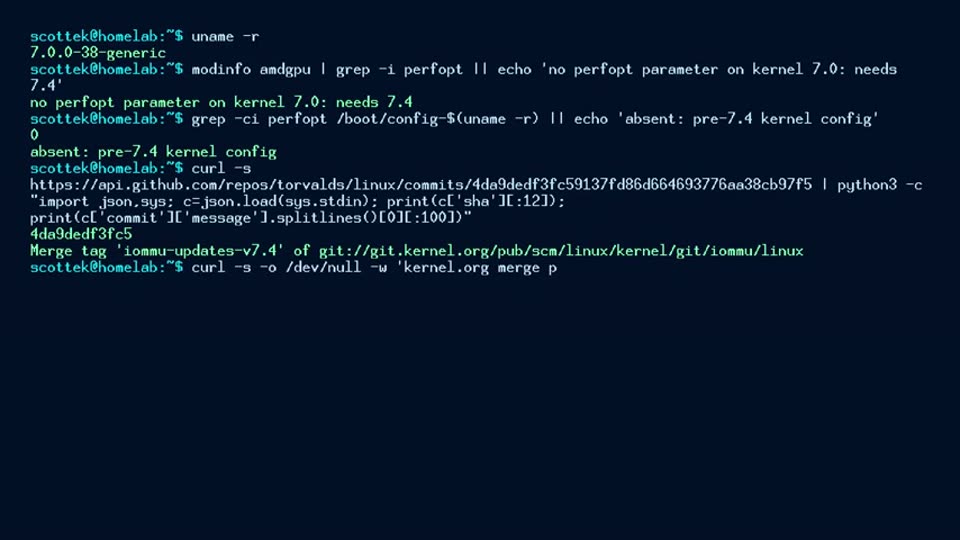
amdgpu.iommu_perfopt=0opt-out plus the dmesg check are documented driver behavior, though every hands-on step in this section is untested here since no AMD iGPU bench was available for this episode. - In the video: the on-camera demo verifies the plumbing rather than the speed, showing the merge commit resolving upstream and the parameter absent on the older local kernel, with the A-B illustration labeled as illustration everywhere it appears.
The security trade-off, quoted
- In the video: the driver's own commit message is explicit, quote: Arming PerfOpt trades IOMMU DMA containment for lower DMA latency, enabled by default for GPUs in the identity domain as a deliberate, documented policy.
- In the video: your GPU page tables still confine normal workloads, but the IOMMU stops being a second line of defense, so a driver or firmware bug, or a workload escaping the GPU's own page tables, would no longer be stopped by the IOMMU.
- Added from the sources: other devices keep their translated domains, so USB4 host controllers and similar stay protected, but VFIO and GPU-passthrough users plus anyone depending on PASID, SVA, or strict DMA isolation around the iGPU should test first and keep the off switch handy, per the Prag research notes.
- In the video: never fake this gain with
amd_iommu=offoriommu=pt, which strip protection from every device at once.
The NPU bonus and who should care
- In the video: community docs for running the XDNA 2 NPU note the NPU needs the IOMMU turned on, and on a stock kernel that choice alone cost the iGPU around 7.5 percent of prefill speed, while with PerfOpt the NPU stays available at effectively no cost to the graphics engine.
- Added from the sources: that 7.5 percent figure carries a stated caveat, since the reporting kernel changed at the same time, so the number mixes PerfOpt with a newer kernel, and the direction rather than the digit is the takeaway.
- In the video: the target demographic is laptops with a small reserved graphics slice running chat, coding assistants, or retrieval workflows locally, 7840U-class machines should expect single digits, maxed-out Halo boxes low single digits, discrete Radeons are untouched by design, and gaming gains are unproven since every bench here is language models.
- Added from the sources: nothing in this guide was tested against a live AMD iGPU here, so treat the commands and version pins as docs-verified starting points from the sources linked above and verify each step during a real run on 7.4.

Bottom line
- In the video: a documented default, a real trade with the off switch next to it, and the biggest wins landing on the cheapest machines, so watch your distro's 7.4 land, check dmesg, and run your own before-and-after since your model mix will differ from any review.