Kwi: KDE's 35x Faster GPU Terminal (Install + Test)

Companion guide and video starting point
In the video: a 458-second bench session on a Proxmox sandbox that tries KDE's brand-new Kwi terminal: a dead-end native build, a missing runtime, a pink error banner, then a real working shell. Genuine session footage with honest numbers, covering the engine, the speed claim, a feature tour, the architecture play, the install recipe, and a keep-Konsole verdict.
Added from the sources: claims checked against Eike Hein's Introducing Kwi announcement of November 1, 2026, all extracted 2026-11-06, plus the Prag package bench record (Debian 13 VM, Qt/KF versions, Flatpak steps, Xvfb captures) that grounds the video's sandbox session. Auto-subtitles returned 429, so the video description serves as the transcript-equivalent and is kept visibly separate from the docs. This is a direct sequel hook to the grid guide Ghostty 1.4: 90% Less RAM for Linux Terminals, which covered the engine Kwi is built on. Anything not independently confirmed below is marked untested.
What Kwi is, and what it is not
In the video: Kwi (pronounced kwee) is days old with no version 0.1 yet, a brand-new KDE terminal claiming up to thirty-five times the speed of Konsole.
Added from the sources: the announcement confirms the name and pronunciation, the Korean kwisin/gwisin ghost etymology behind the ghost logo, and the explicit framing: an experiment and a proposal, not an announcement of future KDE direction, with tempered expectations requested. There is no tagged v0.1.0, and the author asks for bug reports on KDE Bugzilla against the kwi product.
- Treat Kwi as a preview to play with, not a Konsole replacement. The video's verdict is to keep Konsole, and the announcement agrees it is no match for 29 years of Konsole development.
- The 3x-35x range and the 870 fps versus 23 fps DOOM-fire-zig figure are the developer's numbers from the announcement. No GPU bench ran in the sandbox (software rendering only), so they are stated as vendor claims, not reproduced measurements.
- Why Konsole is slow in this telling: Konsole renders through Qt's older QWidget stack on the CPU, while Kwi uses Qt Quick with GPU acceleration via Vulkan or OpenGL. That framing comes from the announcement and is theory, not something this guide re-tests.
The engine: Ghostty's parser, KDE's desktop
In the video: Kwi marries Ghostty's terminal engine to KDE's desktop stack, so KDE focuses on integration and rendering speed instead of reimplementing escape sequences.
Added from the sources: the announcement confirms the stack: libghostty-vt for parsing and state, KPty, Kirigami UI, and the Qt Scene Graph renderer. The library needs version 1.4.0 or newer, and the README deps also require CMake 3.28+, Qt 6.10+, and KDE Frameworks 6.29+, per the Prag bench record of the raw README.
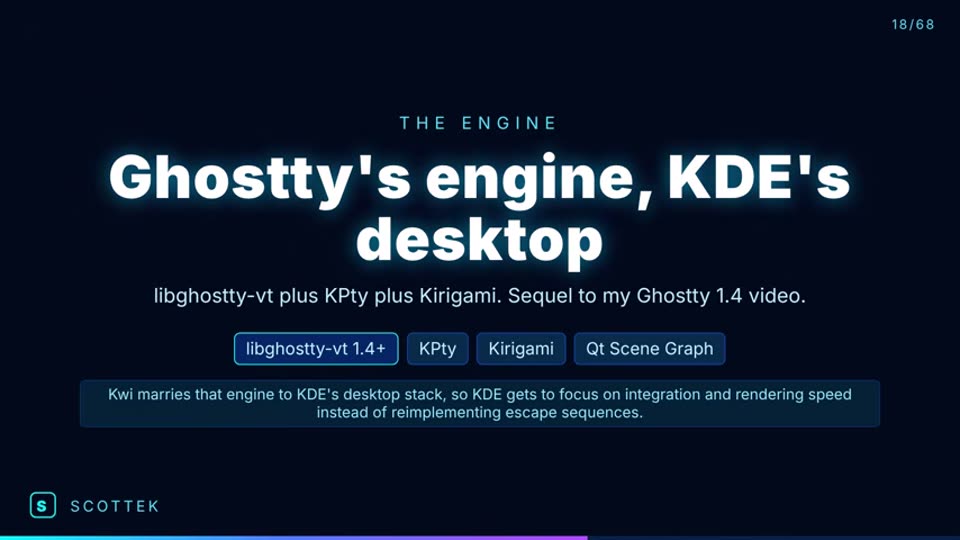
- If you know Ghostty, you already know the parsing core. The Ghostty 1.4 grid guide covers that engine's side of the story.
- On the TUI side the announcement lists Kitty image with parent-relative placement, animation, mouse cursor, clipboard, keyboard, OSC 9;4 progress with error and indeterminate states, CSI 996 color-scheme queries, mode-2027 graphemes, Nerd Font scaling, ligatures, live Plasma color-scheme sync, Wayland fractional scaling, and screen-reader extraction improvements. Protocol support is documented-only here and untested here.
- Do not expect a 1.0 library promise yet: the announcement notes
libghostty-vtwill only make an ABI/API stability promise in 4-6 months, though Neovim and others already adopt it.
The architecture play: one module, app plus embedders
In the video: a public QML module plus a KPart for Dolphin, Kate, and Yakuake that reads Konsole color files, so the app and the embeddable component can never drift apart.
Added from the sources: the announcement confirms embedding support into Qt Quick/Kirigami apps, finer-grained threading, and optimizations for running containerized as a Flatpak. The Konsole color-file compatibility and Yakuake one-line KPart swap tip are video and community-attributed (r/kde, Lobsters with Ghostty's author participating, per the Prag source record).
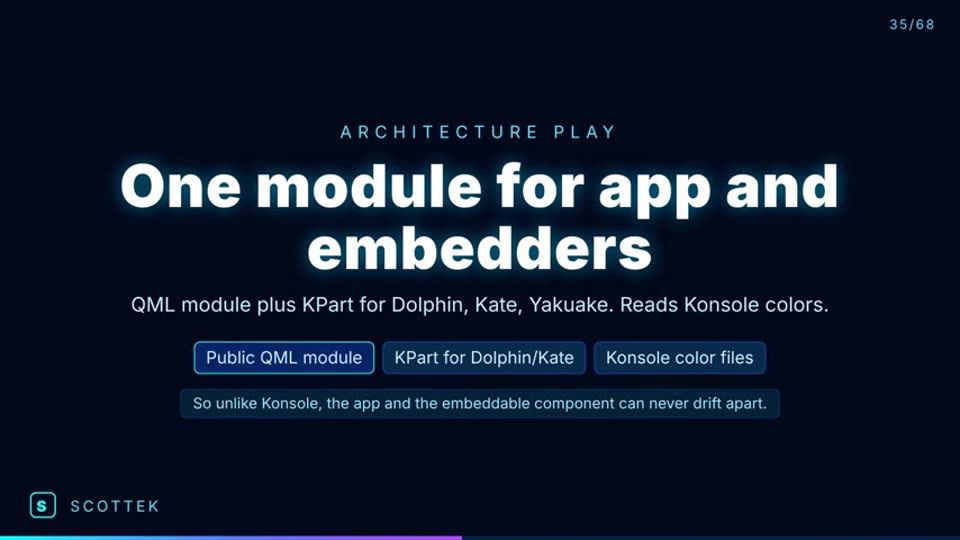
- If you embed terminals in Dolphin, Kate, or Yakuake, this is the part to watch: one shared module instead of Konsole's split app-versus-part history.
- Community questions so far include why not just use Ghostty, plus split views, URL hints, and menu-bar versus hamburger preferences. Those are community-attributed, not verdicts.
- Nothing here is installable as a stable API yet. Build any integration against the nightly with the expectation it will change.
Try it: the Flatpak recipe that actually works
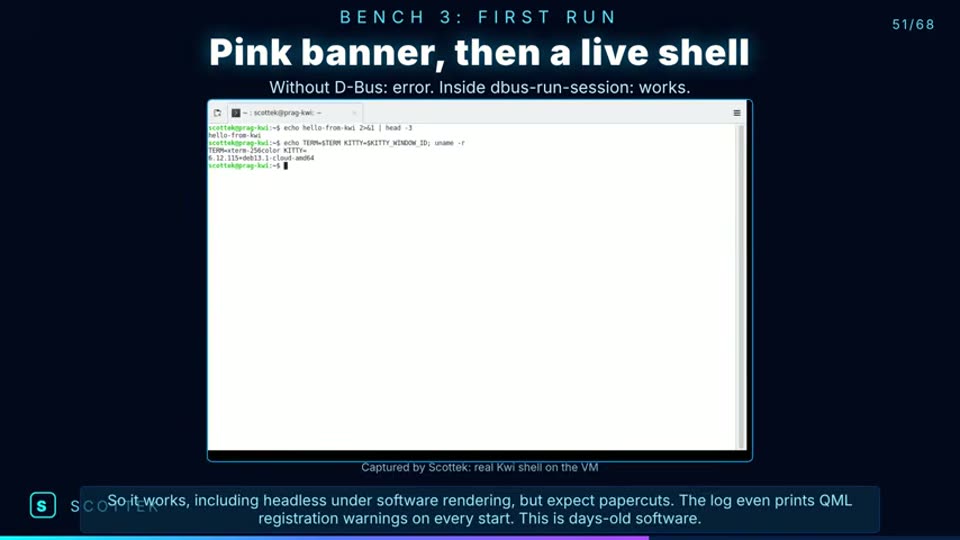
In the video: the native build is a non-starter, the first Flatpak attempt fails on a missing runtime, then pulling the Platform runtime from Flathub plus launching inside dbus-run-session produces a real prompt that answers echo and reports its environment.
Added from the sources: the Prag bench record on a Debian 13 VM confirms each failure precisely: Qt 6.8.2 shipped versus 6.10+ needed, KDE Frameworks 6.13.0 versus 6.29+ needed, and no libghostty-vt package, so native builds are impossible there. The kwi-nightly remote ships only the app, so org.kde.Platform//6.11 must come from Flathub. The installed app reports 12.0 MB on branch master. Without D-Bus the window renders with a pink error banner; under dbus-run-session a live shell answers with TERM=xterm-256color on kernel 6.12.115. The figure below is a walkthrough slide whose inset is a genuine bench capture labeled as captured by the presenter.
- Add the nightly remote from the repo README at
https://cdn.kde.org/flatpak/kwi-nightly/kwi-nightly.flatpakrepo, add Flathub if you do not have it, installorg.kde.Platform//6.11from Flathub first, then installorg.kde.kwifrom the nightly remote. The remote-before-runtime order matters: the app install fails without the runtime in place. This recipe is presenter-benched and untested here. - Launch inside a D-Bus session (for example under
dbus-run-session) or expect the pink error banner with no shell. The banner is the known launch-day roughness, not a broken install. - Verify with a trivial
echoround-trip and an environment probe before assuming the shell is healthy. Headless software rendering works for this smoke test, but it says nothing about GPU speed. - File bugs you find on KDE Bugzilla against kwi, per the announcement. Expect papercuts: the bench log prints QML registration warnings on every start.