DeepSeek V4.1: Pick the Right Local File (V3.1 Guide)

This is the companion to the file-picker video, which is the starting point for everything below. Watch it here: Watch the video on YouTube. This is a distinct sequel to the earlier release guide DeepSeek V4.1-Flash-1017 Frontier Agents, MIT Weights, which covered the model launch and agent angle. This guide answers only which quant file to download for which rig.
What the 1017 model is
In the video: DeepSeek-V4.1-Flash-1017 pairs a 552B-parameter backbone with a second memory system called Engram, another 196B parameters of conditional memory, with only 8B active in prefill and 16B in decode, plus a 1,048,576-token context window, native vision, an adjustable reasoning-effort dial, and an MIT license that keeps commercial use on the table.
Added from the sources: Together AI lists the 1017 update as targeting reasoning, coding, agentic, and visual work with reduced task time and output length versus the original Flash, and the official 1017 versus Flash deltas via Unsloth docs include HLE 42.6 versus 36.8 and Terminal-Bench 4.0 42.3 versus 31.2. License pages checked for the video read MIT on Together AI, with NVIDIA listings noting MIT terms under the NVIDIA Open Model Agreement.
V3.1 versus GSQ-RCO evidence
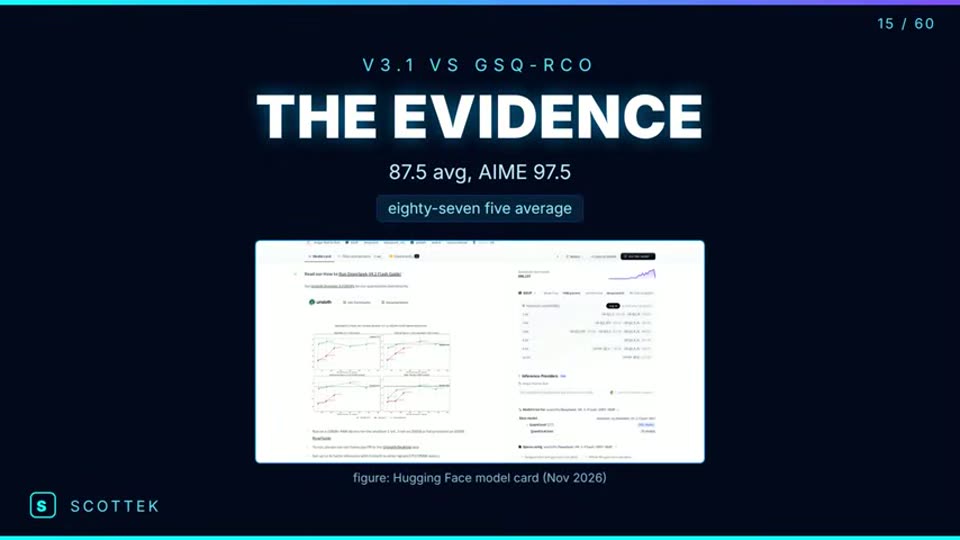
In the video: Unsloth released the Dynamic V3.1 preview recipe on October 30, and Unsloth vendor-published numbers say the Dynamic V3.1 files beat the rival GSQ-RCO files on nearly every test, with the headline UD-Q2_K_XL file at 334.8 GB scoring about 87.5 average across six benches, 97.5 on AIME 2025, 89.6 on GPQA Diamond, and 84.8 on LiveCodeBench, while Unsloth reports it could not reproduce the rival 100 percent recovery claim and measured only about 91.9 percent on AIME in its own retests.
Added from the sources: The fuller Unsloth vendor-published table behind that claim reads UD-Q8_K_XL 508.4 GB at 87.68 average and 97.08 AIME25, UD-Q2_K_XL 334.8 GB at 87.49 and 97.50 AIME25, UD-IQ2_XXS 300.5 GB at 86.63 and 96.88, UD-IQ1_M 250.4 GB at 85.55 and 95.00, UD-IQ1_S 233.0 GB at 83.53 and 92.92, and GSQ-RCO IQ2_XS 265.8 GB at 85.64 and 95.00, with each benchmark run 3 or more times and AIME25 run 16 times and averaged in that round. All of these figures are Unsloth vendor-published measurements, not independent results, and one community critic in the Hugging Face discussion correctly notes that Terminal-Bench 2.1 and DeepSWE 1.1 are largely retired by the industry with wide confidence intervals, so treat the direction as consistent and the exact margins as not settled.
512K agent benches
In the video: On November 3 Unsloth added heavier agent evidence at 512K context across Terminal-Bench, DeepSWE, AutomationBench, Aider Polyglot, and the general suite, totaling 35.1B tokens of benchmarking with 64 repeated AIME runs, landing more than 10 percent ahead on DeepSWE and AutomationBench regardless of quant size, with even the tiny 1-bit file scoring 68.1 on DeepSWE and 72.2 on Terminal-Bench.
Added from the sources: The November discussion post adds AutomationBench v1.0.6 at 52.7 for the 1-bit file and frames the round as about 27 times more data than the earlier 1.3B-token round, and these too are Unsloth vendor-published measurements with the same retired-bench caveat above. The presenter did not run these benches on camera, and nothing here re-tests them.
File sizes and rigs
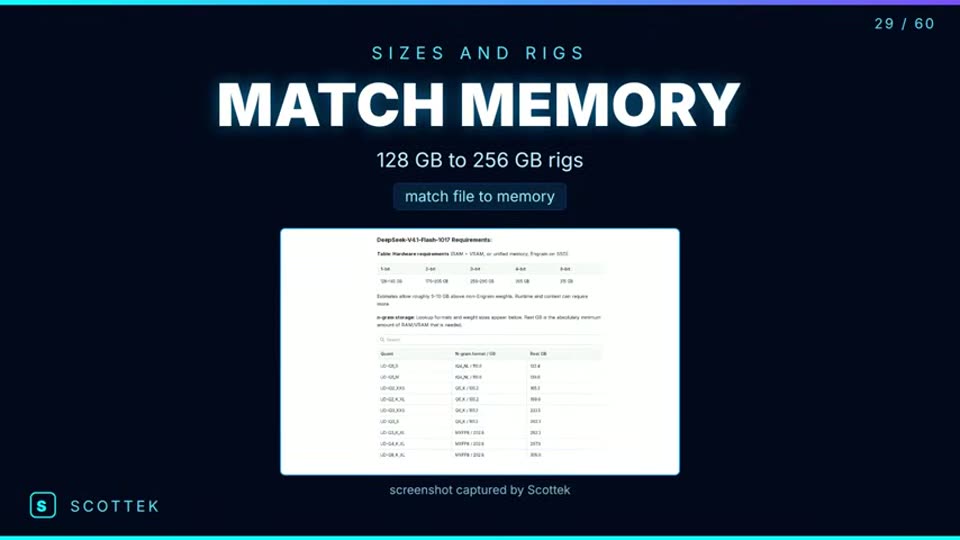
In the video: Nine files span 233 GB to over 500 GB, and the picker is to match the file to memory rather than ambition, with UD-IQ1_S at 233 GB total needing about 122 GB for the non-Engram weights on a 128 GB box such as a MacBook or DGX Spark, UD-IQ1_M at 250 GB gaining back about four points of fidelity, UD-Q2_K_XL at 334.8 GB needing roughly 200 GB as the sweet spot, 3-bit files wanting a 256 GB box such as a Mac Studio, the near-lossless 4-bit near 500 GB, and the 8-bit reference at 508.4 GB, with 64 GB boxes possible only through slower Engram offloading.
Added from the sources: The Unsloth hardware table behind the picker splits each file into Engram plus rest weights, including IQ1_S 110.6 plus 122.4, IQ1_M 110.6 plus 139.8, IQ2_XXS 135.2 plus 165.3, Q2_K_XL 135.2 plus 199.6, IQ3_XXS 161.3 plus 233.5, IQ3_S 161.3 plus 262.3, Q3_K_XL 202.8 plus 282.3, Q4_K_XL 202.8 plus 297.9, and Q8_K_XL 202.8 plus 305.6, with runtime plus context needing roughly 5 to 10 GB above the non-Engram weights. Suggested shortlist by box:
- 128 GB box:
UD-IQ1_Sfor general knowledge only, not agents - About 140 GB of headroom:
UD-IQ1_Mfor a small fidelity gain - About 200 GB of headroom:
UD-Q2_K_XLas the sweet spot near the top of every chart - 256 GB or more: 3-bit files for the last points of fidelity, or 4-bit near-lossless if storage allows
Engram on SSD and DSpark
In the video: The reason a 500 GB model can run on 128 GB of memory is Engram, where the 110 to 200 GB memory table sits on SSD memory-mapped with rows loaded on demand, precision is mix-and-match between backbone and Engram table, and DSpark speculative decoding drafts with a small helper model for about 1.3 to 1.5 times faster decode at about 8 GB extra.
Added from the sources: Documented Engram table sizes are IQ4_NL 110.6 GB, Q5_K 135.2 GB, Q6_K 161.3 GB, and MXFP8 202.8 GB, and the documented DSpark modules are the 8 GB Q8_0 build or the 8.5 GB BF16 build. Keep the Engram table on fast SSD because that single placement decides whether the model feels alive or stalled.
Live repo and license checks
In the video: The on-screen terminal segment is a labeled dramatized illustration with live repo, license, and docs checks rather than a model run, showing the seven weight shards plus the swappable Engram directory with sizes matching the published table, the license file reading MIT, reachable docs endpoints, and the documented run shapes such as unsloth run, hf download, and a server launch pointed at the first shard, with the disclosure that a 233 GB-plus download cannot execute on that bench.
Added from the sources: Documented run paths from Unsloth and the repo include the Unsloth desktop app, unsloth run, llama.cpp builds carrying the DeepSeek V4.1 support patches, docker model run against the Unsloth GGUF tag, and hf download unsloth/DeepSeek-V4.1-Flash-1017-GGUF pointed at the first shard while the runtime loads the rest. Those commands are documented shapes only and are untested on this bench, and no model weights were downloaded or executed for this guide.
Settings and 1-bit caveats
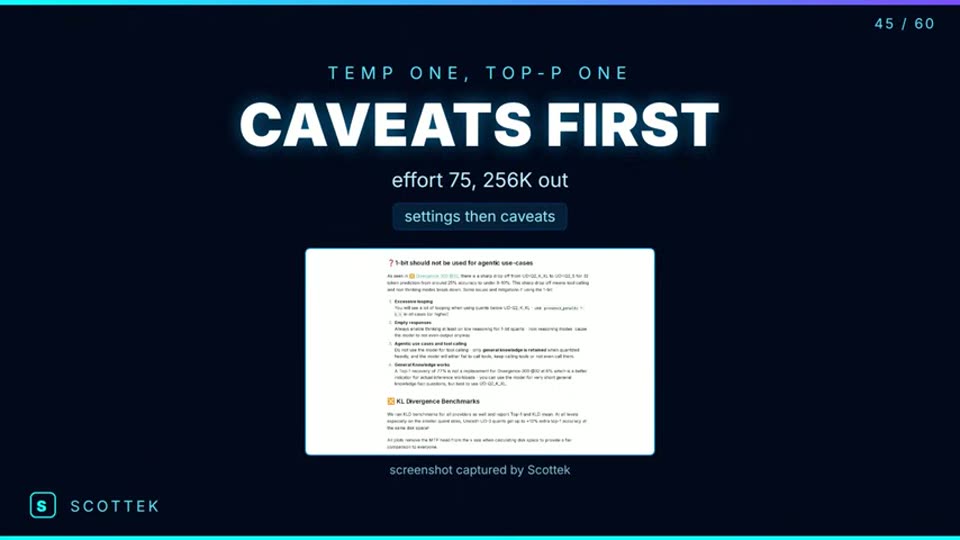
In the video: Below the Q2_K_XL file, do not use the smaller quants for agent or tool-calling work because multi-turn tool accuracy falls off sharply with looping and sometimes empty responses, and anyone running the small files anyway should force thinking on, set presence_penalty to 1.5 or higher, and keep them to short general-knowledge questions.
Added from the sources: Unsloth docs put the tool-calling drop as roughly 25 percent down to 8 to 10 percent on Divergence-300 at 32 on files below UD-Q2_K_XL while general knowledge is retained, and the documented starting settings are temperature 1.0, top-p 1.0, top-k and min-p disabled, thinking on at the default effort 75 on the 1 to 100 scale with 50 low, 62 medium, 75 high, and 100 max, and room for up to 256K output tokens on long agent runs. Applying those settings to a local run is untested here.
Pick your file
In the video: On 128 GB take UD-IQ1_S and accept knowledge-only use, near 140 GB take UD-IQ1_M, near 200 GB take UD-Q2_K_XL at about two-thirds the reference size, on 256 GB or more take the 3-bit files, and everyone keeps Engram on fast SSD.
Added from the sources: That verdict follows directly from the hardware table and the vendor-published averages above, not from a fresh test, and buyers choosing between the 3-bit and 4-bit files are paying roughly 150 to 170 GB of extra download and SSD for the last few points of fidelity. Narration in the video is synthetic, stills are screenshots captured by Scottek from public docs pages plus the Hugging Face model card figure shown with credit, and benchmark numbers throughout are Unsloth published measurements labeled as such.
Sources and next steps
- The companion video is the starting point for this guide and all In the video claims above
- The Unsloth run-locally guide owns the hardware table, Engram sizes, run commands, settings, and 1-bit caveats
- The Dynamic 3.0 GGUF explainer owns the Dynamic quant method background
- The Dynamic V3.1 release thread owns the October 30 V3.1 versus GSQ-RCO table
- The 512K agent results discussion owns the November agent benches and the retired-bench community critique
- The GGUF repo owns the shard layout, file sizes, and download shapes
- The Together AI model page owns the MIT license and 1017 update framing