Granite Switch 4.1: Chat, Judge + Ears on One GPU

This companion guide starts from the video Granite Switch 4.1: Chat, Judge + Ears on One GPU and adds grounded detail from the IBM launch notes and the 8B model card. Watch the video first for the full narrated walkthrough, then use the sections below as the written reference. The video presents vendor-reported numbers with on-screen honesty about their status, so this guide keeps In the video claims apart from Added from the sources research, and every benchmark below is vendor-reported until the community reproduces it.
What Switch 4.1 is
- In the video: IBM shipped Granite Switch 4.1 on October 15th as two checkpoints, an 8B model on a Granite 4.1 8B base with 128,000-token context and a 30B twin, each carrying three composed components: a decision adapter, a guardian safety adapter, and a 470-million-parameter speech encoder, with audio-free previews including a 3B also available.
- Added from the sources: the IBM Granite launch blog confirms the lineup and dates, and the 8B model card confirms the Apache 2.0 license, checked October 2026.
- In the video: the license is the headline for builders, a real open-source license with no revenue tripwires, so downloading, running, fine-tuning, and shipping are all on the table.
- In the video: the architecture trick is frozen-base composition, where small activated LoRA adapters click in per span of tokens, chosen by control tokens the chat template inserts, and because adapters reuse the base model's own key-value cache instead of building their own, switching costs almost nothing.
- Added from the sources: IBM describes this as coarse-grained expert switching with one adapter active across all decoder layers per token span, and notes day-one backends are Transformers plus vLLM only, with no GGUF, llama.cpp, or one-click Ollama path on the card, checked October 2026.
One endpoint, three skills
- In the video: the decision adapter is the headliner, taking a state turn plus a decision turn with single-token labeled options and returning a calibrated probability over every option in one forward pass, scoring 42.9 overall on the public Decision Index fast subset for the 8B and 50.1 for the 30B, with local and hosted serving agreeing within about half a point.
- Added from the sources: the 8B model card documents the Decision Index method and the ticket-routing example that returns option A at 0.982, plus the 128-option chunking recipe for vLLM's logprob cap, checked October 2026.
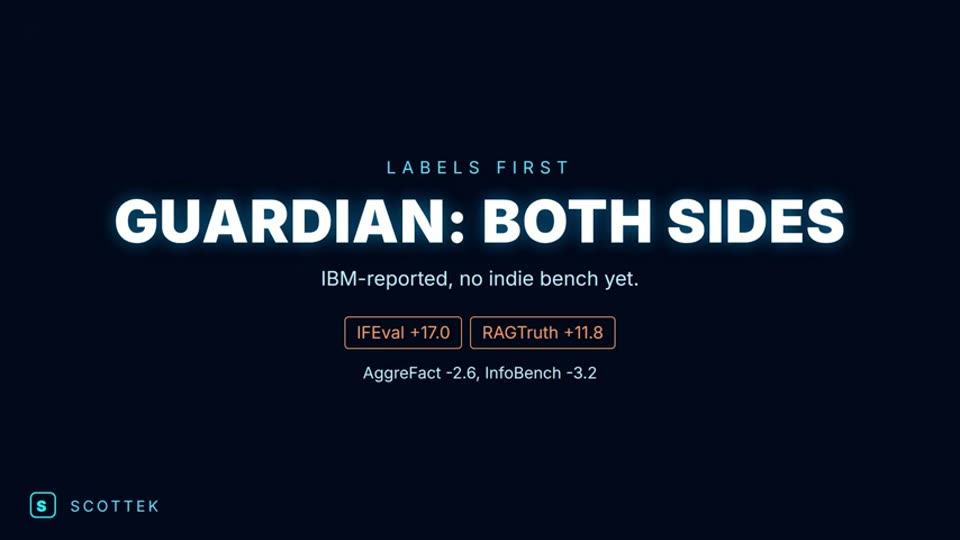
- In the video: Guardian Core screens for harm, jailbreaks, profanity, violence, bias, and unethical behavior, reportedly beating four rival decision models on safety-task average while specialists beat generalists on several tracks and lose on factual aggregation, and every number in the section is vendor-reported with no independent benches yet.
- In the video: speech rides along on the same endpoint with no separate server, as a 470-million-parameter English conformer the vendor calls the fastest on the open ASR leaderboard, transcribing and splicing text into chat context, with IBM's live demo transcribing, summarizing, screening, and checking custom flags in real time.
- In the video: two card-stated caveats come with the audio, English only and lowercase unpunctuated transcripts, plus the honest design warning that mistranscription silently changes what the model responds to since encoder and language model are not jointly trained yet.
- Added from the sources: the card's Limitations section confirms the English-only cascade, the 128-token logprob cap, and that guardian-core is a screener rather than a substitute for application-level safety testing, checked October 2026.
Serve it on one GPU
- In the video: requirements come straight from the model card, Python 3.9 or newer, PyTorch 2.11 or newer, Transformers in the 5.16 line, and vLLM between 0.26 and 0.28, then clone the Granite Switch repo, install the vLLM extra, and start one server with
python -m vllm.entrypoints.openai.api_serverpointed atibm-granite/granite-switch-4.1-8bon port 8000. - Added from the sources: the 8B model card ships that exact serve command and the OpenAI-compatible call shapes, but no live deployment was run for this guide, so treat every command here as docs-quoted and untested until verified in a real deploy.
- In the video: a decision request differs from chat by exactly one field,
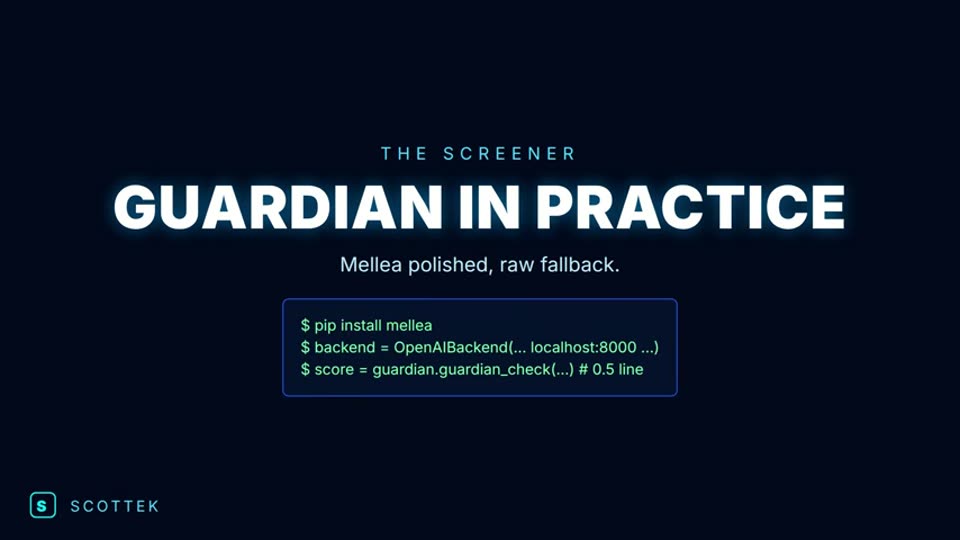
adapter_nameset to decision, plus a logprob readback over the label tokens, with the card's printed ticket example resolving to A at 0.982, and keeping system prompts out lets vLLM prefix caching share work with plain chat about the same state. - In the video: audio uses the familiar OpenAI-style chat shape against the same localhost port with a text part plus a base64 WAV part, one round trip with no sidecar, while IBM's preferred guardian path runs through its Mellea application layer with risk scores thresholded at 0.5, noting the decision adapter has no Mellea intrinsic yet.
- In the video: sizing is straightforward math at about 2 bytes per parameter in BF16, so the 8B weighs roughly 16GB plus context overhead and runs on a 24GB card with room, a 16GB card wants quantization or offload, and the 30B lands near 60GB in multi-GPU territory, while adapters plus encoder cost about the same VRAM as the base alone.
- In the video: three avoidable traps close the build, serving on port 8000 when muscle memory types other ports from earlier guides, improvising prompt framing that breaks prefix-cache sharing, and sending more than 128 options without the chunking recipe, plus the standing advice to measure agent tasks end to end rather than hello worlds.
- In the video: the stack fit is anywhere an OpenAI-compatible URL already lives, pointing Open WebUI at the local port or aiming an automation endpoint at it for judging plus transcription, and readers pairing this with a local front end should also see the Open WebUI 0.12 self-hosting guide, which covers that side of the wiring.
Limits and verdict
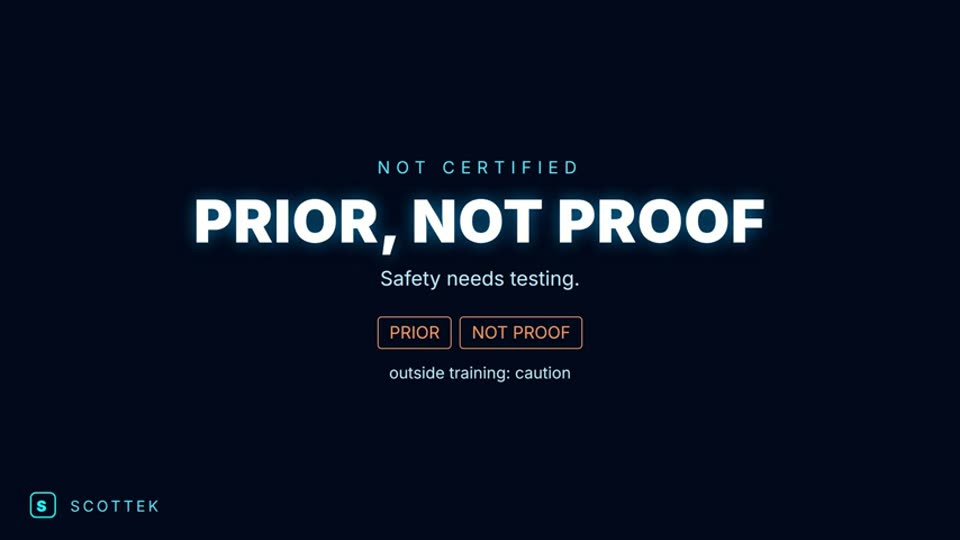
- In the video: four limits stated plainly, speech is English-only and unpunctuated, decision probabilities are a prior rather than a certified classification outside training so keep them off medical and legal calls, Guardian Core excludes factuality and policy adapters, and day-one backends are Transformers and vLLM only.
- Added from the sources: the card confirms decision outputs should be treated as priors outside training domains and that the factuality and policy adapters are not in this checkpoint, checked October 2026.
- In the video: the verdict is to run the 8B tonight if local agents are already in the stack, size VRAM first and wait for an independent bench before believing the 30B gap, and treat every vendor number, including the presenter's, as a starting rumor until the community reproduces it.