Mistral Large 4 Is OUT: Run 1T Params Yourself

Watch the starting point
This guide is a companion to the video Mistral Large 4 Is OUT: Run 1T Params Yourself, a 7-minute run edition that picks up where the prep guide Mistral Large 4 Is Out: Can Your Rig Run 1T Params? left off. The prep edition answered whether your rig can run it, and this one answers how to run it today, ranking five paths from a one-line API call to a full datacenter serve, plus the Ollama trap and the one license tripwire.
This companion guide starts from that video and adds corroboration from the release sources via the channel research package. Video claims and added research are kept visibly separate throughout, and anything not actually tested is marked untested. Auto-subtitles could not be fetched for a transcript check (YouTube returned HTTP 429), so the video side below is grounded in the video description, which mirrors the chapters in order.
What dropped on October 29
- In the video: Mistral Large 4 (Le Chonk) weights dropped October 29, 2026: 1 trillion parameters, 52 billion active, 1M context, open weights, in FP8 plus NVFP4 builds. Benchmarks are aired with both harnesses labeled, including the note that Terminal-Bench differs by harness.
- Added from the sources: the channel research package (verified 2026-11-01 against the Mistral release post, the Hugging Face blog, and the model card) confirms 1.05T total with 52B active including embeddings, 1M-token context, three reasoning efforts (low, medium, high with high default), and official FP8 plus NVFP4 checkpoints under
mistralai/Mistral-Large-4-1T-A52B. All benchmark figures below are vendor-reported Mistral and Hugging Face claims, not independent results: FrontierCode 2.0 at 19.7 percent, Terminal-Bench 4.0 at 41 percent on Mistral's harness versus 28.3 percent on the Hugging Face harness, and an Artificial Analysis coding-agent score of 48 percent at 47 percent fewer tokens per task. The two Terminal-Bench numbers disagree because the harnesses differ, so treat either as a config-dependent claim, not a fixed score.
The sparse architecture in plain words
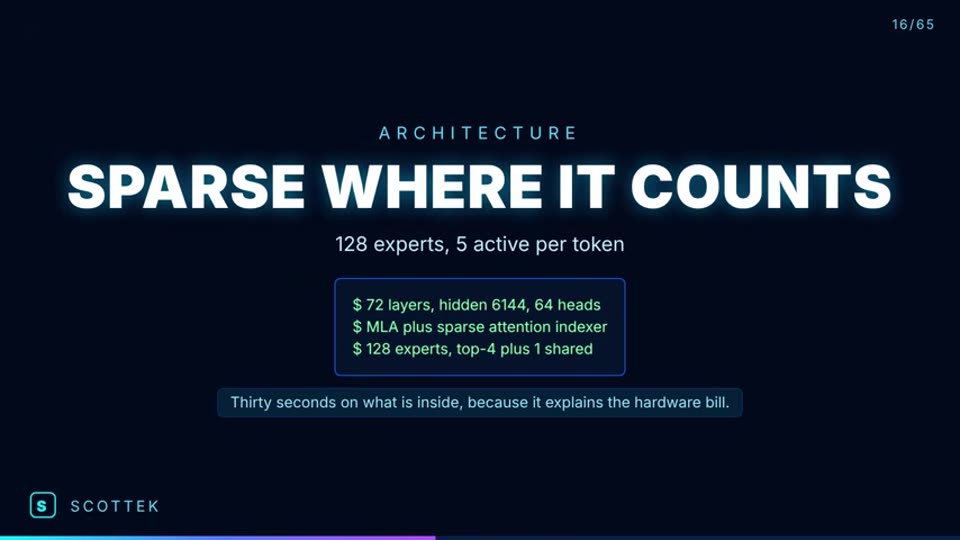
- In the video: a plain-words architecture segment explains why the hardware bill is what it is, with 128 experts and 5 active per token.
- Added from the sources: the research package confirms the frame's numbers against the Hugging Face blog: 72 layers, hidden size 6144, 64 heads, MLA plus a sparse-attention indexer, and a Mixture-of-Experts with 128 routed experts where top-4 plus 1 shared expert (5 total) activate per token. Sparse activation is exactly why a 1T model can serve at a fraction of its headline size, and it is also why the smallest usable quant still starts at 233 GB on disk.
Path 1: the API you can use today
- In the video: path 1 is the API today at 70 cents per million input tokens.
- Added from the sources: the research package confirms the price ladder from the release post: $0.70 input, $0.07 cached input, and $2.10 output per million tokens, available through Mistral endpoints plus OpenRouter, NVIDIA NIM, and Vibe Code. If your goal is building on top of the model rather than hosting weights, the API is the only path that works in minutes with no hardware. Budget check is untested here: run your own token estimate before committing a workload.
Path 2: the Ollama trap
- In the video: path 2 is why Ollama has no local build, so do not plan around
ollama run. - Added from the sources: the research package verified the Ollama library page on 2026-11-01: the single tag is
mistral-large-4:cloudonly, with no local pull, at the same $0.70, $0.07, and $2.10 pricing.ollama run mistral-large-4:cloudroutes to the hosted endpoint, so Ollama today is an API client for this model, not a local path. Watch the library page for a future local tag, and do not treat pull counts as local adoption.
Path 3: llama.cpp plus GGUF on your own iron
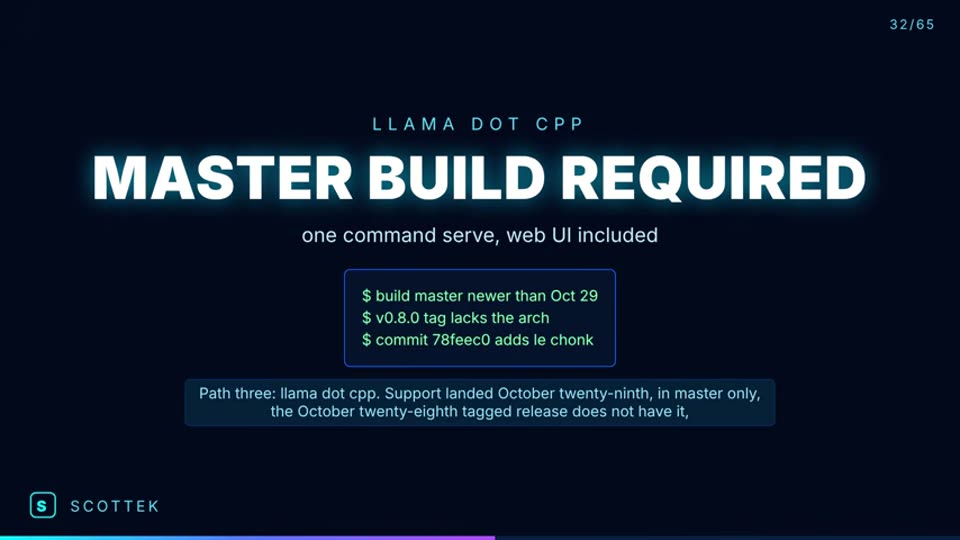
- In the video: path 3 is the llama.cpp plus GGUF serve, with a one-command serve and web UI.
- Added from the sources: the research package confirms support landed in llama.cpp master only, in commit
78feec0on October 29, so the tagged v0.8.0 release from October 28 lacks the architecture and you must build master newer than October 29. Community GGUFs ship from Unsloth and ggml-org, with the Unsloth dynamic ladder starting at 233 GB on disk needing roughly 256 to 270 GB of combined RAM and VRAM, which fits 256 GB unified-memory machines or dual small-GPU boxes but no 24 GB single-GPU story. The single-box path was not run in this package, so check the Unsloth run docs for the current serve flags and mark any home serve as untested until you reproduce it.
Paths 4 and 5: datacenter class
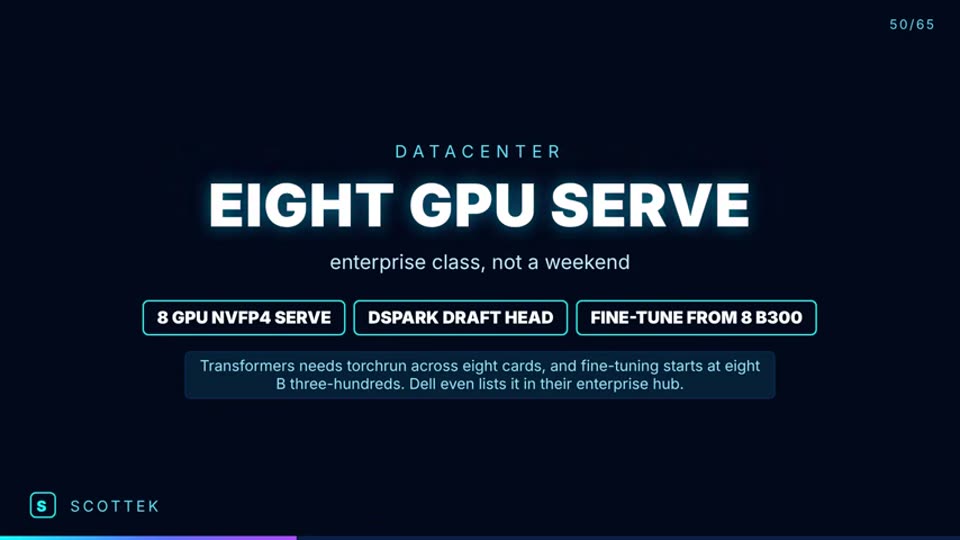
- In the video: path 4 covers Unsloth quants and path 5 covers the datacenter vLLM serve, positioned as enterprise class rather than a weekend project.
- Added from the sources: the research package confirms the datacenter shape from the model card and Hugging Face blog: NVFP4 serving on 4x B200 or B300 class cards, full 8-GPU
torchrunrecipes for Transformers, and fine-tuning examples starting at 8x B300. NVFP4 is Blackwell-only, so older datacenter cards cannot take that path. None of this was run here, and no reader action follows unless you already operate that class of hardware.
The license catch before you serve anything
- In the video: the Ecosystem Open-Weight license catch, with the Model-as-a-Service tripwire called out.
- Added from the sources: the license is the Mistral Ecosystem Open-Weight License, a modified MIT grant that is free to use, modify, fine-tune, and commercialize, with exactly one carve-out: Model-as-a-Service businesses need a separate commercial license from Mistral. Plain reading for this audience is that self-hosting at home is unaffected, while selling hosted API access requires paying Mistral. This is license text summarized, not legal advice, and it is not OSI open source, so say open-weight with a commercial-hosting carve-out rather than open source.
What is untested and what is next
- No weights were downloaded and no serve was run in this package (the smallest quant starts at 233 GB), so every weights path above counts as untested here and serve recipes come from the model card and docs.
- Benchmark figures are vendor-reported claims aired with harness attribution, not independent verification.
- If you only need the capability, start with the API path and its token math. If you need the weights locally, watch the Ollama library page for a local tag and the llama.cpp releases for the first tag containing the new architecture. For the prep-side VRAM math, see the companion prep guide Can Your Rig Run 1T Params?.