Mistral Large 4 Is Out: Can Your Rig Run 1T Params?

This companion guide starts from the video Mistral Large 4 Is Out: Can Your Rig Run 1T Params?, and the video is the starting point for everything below. Watch the video first for the full narrated briefing, then use the sections below as the written reference. YouTube auto-subs were rate-limited at draft time, so In the video claims below follow the narration scripts prepared for the video, cross-checked against the Prag research notes and the primary sources linked inline. This is a decision and prep checklist, not an install log: no 1T weights were downloaded on the bench here, and anything not executed is marked untested.
What actually landed
- In the video: Europe dropped a one-trillion-parameter model on Hugging Face on October 29, not the rumored October 31 countdown date, moving from API preview to downloadable weights with three extra weeks of reinforcement learning behind the release build.
- Added from the sources: the Mistral release post and the Hugging Face blog confirm about 1.05T total parameters with 52B active per token including embeddings and output layers, alongside a 1M-token context window of exactly
1048576tokens. - Added from the sources: the architecture is a granular mixture-of-experts design with 128 routed experts, 4 active per token, plus 1 shared expert that always runs, for 5 active experts per token, with text and image input and text output in over 160 languages, per the Hugging Face blog.
- Added from the sources: two official checkpoints ship in the Mistral Large 4 collection, the FP8 build and the NVFP4 build, with community GGUF quants in the Unsloth GGUF repo.
- Added from the sources: day-zero tooling covers transformers, vLLM, llama.cpp, Unsloth GGUFs, the NVIDIA NIM container, NeMo Automodel, TensorRT-LLM, and TRL fine-tuning, with reasoning effort set per request to
low,medium, orhighandhighas the default, per the Hugging Face blog.
The license before the hype
- In the video: the license has a carve-out that matters, so read this section before planning anything public-facing.
- Added from the sources: the model ships under the Mistral Ecosystem Open-Weight license, a modified MIT license that is free to use, modify, fine-tune, and commercialize, with one condition: businesses operating a Model-as-a-Service offering need a separate commercial license from Mistral.
- In the video: the plain-language read for a homelab is that self-hosting for yourself is fine, while selling hosted API access to the model itself is not, unless you pay Mistral.
- Added from the sources: call it open-weight, not open source, since there is no OSI-approved license here, a wording point the Hugging Face blog keeps by naming the license an MIT derivative with hosting limitations.
Benchmarks with the labels kept on
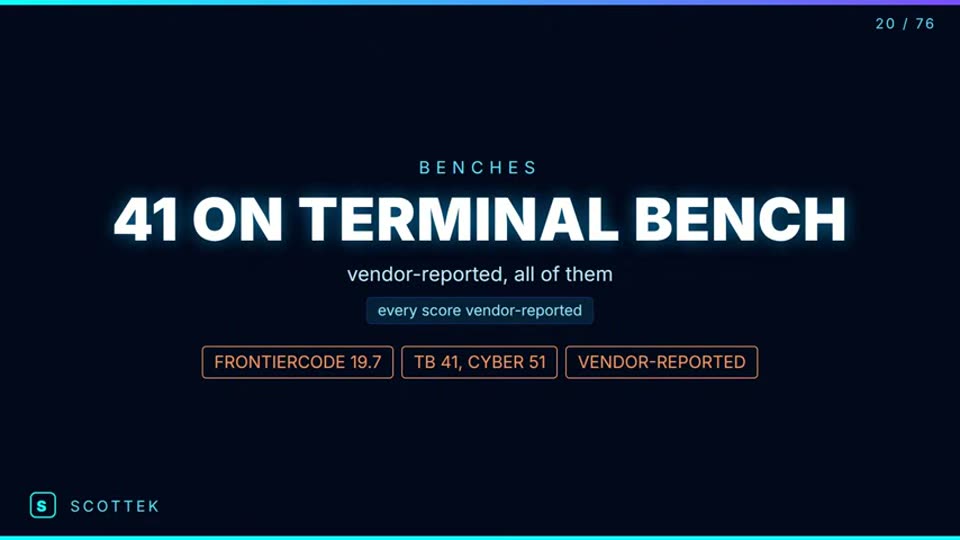
- In the video: every score below is vendor-reported from Mistral and Hugging Face, with no independent community rerun of the full set at production time, so treat them as claimed until reruns land.
- In the video: on Cognition FrontierCode 2.0 the release leads at 19.7 percent, on Terminal-Bench 4.0 it sits at 41 percent, up 13 points from the preview with 30 percent fewer output tokens, and on the Artificial Analysis coding agent index it scores 48 percent, effectively tied with the leading open-weight model while using 47 percent fewer tokens per task.
- Added from the sources: the Mistral release post corroborates those vendor figures, including the 51 percent cyber index score and the 96.6 percent average refusal rate on malicious cyber requests measured across JailbreakBench, StrongREJECT, and AgentHarm.
- Added from the sources: independent numbers from the Hugging Face blog land differently and stay labeled as such, with a 49.8 percent coding agent index, 28.3 percent on Terminal-Bench 4, a top-five cyber index rank, 82 percent on vulnerability reproduction plus patching, 93 percent on a 40-challenge Cybench suite, and 93.3 percent attack resistance on the Lakera B3 prompt-injection benchmark.
- In the video: in Surge Code blind human evaluations, graders preferred it over every open rival tested and ranked it behind only Claude Opus 5.5, which is a vendor-reported preference result, not an independent rerun.
The VRAM ladder your wallet feels
- In the video: total memory means RAM plus VRAM combined, or unified memory on Apple Silicon, and it must exceed the quant file size with room left for the operating system, the KV cache, and runtime buffers.
- Added from the sources: the Unsloth run-locally docs give the hardware table this ladder is drawn from, with the Dynamic 1-bit
UD-IQ1_Sat 233GB on disk needing 256 to 270GB of total memory while keeping 90.6 percent top-1 agreement at 80 percent smaller than FP8. - Added from the sources: the rest of the ladder per the Unsloth docs runs 2-bit at 310 to 390GB with 95 percent top-1 agreement, 3-bit at 435 to 500GB, 4-bit at about 605 to 630GB, 5-bit at 784GB, 6-bit at 890GB, and 8-bit at 1.1TB on disk needing 1.2TB total.
- In the video: there is no 24GB-GPU story here, since even the smallest 1-bit quant starts at a 256GB floor, which is a loaded Mac Studio or two DGX Sparks, while 2-bit wants around 512GB of unified memory at a reported figure near 15 tokens per second, and 4-bit wants roughly 630GB across two big workstations or a small cluster node.
- Added from the sources: the datacenter play is 8-GPU serving over vLLM or SGLang, with NVFP4 as the Blackwell-only checkpoint, per the Hugging Face blog.
Four doors to run it, picked by hardware
- In the video: door one is the easy chair, where Unsloth Desktop on Mac, Windows, or Linux finds the model hub entry, downloads the quant your memory allows, and serves it with reasoning effort included.
- Added from the sources: the documented Unsloth path is
unsloth run --model unsloth/Mistral-Large-4-1T-A52B-GGUF:UD-Q2_K_XL --temp 1.0 --top-p 0.95with reasoning effort passed through the chat template, and untested here end to end, so confirm the quant name in the Unsloth docs before downloading hundreds of gigabytes. - In the video: door two is the tinkerer path with a llama-server style GGUF setup covering model path, context size, GPU layers, and sampling flags, and door three is the datacenter with official FP8 or NVFP4 across 8 GPUs under vLLM or SGLang, where NVFP4 wants Blackwell cards only.
- In the video: door four is the API, priced at 70 cents per million input tokens, 7 cents cached, and 2.10 dollars per million output, which makes a weekend of agent experiments cost less than lunch, via Vibe Code, OpenRouter, or NVIDIA-hosted endpoints, per the Mistral release post.
- In the video: there is deliberately no Ollama one-liner given, because no verified day-zero library listing existed at production time, so treat the GGUFs as real and any Ollama tag as watch-and-wait.
Two settings decisions from Mistral directly
- Added from the sources: Mistral recommends the same sampling for every reasoning effort, with temperature
1.0and top-p0.95, so do not chill it like an old chat model, per the Unsloth docs. - Added from the sources: reasoning effort is
lowfor simple tasks and replaces the old none mode,mediumfor everyday chat and light tools, andhighas the default for coding sessions, long tool traces, and hard analysis, with reasoning impossible to fully disable, per the Hugging Face blog. - In the video: same weights, three cost profiles, so match the effort to the job or burn tokens proving you can.
The honest single-rig answer
- In the video: with a 512GB unified-memory box, download the 2-bit dynamic quant and run
mediumeffort for chat andhighfor agents, while 256GB boxes take the 1-bit quant and keep contexts modest. - In the video: with a Blackwell cluster, pull official NVFP4 and serve with vLLM or SGLang, and everyone else should hit the API or wait for the promised distilled smaller versions, which have no dates.
- Added from the sources: the rival framing for context is Beam 501B under Apache 2.0 with no hosting carve-out, the other roughly 1T MoE in Kimi K2 covered separately in Kimi K3.1 Pro: Can Your Homelab Run It?, plus Step 5 at 600B and the text-only Qwen3.8-Max at 2.4T under a bespoke license.
- In the video: run twenty dollars of API calls first, since if the answers earn a 400GB download you will know, and if they do not, you just saved a weekend of transfers, so measure your own rig before believing any screenshot, including this video's.