Linux Kernel 7.3: What's New for Homelab and Desktop

Companion guide to the video walkthrough: Linux Kernel 7.3: What's New for Homelab and Desktop — the video is the starting point and this page is the reference copy, with consequential claims linked to their sources.
Linux kernel 7.3 is days away, and this guide treats it as what it is at the time of writing: a preview plus action list, recorded against release candidate 7 rather than stable. The verdict first: containers, Btrfs-backed VM hosts, and hybrid Intel boxes gain real things, while a NAS holding steady on an LTS kernel is fine where it is. Read on for the speed story, the two changes touching your mounts, and how to get 7.3 without breaking your lab.
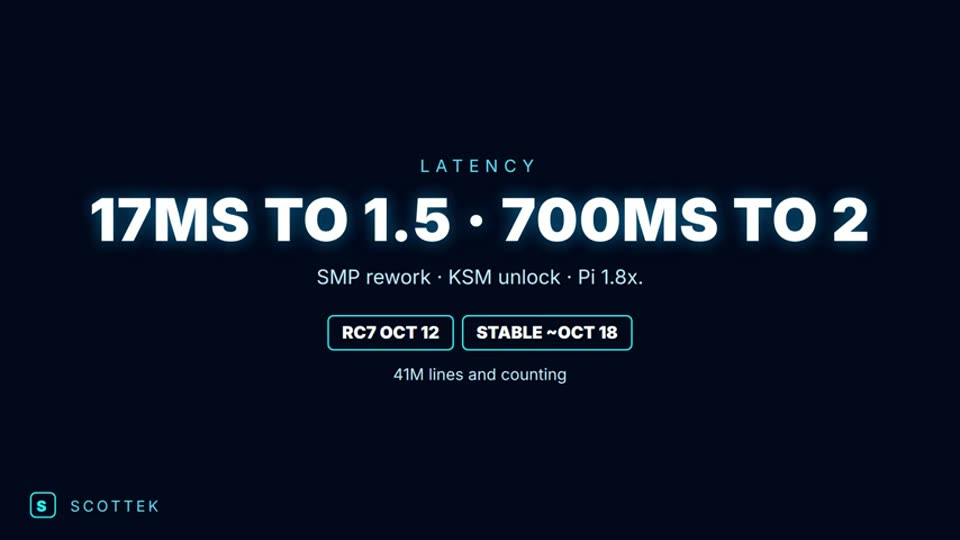
Release status: preview, with stable targeted around October 18
- Release candidate 7 landed October 12 and is a fixes-only snapshot, arriving about six hours late after Linus Torvalds mixed up the day following Kernel Maintainer Summit travel, per LinuxCompatible's rc7 report.
- Stable is targeted around October 18, with Torvalds' own caveat that anything new showing up can push it a week, so mark the date in pencil rather than pen.
- It is a big release by volume: the tree sits just shy of 41 million lines, and roughly a third of the rc1 diff is one mechanical item, AMD display register headers, per Phoronix's 7.3 features overview.
- Because this guide was written pre-stable, every date below is a target rather than a promise, and every performance figure is a sourced test result rather than something re-tested here — untested by this guide.
Storage speed: the headline for NAS and VM hosts
- Btrfs direct I/O was rewritten to run through an IOmap bounce buffer instead of falling back to buffered I/O, taking some workloads from around half of theoretical throughput to nearly 95 percent, per It's FOSS's 7.3 preview.
- Two Btrfs logging and fsync fixes add roughly 5x each on their workloads, one by removing a multi-task log delay and one by skipping unneeded hole detection on full fsync of hole-free multi-extent files, and the free-space cache default moves from v1 to the safer, faster v2.
- EXT4 answers back with parallel direct I/O writes, a smarter
fallocate()allocator shortcut, and the same underlying IOmap single-iterator rework, which pushed EXT4 from 1.92M to 2.19M IOPS on fast NVMe in the sources' testing, per It's FOSS. - The honest caveat: these are direct-I/O workloads — databases and VM images — so a Proxmox box full of
qcow2files may feel it while a typical desktop will not, and none of these numbers were re-benchmarked for this guide — untested here.
Safer containers, plus an ext4 deadline
- Mount hardening dominates rc7: VFS maintainer Christian Brauner accounts for 58 shortlog entries, with roughly half of the rc7 diffstat being the self-tests proving the fixes hold, per LinuxCompatible.
- The substance is container security plumbing: copied mounts stay unbindable, busy propagated copies cannot be synchronously unmounted from under their users, and recursive bind mounts cannot loop a mount namespace into itself — the floor getting stronger under every Docker volume, LXC mount point, and Proxmox bind mount.
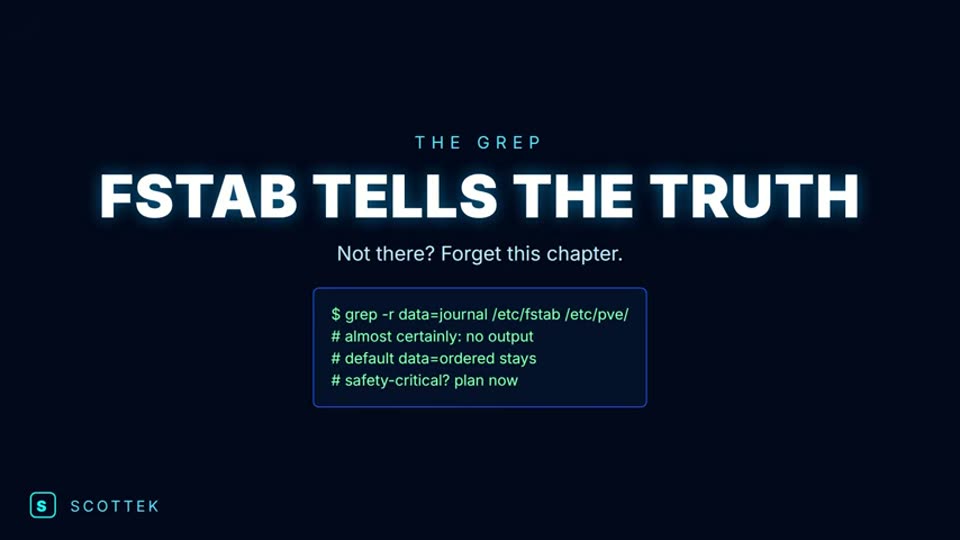
- ext4
data=journalis deprecated, with removal slated for January 2028, per the official kernel ext4 admin guide. It journals all data plus metadata — the strongest crash consistency ext4 offers and the slowest by a comfortable margin — while also disabling delayed allocation andO_DIRECT. - Homelab action: run
grep -r data=journal /etc/fstaband check your storage configs too. The defaultdata=orderedis unaffected, and ifdata=journalappears nowhere — which it almost certainly does not — there is nothing to do. If it does appear on a safety-critical partition, plan the migration before the 2028 clock runs out.
Scheduler and latency: smoother hybrids, calmer VM hosts
- The scheduler was reworked around a single runqueue by Peter Zijlstra's flatten-the-pick patches, and on an aging Sandy Bridge box with an RX 580 both frame rate and frame-time consistency improved — borderline games on old hardware can cross into playable, per It's FOSS.
- Hybrid Intel CPUs get a real fix: cache-aware scheduling was parking tasks on little cores that could not run them, and the fix prefers the right-sized core over cache locality on Alder Lake, Lunar Lake, and Panther Lake — asymmetric systems only — which should calm stutter on P/E-core mini-PCs juggling builds, games, and background containers.
- Cross-CPU call latency was reworked so tasks keep running instead of freezing while one CPU waits on the rest, with worst-case delays in fleet networking tests falling from around 17ms to 1.5ms, per It's FOSS.
- VM hosts gain twice: a KSM reverse-mapping lock fix drops worst-case stalls from around 700ms to under 2ms — fewer freezes on KSM-heavy Proxmox hosts — and a zsmalloc fix worth up to 1.83x on a Pi 4B in testing makes zRAM and zswap snappier on Pi-class boards. All figures are the sources' test results, untested by this guide.
New hardware: broad enablement, one asterisk
- AMD: Zen 6 preparation continues especially on the Ryzen client side, EPYC Zen 5 gains per-CCD temperature readings via
k10temp, and the DCN 6.0 display block lands, per Phoronix. - Intel: Xe3P graphics for Nova Lake are enabled by default, early Starfire prep (a Panther Lake-derived extreme-environment SoC) is in, and directed package-level thermal interrupts arrive.
- Connectors and devices: USB-C cables now report real alt-mode capabilities instead of making the kernel guess, low-latency USB4STREAM mode appears, ThinkPad USB-C security lands via ACPI, a Ryzen AI Halo LED and RGB driver is added, and the 2026 Valve Steam Controller gets a driver.
- The asterisk is Apple M3: initial Pro, Max, and Ultra bring-up is CPU work only, with no GPU and nothing near day-to-day use, per Phoronix. Also in: Qualcomm Shikra beginnings, eleven new RISC-V ISA extensions, ARM64 BBML3, IBM Power12 beginnings plus in-kernel Rust on PowerPC, and M1 Pro/Max/Ultra power optimization.
- Gamers on a budget win: Valve's vRAM-eviction handling helps constrained cards around 8GB, a second graphics pipe on modern AMD APUs steadies frame pacing and 1% lows,
ath11kWi-Fi latency drops up to 7x,sched_extschedulers gain lower overhead plus a freeze rescue, older AMD cards get format-modifier and reset-recovery fixes, and on Nvidia the Rust-based Nova driver gains GSP boot with early Hopper and Blackwell support while Nouveau gets the NVDEC interface NVK needs for Vulkan Video. - Never buy hardware off a merge-window headline — enablement lands over several releases, not on release day.
Filesystems and networking notes
- NVMe and block: a small-I/O bottleneck fix for PCIe Gen5 NVMe, plus
RWF_DONTCACHEfor block devices — a win for database servers on raw devices — per Phoronix. - Arrays and network storage: RAID 5/6 now picks algorithms by benchmarking at boot instead of guessing, F2FS flushes multi-device volumes in parallel, XFS gains
FALLOC_FL_WRITE_ZEROES, NFS picks up quiet improvements your shared storage inherits, and the in-kernel SMB server KSMBD now interoperates with Apple Time Machine, so a Linux NAS can be a proper backup target. - Desktop-adjacent filesystems: the NTFS driver reads Windows System Compression (WOF) files for dual-boot rescue jobs, FUSE gets faster zero-copy handling via io_uring buffer pools — good news for mergerfs and friends — and FSCRYPT work lays ground for future Btrfs encryption.
- FailFS is the delightful oddity: a tiny test-only filesystem, sibling to 7.0's NULLFS, where every operation fails by design so sandboxed tasks can shed all filesystem state except explicitly handed file descriptors. Systemd releases from September 2026 already recognize it so boot does not trip, per the Phoronix features overview and daily.dev's 7.3 rundown.
- Correctness over speed, twice: EROFS disabled its LZ4 rolling-decompression optimization after an AWS corruption finding — the right trade, at the cost of some memory footprint — and the kernel sheds weight with ancient 32-bit ARM platforms and fossil filesystem drivers heading out alongside a tree-wide
kmalloc()tokmalloc_obj()type-safety conversion. - Security context, not 7.3 itself: days before rc7, 7.2.10 and 6.18.56 shipped the same two fixes — a TCP IPv4 use-after-free under concurrent retransmission (IPv6 was already safe) and a perf-subsystem KASLR leak — per LinuxCompatible. And rc7 pulls an AMD TLBI Erratum #1718 workaround guarding Zen boxes missing the microcode fix, with backports expected.

How your homelab gets 7.3
- Bleeding edge today means mainline builds or respins such as XanMod — already re-spun for the October point releases — while distro kernels follow their own schedules: spring releases carry the 7.3 line and LTS users stay put with backports.
- Ubuntu is the concrete example: Ubuntu 26.10 ships kernel
7.3.0-9.9based on7.3-rc6, since final upstream 7.3 lands after its GA — and its notes already document one 7.3 regression, a keyboard clock-rate issue on some Snapdragon X2 Elite laptops with a fix under investigation. - Proxmox tracks its own kernel builds, so 7.3 behavior arrives via PVE kernel updates rather than release week — expect it there, not on day one.
- The caution is non-negotiable: release candidates belong in a spare VM or test node, never on the box holding your photos. The rule from the video stands — the test node gets the kernel in week one, the NAS gets it when the distro hands it over. No install steps in this guide were executed against 7.3 here — untested.
When to care, and when to skip
- Care now if you run a Btrfs-backed Proxmox host with heavy VM images, a hybrid Intel mini-PC that stutters under mixed load, KSM-deduplicated VMs, Pi-class boards on zRAM, an 8GB-GPU budget gaming box, or silicon so new that 7.3 is its first real enablement.
- Skip calmly if your NAS is stable on 6.18 LTS or 7.2 with point releases applied, your ext4 mounts use the
data=ordereddefault, and your servers are symmetric, virtualized guests that inherit whatever the host runs. - Monday's list: install the 7.2.10 or 6.18.56 point release first — those October 11 updates are the install-today items, not 7.3 — then
grep -r data=journal /etc/fstab, then try 7.3 on a test VM if curiosity wins.
Related
- Ubuntu 26.10: Install, Upgrade + Myna AI — the companion Ubuntu guide, whose release ships a 7.3-series kernel, so the two guides meet in practice.
- Linux Kernel 7.3: What's New for Homelab and Desktop — the walkthrough video this guide accompanies; watch it for the full on-screen tour, then use this page as the sourced reference.