Survival LLM: Offline Emergency AI That Cites Sources

This companion guide follows the video on Survival LLM, a free offline emergency AI assistant that answers from a built-in survival library and shows the cited passage behind each answer. Watch the video.
The video is the starting point for everything below. Claims the presenter voices on camera are marked In the video:, and facts checked against the project pages afterward are marked Added from the sources:. All test scores are the author's own numbers, not independent results, and every install step here is untested here.
What Survival LLM is
In the video: Survival LLM is a free app for Mac and Windows plus a local model run through Ollama. You ask blackout food-safety, burn-treatment, or water-purification questions, and the model searches an offline library, reads the article, and shows it on screen with the cited passage highlighted. Search is a local full-text index with official sources ranked higher, the server listens only on your own machine, and there is no account and no tracking. Setup needs internet; after that it needs none. The code is MIT licensed while the library keeps each source's own license.
Added from the sources: the current release is v0.3.4 (October 28, 2026) in a fast-moving series that began with v0.1.0 on October 24, per the release list. The repo observed October 29, 2026 shows roughly 700 stars with 9 tags and 30 commits. The project page confirms the core mechanics: a SQLite FTS5 index with BM25 ranking over roughly 1,500-character passages, a server bound to 127.0.0.1 only, and a chat.py terminal client alongside the desktop app.
The library is the real asset
In the video: the full pack is about 9 GB to download and around 20 GB installed, with a smaller essentials pack without Wikipedia and iFixit at about 1.3 GB. Inside are roughly 930,000 of Wikipedia's most-read articles plus WikiMed, MedlinePlus, emergency-medicine references, FEMA Ready.gov guides, CDC travel health, US military medicine and survival manuals, how-to guides, iFixit repairs, and Q and A archives on home repair, cooking, gardening, and ham radio. You can add your own files — a generator manual, a family emergency plan — and search covers those too.
Added from the sources: the project page prices the full library at a 9 GB download (19 GB installed) or 1.3 GB (3 GB installed) without Wikipedia and iFixit, with free disk needed of model size plus 5 GB, plus about 27 GB free during a full install (10 GB for the smaller pack). The repo counts about 1.5M articles total, and the app can also keep short memory notes such as an allergy or a generator model, viewable and editable with an off switch.
Your memory picks your model
In the video: the app checks your memory and downloads the model that fits, and every score is the author's own number from his blind test, not the presenter's. The headline for most laptops is an honest 14 of 22 — nearly half the main points missed — so treat the small model as a reading aid, never as guidance.
Added from the sources: the project page ladder, author-reported and framed as model comparison rather than guarantee, reads as follows.
- Mac with 128 GB or more — NVIDIA Nemotron 3.5 Super, 80 GB download, 21 of 22 right
- Mac with 32 to 96 GB — Qwen3.8 27B, 18 GB download, 21 of 22 right
- Windows PC with 32 GB or more — NVIDIA Nemotron 3.5 Lightning, 25 GB download, 19 of 22 right
- Mac or PC with 16 to 31 GB — IBM Granite 4.2 8B, 6 GB download, 14 of 22 right
- 8 GB machines — library search only, no recommended model
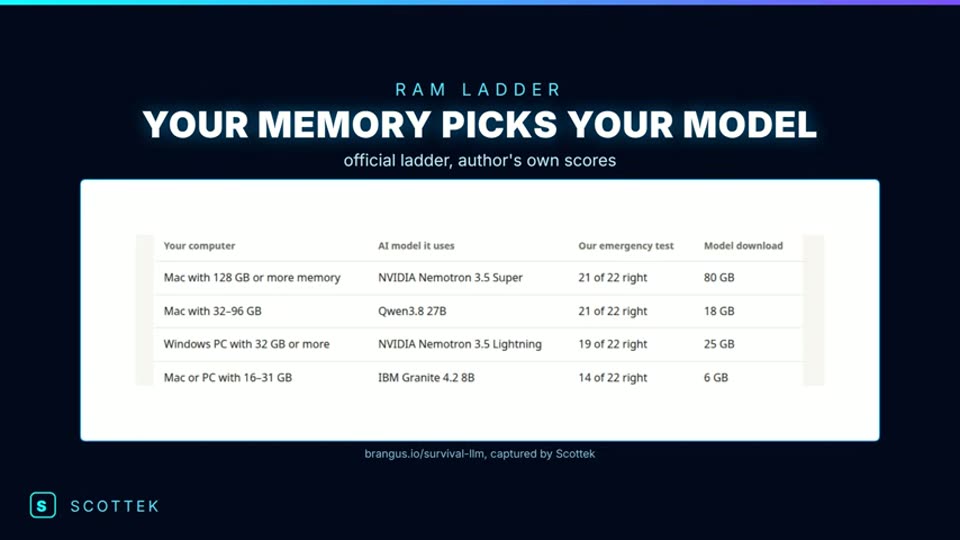
The author's test also names the failures, which is why the video calls this the most honest offline AI package of the month. A tiny Granite 3B the author tested but does not ship scored 8 of 22 with five harmful answers, two described as potentially fatal — skipping a tourniquet on an arm, and standing 3 feet from a downed power line against 35-foot guidance. Qwen 3.6 was dropped after repeating itself on two questions, once for 94 minutes. The 22-question method — blackout and first-aid questions graded blind by AI judges against USDA, CDC, FEMA, EPA, NHS, WHO, and Red Cross guidance — and its limits are documented in the repo README and the independent explainx breakdown.
How it answers: search, read, show
In the video: three tools run the same loop every time — search the library, read the article, show the article with the passage highlighted. A reasoning panel opens on click to show what the model thought and read between searches, and a terminal chat offers slash commands to list sources, open one, start fresh, or cap answer length. Version 0.3.4 adds a reasoning budget (Off, 1,000, 4,000, 16,000 tokens, or no limit) so a model stuck thinking in circles is stopped and told to answer from what it has, plus a second try that hands a blank-answering model its best passages and asks once more without tools.
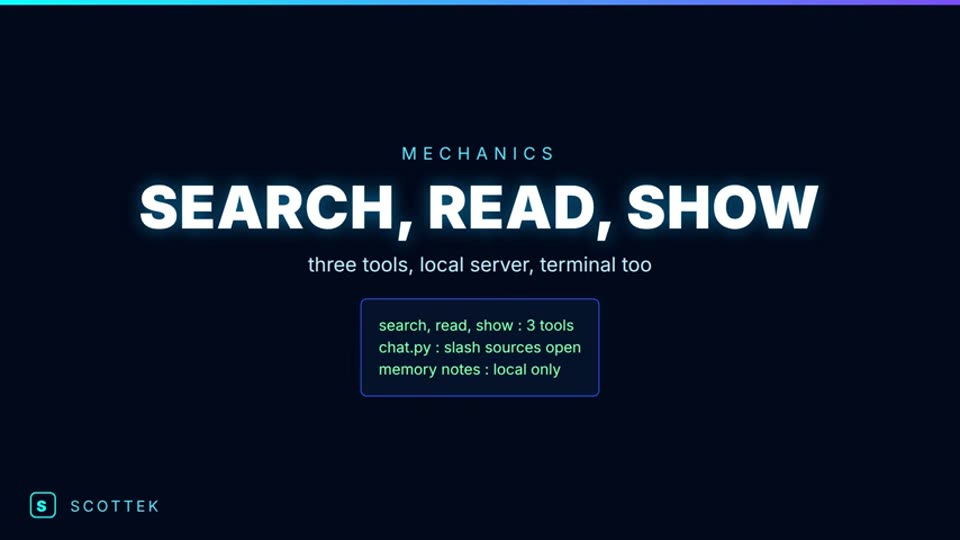
Added from the sources: the v0.3.4 notes confirm the reasoning budget replaces Think harder, the second try answers the reported blank-answer case (Granite searching six times on a downed-power-line question then writing another lookup instead of answering), and a search-when-asked rule re-prompts models that answer from memory when asked to look something up. The most instructive pattern is the citation fix: in a separate 14-question check the models sometimes ended answers with Sources lines naming articles they never opened (the largest model 6 times, the mid model 3, three smaller models once each), so the app now compares claimed sources against the actually-opened list and replaces over-claims with the really-read list. Answers also declare whether they came from memory, articles read, or unopened search results. The video's rule of thumb stands: a cited answer is not automatically a grounded one — check the highlight, not the headline.
Setup in three steps
In the video: three steps, then waiting — about 20 minutes to two and a half hours depending on connection, with roughly 5 minutes of clicking. None of these steps were tested for this guide.
- Download and unzip the Mac app (212 MB) or the Windows app (25 MB) from the project page — untested here
- Open it — Mac by double-clicking, Windows via Survival LLM.bat — then approve the first-launch warning once (System Settings then Privacy and Security then Open Anyway on Mac; More info then Run anyway on Windows), since the app is not store-signed — untested here
- Follow the in-app setup while online as it downloads the engine, the model for your memory tier, and the library, then use Check for updates in the app for later releases, which keeps models, library, and files — untested here
Added from the sources: Apple Silicon M1 or newer with macOS 14 Sonoma or newer, or 64-bit Windows 10 or 11, per the project page. The Mac app bundles portable Python, pywebview, and Ollama; the Windows app bundles Python and pywebview and downloads Ollama on first use (1.6 GB with graphics-card libraries), per the repo README. Author-measured power on a MacBook Pro ran about 100 W while answering, 5 to 40 seconds per question, or roughly 100 to 300 answers per full battery — vendor-reported, untested here.
The Linux reality
In the video: there is no Linux app binary — Mac and Windows only — and the presenter states plainly that no Linux build was benched for the video, so none is claimed to work. The honest paths are running it from source, since the server is plain Python plus Ollama with a small dependency list, or reusing the idea on a homelab: the library packs, the local search pattern, the cite-against-the-log fix, and the add-your-own-manuals trick all port cleanly.
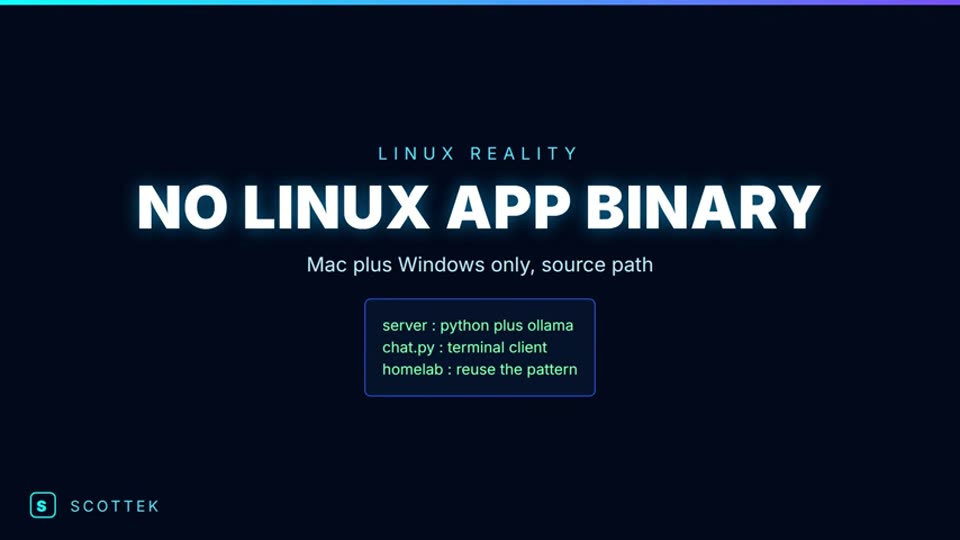
Added from the sources: the project page lists only Mac and Windows downloads with Mac/Windows system requirements, and the repo documents the Python server plus Ollama architecture that a from-source path would build on. Any from-source install on Linux is untested here.
What the Hacker News thread argued
In the video: the thread reached the front page around October 27 and split exactly where expected — supporters love an offline assistant for outages and field teams, while critics ask why an LLM at all when a searchable archive like Kiwix would be smaller and exactly as trustworthy as its sources. Others call the 16 GB tier a reading aid and keep printed manuals as the baseline, with further debate over power needs, no phone build, and the unsigned-app warning. The consistent pattern: everybody respects the library, everybody argues about the model.
Added from the sources: the HN thread (item 50264853, late October 2026) carries the commenter-side objections summarized above — archive-vs-model, small-model accuracy, electricity dependence, phone-size builds, and installer trust — reported here as commenters' views, not verified findings. The independent explainx breakdown (October 27, 2026) reaches a compatible verdict: the app is real, free, and well documented, the big models test decently, the small ones do not, and the searchable-archive objection deserves a serious answer.
Should you install it
In the video: if you have a Mac with 32 GB or more or a Windows PC with 32 GB or more and want a private local model with retrieval over your own documents, try it — and verify every answer through the cited-passage view. On 16 GB, be cautious: use it to find and open the source article, then read the source yourself. For anything life-threatening, a printed first-aid manual and local emergency services are the baseline, full stop. This tool finds the page faster; it does not replace the page.
Added from the sources: this matches the author's own framing — smaller models make more mistakes, so the app always shows the source to check, per the project page. The 22-question sample with AI judges means one- or two-answer gaps between models are not meaningful, and the author asks readers to treat the table as model comparison, not a guarantee — so weigh the 14-of-22 tier as a finder, not an oracle.
Keep going
- Qwen 4 27B: What to Expect — read the companion guide