Pulse Alpha: Who Built the Free 1M-Context AI?

This companion guide starts from the video Pulse Alpha: Who Built the Free 1M-Context AI? — the video is the starting point and this text adds linked sources, a sharper split between evidence and guessing, and copyable try-it steps.
In the video: two mystery models free on OpenCode Zen, the Pulse specs, a four-clue fingerprint pointing at Thinking Machines, the Fledge precedent, an honest counter-case, the Crouton overview, the try-it flow, and a live bench check of the catalog numbers.
Added from the sources: direct links to the Zen docs, the provider table, the tracker thread, the Inkling background, the Fledge precedent page, and the Crouton listing, plus explicit labels for what is reporting, interpretation, or speculation.
Sourcing note: YouTube auto-subtitles returned HTTP 429 at package time, so the Prag narration scripts (long_take00 through long_take10 plus longform.md) are the transcript-equivalent used here. Nothing below claims presenter actions beyond what that narration states.
What dropped
Two unnamed models are sitting in OpenCode Zen, the model catalog for coding agents, both with a one-million-token context window and both labeled Stealth. Zen lists them as free for a limited time to collect feedback. The first, Pulse Alpha Free, went live around November 2nd and has been fingerprinted as a possible secret model from Thinking Machines Lab — evidence this guide reports as tracker claims, not confirmed facts. The second, Crouton Alpha Free, surfaced around November 3rd with no credible attribution at all.
Pulse Alpha Free and the specs
Reporting from the narration and the provider table:
- Model ID
opencode/pulse-alpha-freeon OpenCode Zen, with specs visible in the models.dev provider table - One million tokens of context and about 131,072 tokens of output
- Text plus image input, tool calling, and a reasoning-effort knob with three settings:
low,high, andmax - Closed weights, cost $0, served as a stealth listing
- Not available in the EU, Norway, Iceland, Liechtenstein, or the usual sanctioned countries
- Early testers describe it as small but decent at around 60 tokens per second — tester claims, not this guide's measurements
That combination of a huge context window, tool use, and fast-looking output already narrows the suspect list, which is where the fingerprinting starts.
The fingerprint case against Thinking Machines
This section is reporting: it relays the tracker's evidence chain from the AI Tracker Bot thread via the narration. Treat every clue as an unconfirmed fingerprint evidence claim, never a confirmed fact.
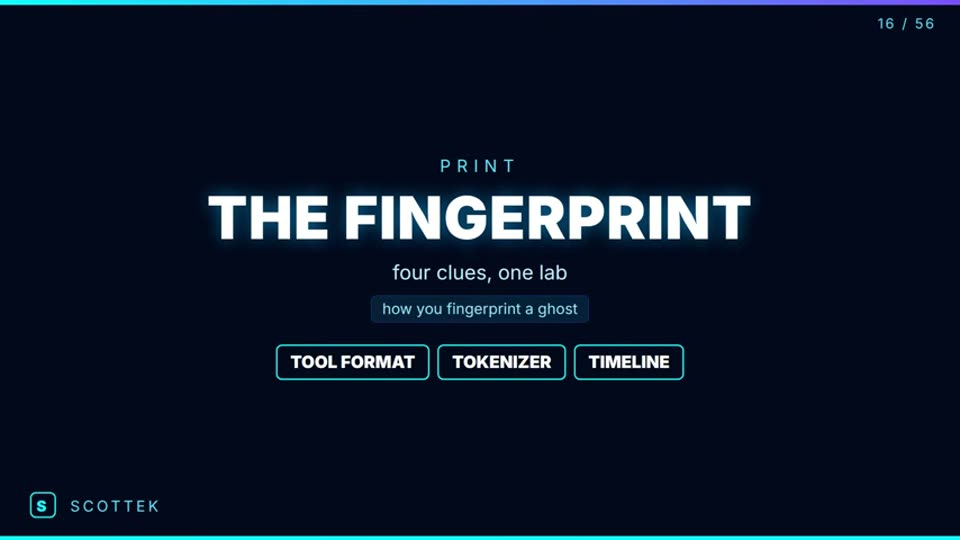
- Clue one is tool-definition formatting: the tracker fingerprinted how Pulse formats tool definitions inside the prompt and compared it against Inkling plus eleven other labs' APIs and about five hundred public chat templates, with nothing coming close — read as evidence it is probably not Inkling and not the usual suspects either
- Clue two is the tokenizer: what does match is Pulse's tokenizer lining up with Fledge Alpha, the stealth model that sat in the same free pool in October
- Clue three runs through Tinker, the Thinking Machines training platform: Fledge's listing mapped its effort levels to the exact values Tinker uses, and the model itself says it was trained by Thinking Machines Lab — both points are the tracker's claims, aired as their claims
- Clue four is the timeline trick: general knowledge stopping around December 2025 while still knowing about Inkling, which Thinking Machines announced in July 2026 — consistent with training after Inkling existed on an older knowledge cutoff
The tracker's pick is a new Thinking Machines model, and the narration states plainly that Thinking Machines has not confirmed it. The Fledge precedent strengthens the pattern without proving it: Fledge Alpha arrived October 1st with the same shape — one million context, 131,072 output, the same low, high, max effort steps — then vanished around October 11th, and independent testers reported strong scores on a messy real repo. Same pool, same shape, same tokenizer family, one month apart.
The honest counter-case
This section is interpretation and speculation, kept separate from the reporting above.
- The
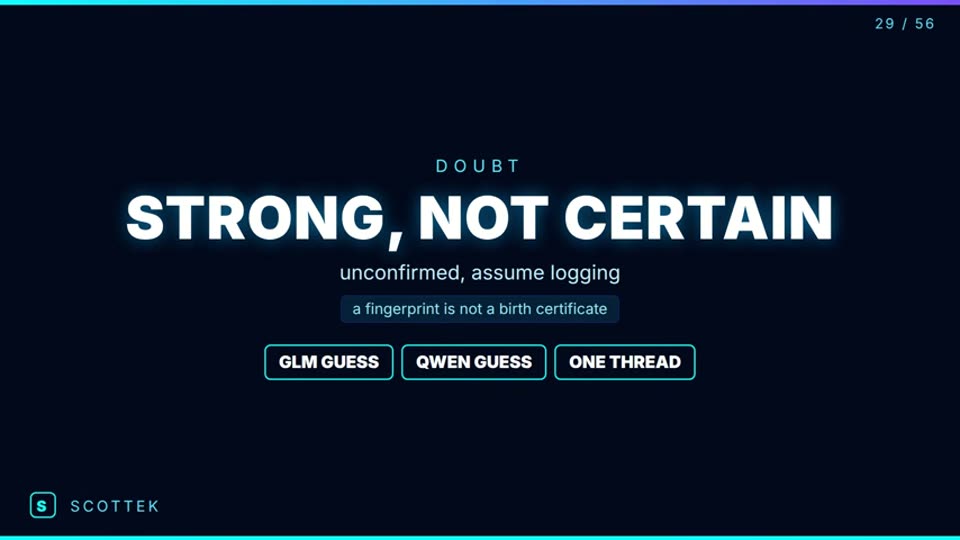
low,high,maxeffort steps also show up across the GLM family, and the earliest guesses for Pulse were Qwen or Hy4 derivatives - Tool formatting and tokenizer overlap are strong signals, but two models can share plumbing without sharing a lab — that step from evidence to attribution is interpretation, not proof
- A fingerprint is not a birth certificate: until Thinking Machines confirms something, Pulse Alpha is an unclaimed model with a good detective story, not a confirmed release
And the safety rule from the narration stands regardless of who built it: assume your prompts are training data, because the listing says the free pool exists to collect feedback. Never paste secrets, keys, or customer code into a model with no owner and no retention policy you can read.
Crouton Alpha Free and the other mystery
Crouton is the stranger of the two. The AIHubMix listing describes a lightweight model built for scalable coding, agentic, and multimodal work, with the same one-million-token context window, text and image input, tool use, and structured output. The owner field just says Stealth — no lab, no fingerprint thread yet, no timeline tricks to decode, and nobody has credibly claimed it. This guide pins no output-token figure for Crouton: the narration deliberately states none, avoiding aggregator conflicts, and you should do the same. One shopping warning from the narration: aggregator pages auto-generate benchmark tables and composite scores for models with zero published evals, so a rank number next to a model nobody has benchmarked is filler, not data — ignore the scores and test it on your own workload.
Trying them free tonight
The flow below follows the narration and the OpenCode model docs, and every step is untested here — this guide did not execute the install or call either model.

- Install OpenCode with their one-line script from opencode.ai, then run
/connect, pick the OpenCode pay-as-you-go provider, and paste your key — background on the client is in the OpenCode setup guide - Run
/modelsand selectopencode/pulse-alpha-freeoropencode/crouton-alpha-free - Set effort to
lowfor quick triage andmaxwhen you want the deepest reasoning - Free-tier chat models require the OpenCode client itself — other API clients only work with paid models, and
OPENCODE_DISABLE_FREE_MODELS=1hides the free models entirely - Expect rate-limit errors under load on the shared free pool — that is normal, just retry
- Remember the region block: readers in the EU, Norway, Iceland, or Liechtenstein will not be served Pulse at all
In the narration, the video then verifies the numbers live on camera: the docs page returning 200, both model IDs present in the catalog, and the context figures matching the tracker reports.
Who should care
If you build agents and have ever wanted a free one-million-context tool-using model to throw sub-tasks at, this free window is your evening. For the homelab crowd, be clear-eyed: these are closed API models, not downloads, so there is nothing to self-host — you run them through OpenCode, your keys stay local, and you treat the models as disposable. Do not build production on a model ID that could vanish next week; Fledge lasted about ten days. What to watch next is an official reveal, whether weights ever appear, and what effort pricing looks like once the free window closes. Run your own battery while it is free, because that is what the pool is for — and the listing trackers (llmperks new-model feed, freetokens timeline) are the places to catch the next stealth arrival.