Ripple-65B: 65B Local AI Beats 500B Models?

What the video covers
The video is a full honest breakdown of Ripple-65B Preview: a 65 billion parameter dense open model that scores 80.5 on TerminalBench 2.1, ahead of a 501 billion parameter giant, ships Apache 2.0, and runs on a single GPU. This companion guide keeps the video's structure — the claims, the scorecard with counterpoints, the VRAM ladder, and the run-it paths — in copyable form. Watch it alongside the video at Ripple-65B: 65B Local AI Beats 500B Models?.
Two honesty notes carry over from the video. First, every benchmark number below is vendor-reported unless labeled otherwise, and the margins are thin. Second, Scottek's bench box (32 GB RAM, no discrete GPU) cannot load a 65B model, so no local inference was run for the video — the on-camera bench checks are live public-API lookups and config math, and the install steps below are marked untested.
What Ripple-65B is
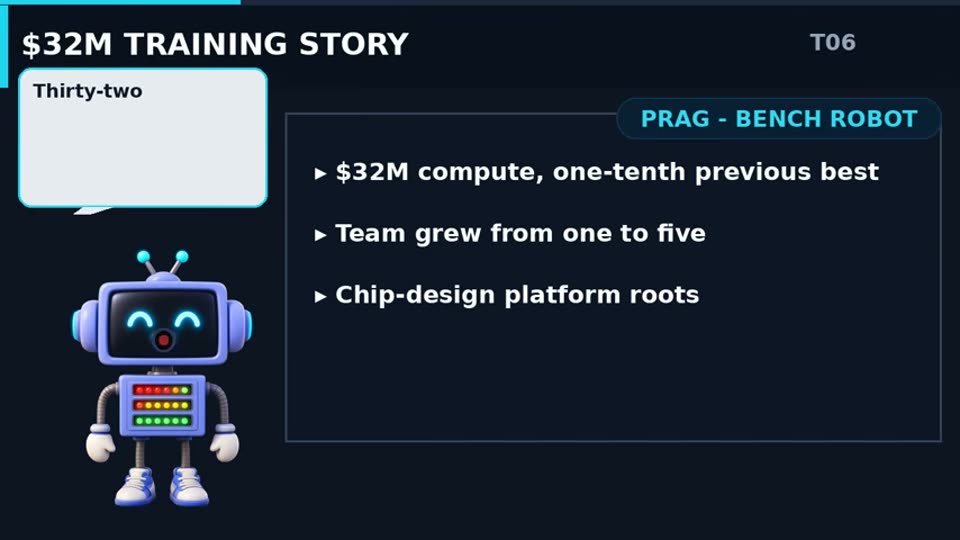
A small team of ex-Google chip designers, Ricursive Intelligence, trained a 65B dense Transformer from scratch on 12 trillion tokens and released it under Apache 2.0, which allows commercial use with the weights included. Dense means every token touches every weight — no mixture-of-experts tricks. The shape is 80 layers by 5120 wide with a 1 million token context window, which is the agent story: whole repositories fit inside one session. The vendor's training story is $32 million of compute, stated as one-tenth of the previous best — a vendor claim, aired as one.
The benchmark table, honestly
TerminalBench 2.1, vendor-reported: Ripple 80.52 against Beam 501B at 80.1, Meta's open model at 76.4, Inkling at 63.8, and Nvidia's model at 56.4. That is the United States open-weight lead per the vendor's table, but the margin over Beam is tiny. The model card also carries an independent rerun column that scores some rivals differently, so treat benchmarks as a map, not the territory.
The honest scorecard from the video: Ripple also leads the software-engineering hard set at 79.1, but it trails on DeepSWE and on MCP Atlas — the video shows both counterpoints on camera rather than hiding them. If you run Beam today, the Beam 501B coding-agent guide remains the comparison baseline.
Tooling timeline
The dates matter because the tooling only just caught up. Weights landed November 4 2026, llama.cpp support merged November 5 (PR #31692), the first release that loads the model shipped November 6 (build 12167), Ollama listed it November 9 with tens of thousands of pulls in the first days, and the vendor launch post came November 11. The video verifies each link live: the weights repo is 129.6 GB across 16 shards and the 4-bit quant is 38.8 GB.
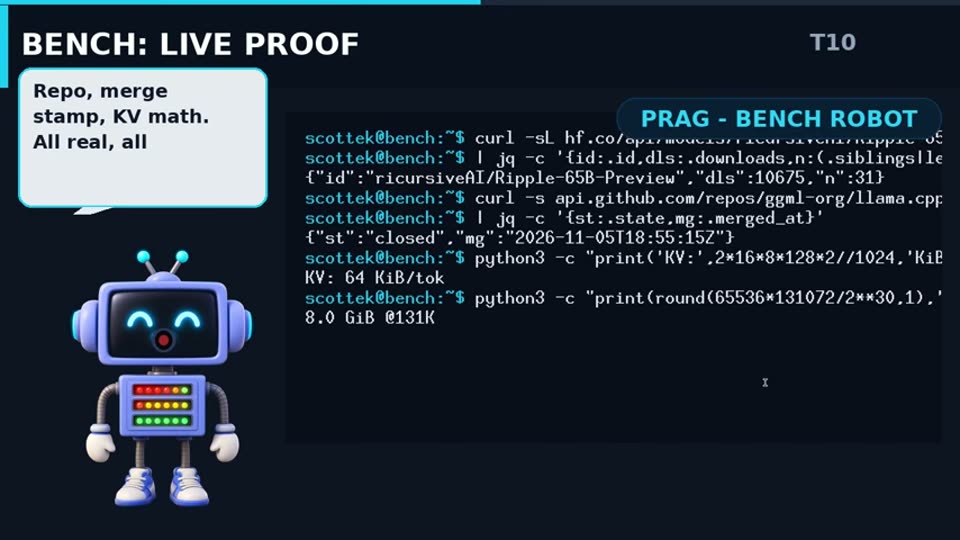
You can re-run the video's own verify-it checks from any machine with curl and python3. Untested in this guide's sandbox beyond the public lookups below:
curl -sL hf.co/api/models/ricursiveAI/Ripple-65B-Preview | jq -c '{id:.id,dls:.downloads,n:(.siblings|length)}'— repo identity, download count, and file countcurl -s api.github.com/repos/ggml-org/llama.cpp/pulls/31692 | jq -c '{st:.state,mg:.merged_at}'— support-merge state and timestamppython3 -c "print('KV:',21681282//1024,'KiB/tok')"— 64 KiB of KV cache per token from the config, not marketingpython3 -c "print(round(65536*131072/2**30,1),'GiB @131K')"— about 8.0 GiB of KV at 131K context
Context math from the config: about 2 GB at 32K, about 8.6 GB at 131K, and about 68.7 GB at the full 1M. Note the 2M figure in the config is a maximum position value, not a supported-context promise — 1M is the supported figure.
Run it: llama.cpp
Untested: you need llama.cpp build 12167 or newer with the Ripple support merge. Serve the 4-bit file with the embedded template flag at 32K context to start — the template carries tool calls and reasoning, so pass it through. If your llama.cpp is older than the November 6 release, work through the llama.cpp 1.0 upgrade guide first, since 1.0 postdates the minimum build and carries breaking changes. Sources: llama.cpp PR #31692, the model weights, and the vendor page.
The VRAM ladder
Measured, not marketing — pick your quant by your card:
- 4-bit Q4 needs about 39.7 GB at 8K context, so a 48 GB card
- 3-bit build is about 28 GB, fitting a 32 GB card
- 2-bit squeezes onto a 24 GB card
- Full precision is 130 GB and out of single-GPU reach
Ollama path
Untested: the easiest route is one command, ollama run ripple-preview, which pulls the 4-bit build. Seven tags exist, including full precision and the NVFP4 build — but pin a named tag before you benchmark, because the default tag is not a named quant and its digest matches neither. The NVFP4 tag is an MLX-runner build, not a llama.cpp GGUF, so check which runner a tag targets before pulling. New to Ollama entirely? Start with the Ollama plus Qwen3 local setup. Sources: ripple-preview on Ollama and its tags page.
Spark and agent harnesses
The DGX Spark path is experimental: an offline engine with a hardware check, plus a community wrapper that adds an API server — expect rough edges, not a one-click install. Where the model fits naturally is agentic terminal work, with one-command launch lines across Claude Code, OpenCode, Hermes, and OpenClaw.
Verdict and what to test
The video's verdict: a genuinely interesting efficiency story — dense 65B matching or edging 500B-class models on terminal coding — with thin margins, real counterpoints on other suites, and VRAM demands that still mean a 24 GB card minimum for the smallest usable quant. If you test it, pin the quant tag, record which digest you benched, and compare the same harness and context length before declaring a winner.