This 33B Model Was Built to Be a TEACHER (Nanbeige 4.3 beats Qwen at agents)

What this guide covers
This companion guide starts from the video Nanbeige 4.3 teacher-agent guide and expands it into written steps you can follow at your own pace.
This draft is grounded in the video transcript, the Prag research LEDGER for this video, the official Nanbeige4.3-33B model card, and the community GGUF quant page. Anything beyond what the video shows is marked as untested in this guide below.
The video presents Nanbeige 4.3-33B as a flagship teacher agent for coding and cowork work, and every benchmark number below comes from the model card's own same-harness vendor runs, so treat them as vendor-reported rather than independent results.
The idea first: a teacher, not a chatter
Most model releases chase chat scores, while Nanbeige 4.3 chases agency: coding agents and professional cowork agents that operate terminals, call tools, and plan multi-step work.
- 33B dense model on a 52-layer Llama-architecture network
- About 66 GB in half precision with a 512K-token context window
- Thinking mode on by default, reasoning before responding
- Tool calling that speaks XML first with JSON fallback
- Apache-2.0 license, confirmed on the model card
- The 33B anchors the distillation pipeline feeding an upcoming 3B student for self-hosters
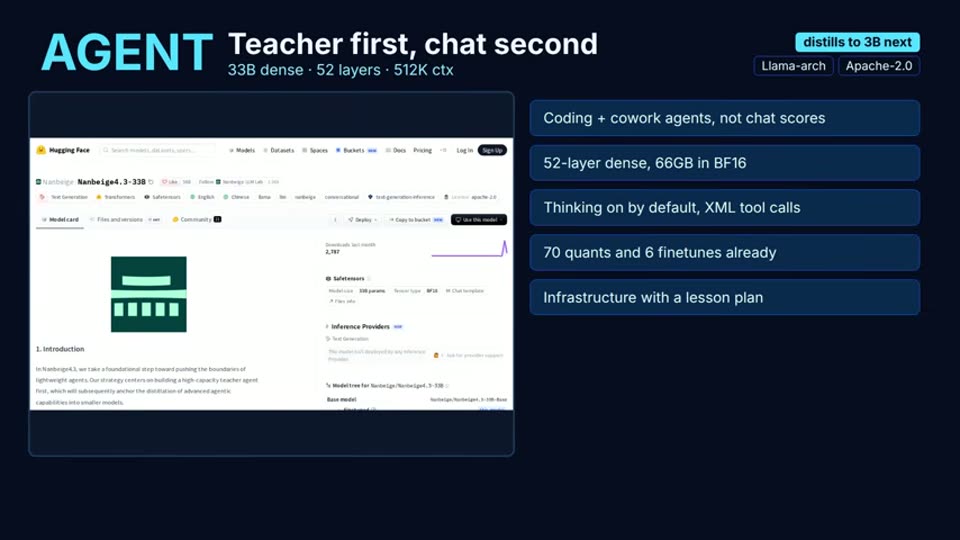
The still shows the agent-first framing the video opens with before the benchmark numbers.
The numbers with the losses left in
All scores below are the team's own reported numbers at highest thinking effort with the same harness across models.
- Terminal-Bench 2.1 real terminal tasks: Nanbeige 80.9 against Qwen 73.0, Muse Glimmer 61.8, and Gemma 47.2
- Terminal-Bench 4.0: 23.8 against 6.3, 1.6, and 0.0
- DeepSWE: 65.5 against 42.5, 4.4, and 2.7
- Automation Bench cowork tasks: 54.2 against 38.3
- JobBench across 35 occupations: 44.8 against 34.5
- YC-bench measured in dollars of work completed: just over 1,025,000 against about 641,000 for the next best
- Honest losses: SWE-Bench Pro goes to Qwen 61.7 to 60.3, GPQA Diamond goes to Gemma, and GDPval goes to Qwen 86.4 to 84.8
The shape is what matters: where the task is agentic with tools, terminals, and plans, the teacher leads by miles, and where it is pure knowledge recall, the field bunches up.
Real VRAM math before you pull anything
Full precision is about 66 GB, which means two 24 GB cards with tensor parallelism, a single large card, or serious CPU offload, and nobody in a homelab runs the full weights for chat.
- The community sweet spot is Q4, and the bartowski build the video uses is a 20.79 GB file that fits comfortably on a single 24 GB card with room for a useful context window
- Q8 needs roughly 35 GB, which is dual-card or offload territory
- On the Apple side, a 4-bit MLX quant runs on a 64 GB Mac at about 14 generated tokens per second using 19 GB at short context and scaling toward 48 GB at 128K, with the 128K needle test passing at every depth per the Prag LEDGER
- With two RTX 3090 cards, a community INT4 build sustains about 66 tokens per second single-stream and 354 across six streams with quality essentially intact
- The honest summary: a 24 GB Nvidia card runs Q4 well, a 64 GB Mac runs the MLX build patiently, and full fat needs a rack, not a desk
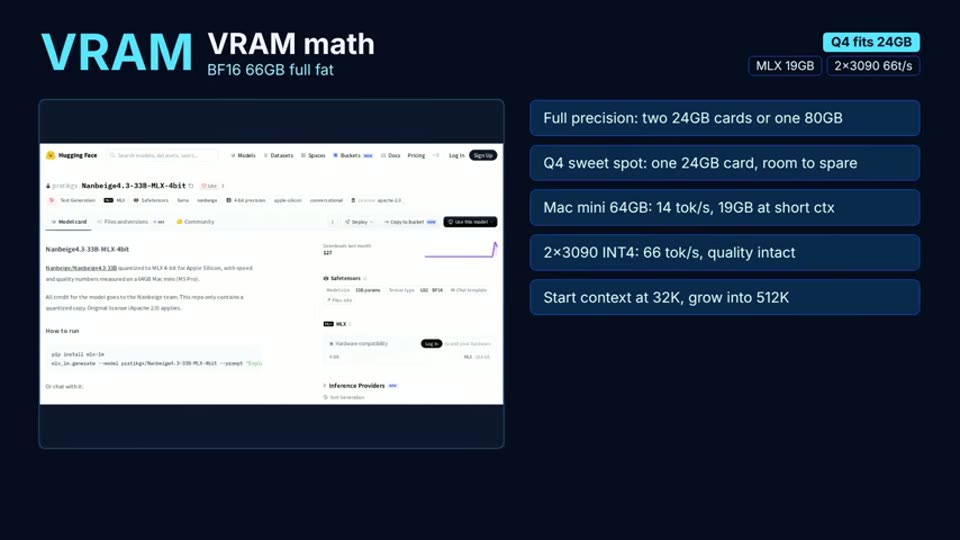
The still shows the VRAM breakdown the video uses to size the model to your hardware.
Run it tonight with the one-liner
The easiest path is Ollama with the community quant.
ollama run hf.co/bartowski/Nanbeige_Nanbeige4.3-33B-GGUF:Q4_K_Mpulls the quant and drops into chat with thinking on- Prefer
llama.cppdirectly: serve the same files overllama-serverwith a Jinja template and a 32K context flag to start - Two settings matter most: leave the thinking toggle on for agents, code, and tool workflows, and switch it off for plain chat where tokens per second roughly double with barely any quality loss on simple tasks
- Set the tool-call format in your agent harness: XML is the recommended dialect and JSON is there for compatibility
- Temperature guidance from the model card: 1.0 for agentic and tool work, 0.6 for reasoning and chat, with top-p 0.95 either way
- Homelab warning that applies to every 512K-context model: the window is real but the memory bill scales with what you actually fill, so start at 32K and grow into it
The 128K needle test result and the Mac and 2x3090 community numbers above come from the Prag research LEDGER, untested in this guide.
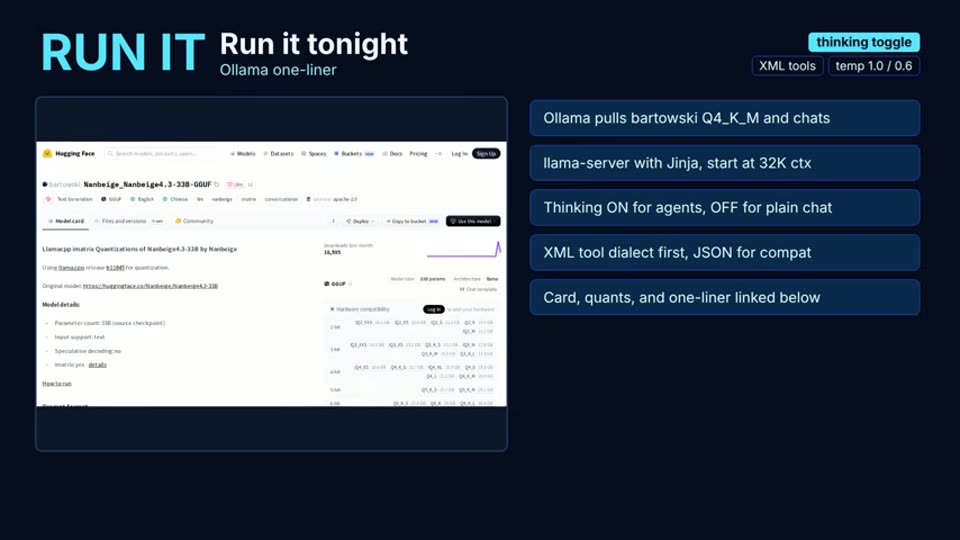
The still shows the run command the video ends on.
Related local-AI guides
- Install Claude Code with Ollama to point an agent harness at local models
- Flint 40B local coding agent for another one-GPU agent option
- Raon-1 Mini one-GPU local AI for a 30B MoE reasoning alternative